
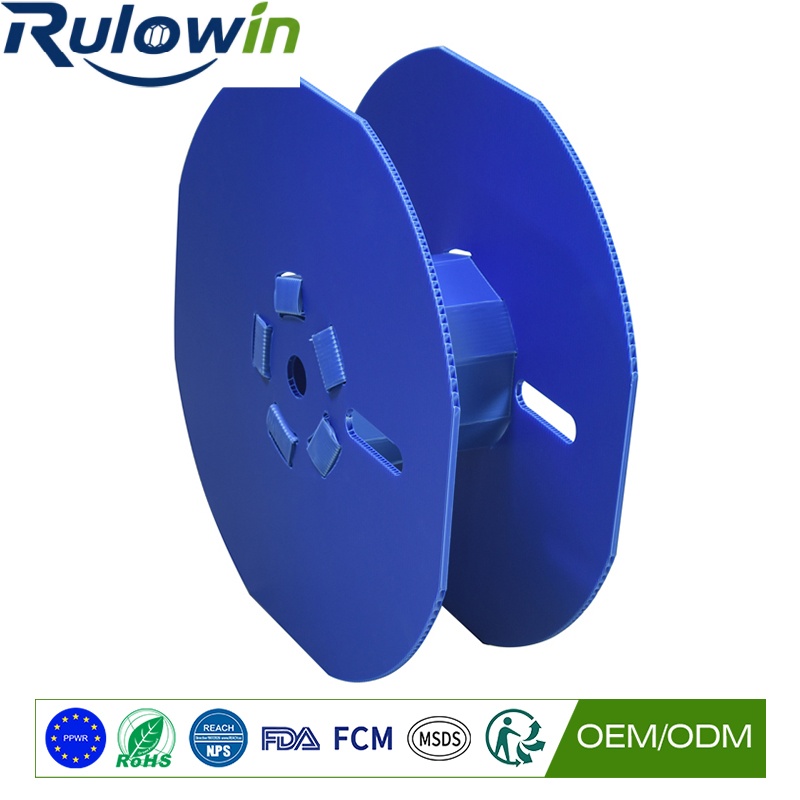
A spool that works at 400 mm flange diameter tells you surprisingly little about the same design at 900 mm. Some things scale with size and some do not, and the ones that do not are where large spools go wrong.
What gets worse faster than size
Flange deflection. The dominant issue. A disc fixed at the centre and loaded around its circumference deflects at the rim, and the amount increases sharply with diameter for a given thickness. Doubling the diameter is not compensated by doubling the thickness.
Practically, this means a large spool needs disproportionate flange stiffness — through thickness, ribbing, or profile. This is the territory of our ribbing and profile articles, and it is where large spools live or die.
Hoop load. More product on a larger circumference at greater radius means more total outward force on the flange, and it acts at a longer lever arm.
Weight of the spool itself. Scaling up a construction increases its own weight, which affects handling and freight and — at some point — becomes the limiting factor.
Transport and storage volume. A large spool is mostly air even more than a small one is. This compounds with the freight arithmetic in our volumetric weight article.
What gets easier
Bend radius constraints relax. A larger core is easier to accommodate, which is generally good for the product — the constraint discussed in our bend radius article disappears as a practical issue.
Layer count decreases for the same length. Fewer layers means less accumulated compression for a given fill, which helps with the set and crush problems described elsewhere in this series.
Relative dimensional tolerance loosens. Half a millimetre matters less on 900 mm than on 300 mm, which is one of the few places where larger is more forgiving.
Handling changes character
A large spool stops being a manual object entirely. This brings:
- Lifting equipment as a requirement rather than an option — the subject of our lifting article
- Greater consequence from a dropped spool, both for the spool and for anyone nearby
- Stacking limits that are about stability more than load, per the stack height article
- Storage footprint that constrains layout
Construction considerations
At larger sizes, certain things become more attractive or less so:
- Take-apart construction becomes more valuable, because the volume saving on return freight is much larger — see the take-apart article
- Reinforcement at the rim earns its cost, since large rims take more abuse
- Material direction effects become more pronounced, as discussed in our flute direction article
- Core specification matters more, because the core spans more and carries more
Where the practical limits are
There is a size beyond which hollow board construction stops being sensible and steel or a hybrid becomes right. Where that boundary sits depends on load, duty and how the spool is handled — and it is worth asking rather than assuming, because it is not a sharp line and it moves with the application.
Our article on where plastic spools reach their limit covers the load side of the same question.
What to specify differently
For a large spool, compared with a small one:
- State the duty more precisely — tension and fill weight matter more at scale
- Expect more discussion of flange construction
- Decide nesting early, because it is a design decision
- Plan handling before the spools arrive
What we would say
Tell us the diameter, the load and how it will be handled, and we will tell you honestly whether our hollow board spools are comfortable at that size for your duty or whether you are in the range where another construction serves you better. Large spools are the case where that conversation matters most, because getting it wrong is expensive.