
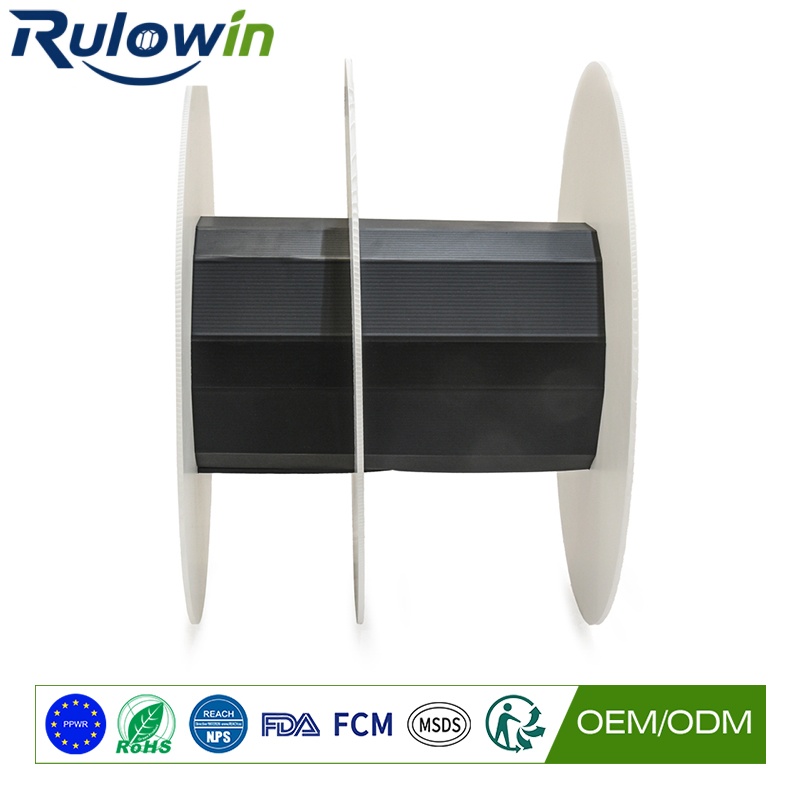
Most people think about bend radius in terms of the route: pulleys, sheaves, conduit bends, the customer’s installation. The tightest bend the product actually sees is often much earlier and closer to home — at the flange face, on the last layer, as the spool empties.
Why the end of the run is worst
Two things happen as a spool empties. The effective diameter shrinks, so the product leaves at a steeper angle relative to the flange. And there is less product on the spool, so there is less of it to share the load — the last few turns are doing the work alone.
The angle at the flange is set by the geometry: core diameter, flange diameter, and how close to the flange the pack extends. A large core and a small flange give a gentle angle; a small core with a wide pack wound close to the flange gives a steep one.
When it matters
For copper power cable, almost never — the product is far more tolerant than the geometry. For anything with a specified minimum bend radius, it matters constantly:
- Fibre optic cable, where exceeding the radius causes attenuation that may not show up until the link is tested
- Micro-duct, which kinks and stays kinked
- Some data and coaxial cables, where the geometry of the dielectric is affected
- Any product with a stiff or armoured construction that takes a set
The failure mode is nasty because it is invisible. The product looks fine, it installs fine, and it fails at commissioning or, worse, in service.
Opening the angle up
Four levers, roughly in order of cost:
- Wind less wide. Keeping the pack away from the flange is free and immediately reduces the angle. Costs capacity.
- Increase the core diameter. Reduces the full-to-empty ratio and flattens the angle change. Costs capacity.
- Reduce the flange diameter. Counter-intuitive, but a smaller flange means the product approaches the rim at a shallower angle for a given pack width. Costs capacity.
- Increase the traverse reversal radius. A generous radius where the flange meets the core gives the product somewhere to turn rather than an edge.
Three of the four cost capacity, which is why this gets ignored. It is worth pricing: the length you gain by filling the spool is not worth much if the last fifty metres are unusable.
Measuring rather than guessing
If the product has a specified minimum bend radius, measure the actual angle at the flange on an empty spool with a protractor or a photograph and compare it against the specification. It takes five minutes and it is the only way to know whether the geometry is safe, because datasheet capacity figures say nothing about the angle at the rim.
Do it on the spool you actually use, at the fill height you actually wind, on the last layer — not on a full spool, where everything looks fine.
What to ask for
If you tell us the product’s minimum bend radius, the spool dimensions and the fill height, we can tell you whether the geometry is safe and what would need to change if it is not. Sometimes the answer is a different core; sometimes it is simply a wind that stops short of the flange, which costs nothing but a few metres.
Where the number comes from
Minimum bend radius is a product manufacturer’s figure, and it varies with construction in ways that are easy to overlook. A screened cable behaves differently from an unscreened one; a multi-core behaves differently from a single conductor; armour changes it substantially.
Temperature matters too. A cable that tolerates a tight bend at 20 °C may not at 5 °C, and spooling in an unheated building in winter is a real scenario. If the wind is happening cold, the cold figure is the one to design to.
Ask for the figure in writing and ask which conditions it applies to. If the answer is a range rather than a number, design to the conservative end.