
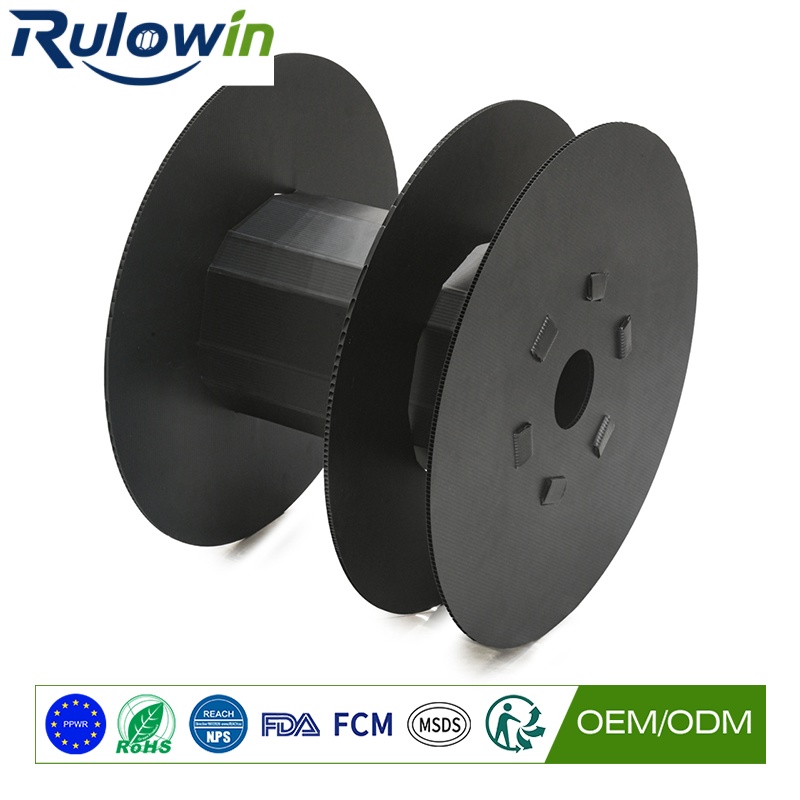
Tension control on payoff is a solved problem in the sense that there are three mature ways to do it and all three work. They differ in what they are good at, what they cost, and how much they can compensate for a bad spool. Understanding the difference helps when the line is not behaving.
The dancer arm
A pivoted arm with a pulley on the end rides on the product between the spool and the process. Its position is a direct analogue of tension: if tension rises, the arm is pulled up; if it falls, the arm drops. That position drives a brake or a motor on the spool.
What it is good at: absorbing transients. The arm has mass and travel, so a sudden change in demand gets taken up by arm movement rather than transmitted to the product. It is mechanically simple, easy to understand, and forgiving.
What it is not good at: very fast response, and very light tension. The arm’s own inertia limits how quickly it can react, and at very low tension the arm weight becomes a significant part of the tension itself.
The load cell
A tension-measuring roller in the line feeds a controller that adjusts the spool brake or drive. No moving arm, so no inertia, and response is limited mainly by the control loop.
Good at: precision, fast response, and low tension. This is the usual choice for fine product and high speeds, and for applications where tension has to be logged.
Not good at: absorbing large transients. A dancer arm takes up a shock mechanically; a load cell sees it and reacts, and by then the product has felt it. Where the process has big, sudden demand changes, a load cell alone can be twitchy.
The electronic brake or motor
Not really an alternative to the above — it is the actuator they drive. A hysteresis brake, a powder clutch, or a servomotor on the spool shaft. What matters is whether it can hold tension at low speed and whether it can drive as well as brake, which some processes need on start-up.
The practical point: the brake is what actually sets the tension, and its torque curve matters. A brake that is nonlinear at low speed will produce tension variation at exactly the point where the spool is fullest and tension is lowest — which is where problems often start.
What none of them fix
A control system regulates the tension it can measure and correct for. It cannot correct for:
- Spool runout. An eccentric spool produces a once-per-revolution pulse that no brake can anticipate. It has to be fixed at the spool.
- A snag. Product catching at a flange or on a burr produces a spike faster than any loop can react.
- A very wide tension swing. If the full-to-empty ratio is extreme, the system runs out of range at one end or the other. That is a core diameter question, not a control question.
This is why the spool specification and the tension control should be looked at together. Buying a better controller to solve a spool geometry problem works poorly; changing the core diameter often costs nothing at all.
Choosing
Coarse product, moderate speed, rough duty: dancer arm. Fine product, high speed, tension needs logging: load cell. Big transients from the downstream process: dancer, or a load cell with an accumulator.
If you are commissioning a new line, tell us the product, the speed range and the tension window and we will tell you what spool geometry gives the control system the most room to work in — which is usually worth more than a specification upgrade on the controller.