
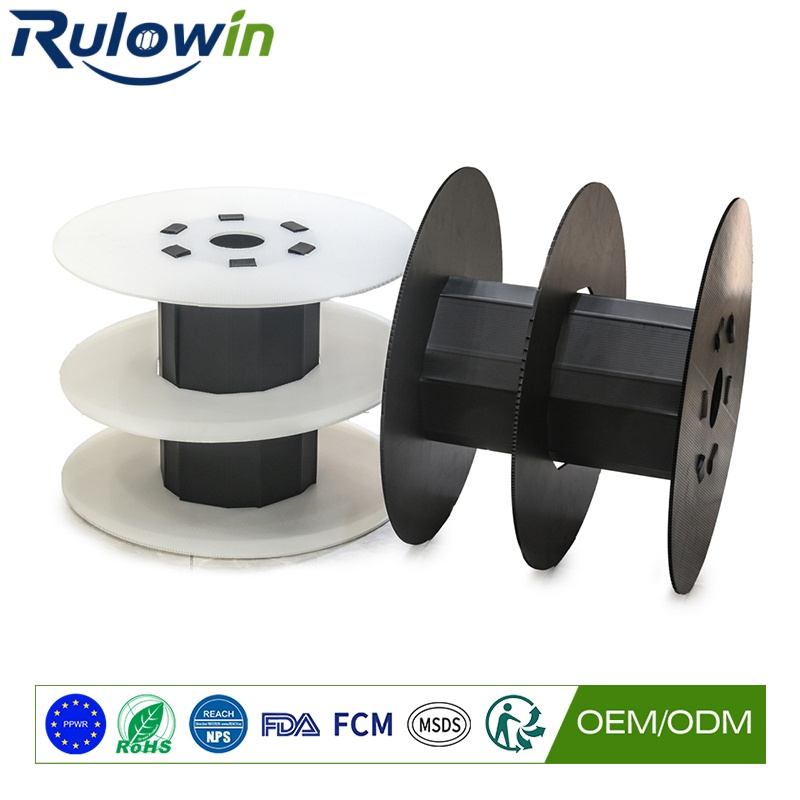
Corrugated PP sheet is not isotropic. It has internal channels running in one direction, and those channels give it most of its stiffness — in that direction. Turn the sheet ninety degrees and the same material behaves quite differently. This matters for a spool flange more than most people realise.
What the flutes do
The channels form a series of small I-beams running the length of the sheet. Along the flutes the sheet is stiff in bending. Across them it is much less stiff, because you are bending across the top and bottom faces of those beams with nothing between them.
The difference is not subtle. In the piece we wrote about wall thickness, thickness is treated as the main stiffness lever — but for a given thickness, orientation changes stiffness substantially too.
Why it matters for a flange
A spool flange carries hoop load outward from the hub to the rim, in every radial direction. There is no single direction to align the flutes to, because the load radiates.
Practically this means:
- A flange cut from single-direction sheet is stiffer in one axis than another. Under load it deflects unevenly around the circumference. Usually this is small enough not to matter, and usually nobody notices.
- Rotation under load can be uneven, which is one of the subtler contributors to what looks like a balance problem — the subject of our article on balancing for high-speed payoff.
- Edge sealing and water ingress depend on direction. Open flutes at an exposed edge admit water and dirt along the channel.
What suppliers do about it
Several things, depending on how much the application cares:
Cross-laminated construction. Two layers with flutes at ninety degrees to each other. Stiffness becomes roughly uniform in both axes at the cost of thickness and a bonded joint. This is the usual answer where it genuinely matters.
Formed rather than flat. Once the flange is given a profile — discussed in our piece on flange profile — the geometry contributes stiffness and the material direction matters less.
Ribbing. Radial ribs address the load direction directly and largely swamp the material direction effect.
Nothing. Which is very often the right call. For most general spooling at moderate load, single-direction sheet performs adequately and cost matters more.
When you should ask
- High-speed payoff where small geometric variation becomes product-quality variation
- Thin flange designs where there is little margin
- Large diameters, where deflection scales up
- Anything where the radial load is genuinely heavy rather than nominal
- Applications where you have chased an unexplained runout or balance issue
When you should not bother
Modest loads, moderate speeds, standard sizes. If the flange is adequately specified, single-direction sheet has been used successfully for years in these applications and adding construction complexity buys you something you cannot detect in service.
Also worth knowing
Flute direction affects the open edge. A flange rim where the channels run radially exposes them along the rim; one where they run tangentially does not. This connects to the delamination and water-ingress risks we covered in the article on rim reinforcement, and it is another reason edge treatment is worth specifying on reusable spools.
How to raise it
You probably do not need to specify construction. Tell us the duty and ask what we recommend — that gets a better answer than dictating a laminate schedule, because there are usually three or four ways to achieve the stiffness and the cheapest depends on size and volume.
Our hollow board spools and our PP hollow board sheet both come out of the same material family, and if you want to understand the construction properly the sheet product page is the clearer starting point.