
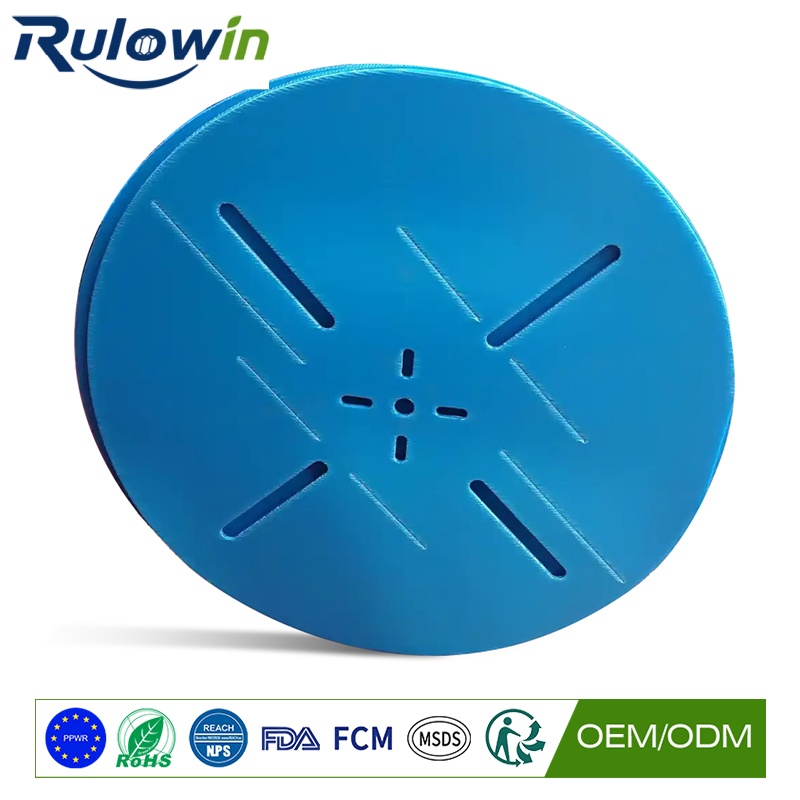
Given the choice, most buyers specify the thicker wall. It feels safer, the sample feels more substantial in the hand, and nobody was ever blamed for over-specifying. On a hollow board spool the relationship is less linear than that, and past a certain point extra thickness starts costing you things you did not budget for.
What the wall does
In a hollow board construction the skins carry bending load and the flutes between them hold the skins apart. Stiffness comes mostly from that separation — the distance between the skins — which is why thickness is such an effective lever and why the material between the skins matters comparatively little.
Compression through the thickness, which is what happens under strap tension or when spools are stacked, is carried by the flutes. That is a different property from bending stiffness, and a thicker sheet with the same flute density is not automatically better at it.
What thicker walls buy you
- Impact resistance. Genuine, and the main reason to go thicker. A thicker sheet absorbs a knock better.
- Crush resistance at the bore and at the flange rim. Real, where the load is concentrated.
- Creep life. Under sustained load, more material means less creep.
What thicker walls cost you
- Weight and freight. Obvious, and it matters on air freight and weight-limited road transport.
- Cycle time and price. More material, longer cooling, higher unit cost.
- Brittleness at the folds. This is the counter-intuitive one. A thicker sheet folded to the same radius puts more strain on the outer skin, and heavy-gauge sheet folded tightly is more likely to crack at the fold than a lighter one.
- Dimensional accuracy. Thicker sections shrink more and hold tolerances less well, which matters at the bore and at any seating face.
Where the sweet spot usually is
For most industrial spools on a reusable programme, the answer is a moderate wall with the stiffness put where it is needed — ribs on the flange, adequate section at the bore and rim — rather than a uniformly heavy section.
The exceptions are real, though. Spools that are dropped rather than placed, spools that go through a rough return loop, and spools carrying very heavy product at high tension all justify more material, because in those cases impact and creep are the limiting factors rather than weight.
The specification conversation
Rather than “give me the thickest you make”, give the supplier the duty:
- Maximum winding tension and product weight
- Handling method — by hand, by machine, or thrown into a truck
- Trip target, and whether the spool is washed between trips
- Whether freight is weight-limited or volume-limited
Those four answers decide the wall thickness better than any rule of thumb, and they usually produce a lighter, cheaper spool than the one a cautious buyer would specify on their own.
One thing to test
Before committing to a run, drop a loaded sample from the height it will actually be dropped from — not from a standard test height, from the height of your loading dock or your forklift forks. Thicker sheet wins that test, and it is the test that predicts most field failures.
Then check the folds. A spool that survives the drop and cracks at a fold line six weeks later is a spool that was optimised for the wrong test.
What thickness does not fix
It is tempting to solve a stiffness problem by going thicker, and it does work — but it is the expensive way, and there are things it will not address:
- Rim flex. Thicker board does not stop a flange rim deflecting if the unsupported span is too long. Ribbing or a rim profile does.
- Bore wear. Entirely unaffected by flange thickness. If bore life is your problem, more thickness buys nothing.
- Core compression. A separate component with its own specification.
- Impact in the cold. More material helps somewhat, but grade selection helps more.
Match the change to the failure. Thicker board is a blunt instrument and usually the most expensive one available.