
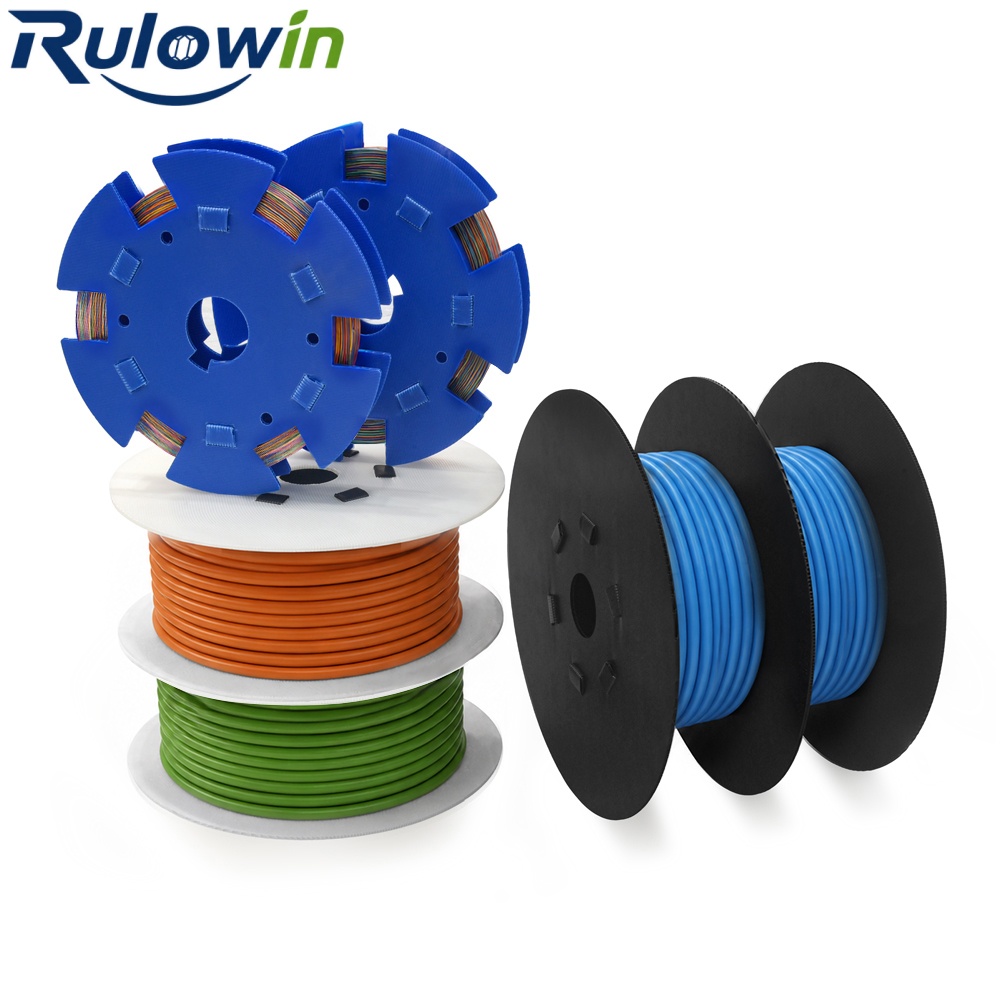
The rim is the part of a spool that everything happens to. It is what hits the ground when a spool is tipped, what a forklift catches, what the next spool rests on in a stack, and what the outer turns of product press against. Reinforcing it is often the cheapest reliability improvement available on a spool — and often unnecessary.
What actually damages rims
Ranking the causes from what we see coming back:
- Dropping or tipping. The dominant cause by a distance.
- Forklift contact. Glancing impacts that would leave cosmetic marks elsewhere open cracks at the rim.
- Stacking loads. Spools resting flange-on-flange concentrate load at the rim rather than across the face.
- Dragging. Sliding a spool across rough ground abrades the rim and can peel a delaminated edge.
- Cold. Everything above gets worse below freezing, which we covered separately.
Notice that most of these are handling rather than duty. If your rims are failing, the first question is about the handler rather than the spool.
Three ways to reinforce
A bonded extra layer at the rim. A second ring of board or strip bonded around the circumference, thickening the outer band. Simple, effective against abrasion and minor impact, and it can be applied to existing tooling. It adds a joint, and joints peel.
A rolled or folded edge. The board edge is folded back on itself, doubling thickness and eliminating the exposed cut edge that delamination starts from. Very effective against both peeling and abrasion, and it does not introduce a bonded joint. Harder to produce and not available at every diameter.
A rim profile with more material. Where the flange is formed rather than cut, the rim can simply be made thicker. Cleanest result, needs the right process, and generally implies volume.
Why the cut edge matters
A hollow board flange has an open edge at the rim — the flutes end there. Left raw, that edge collects dirt and water, and it is where delamination begins when something peels it. Rolling or capping the edge closes that pathway, which is why it often outperforms a bonded layer despite adding less material.
We mentioned this in the context of cleaning — see our piece on cleaning spools between runs — but the argument is broader than hygiene. A closed rim survives real service better.
When reinforcement is a waste of money
- Your spools are handled well and rarely dropped. If nothing is hitting them, the standard rim is fine.
- You stack correctly. Flange-on-flange stacking loads the rim; palletised storage on the flange face does far less so.
- The spool is a one-trip item. No point building for longevity that will never be used.
- You are solving the wrong problem. If products get dropped by hand from a truck bed, reinforce the process before the rim.
When it clearly pays
- Harsh yards, rough ground, multiple handling points
- Long-distance loops where every return is another chance to damage
- High trip counts where replacing even 2% of the fleet per cycle is significant money — the arithmetic from our cost per trip article applies directly
- Outdoor storage, where UV and moisture attack the open edge
A cheap diagnostic
Look at your returned spools and note where the damage is. If it is concentrated at the rim, reinforcement is likely worth discussing. If it is spread across the flange faces and the core, you have a handling problem and reinforcement will just move the failure somewhere else.
Send us a photo of a damaged spool and tell us how many trips it made. That is usually enough to say whether a reinforced rim would pay for itself on our PP hollow board spools for your duty.