
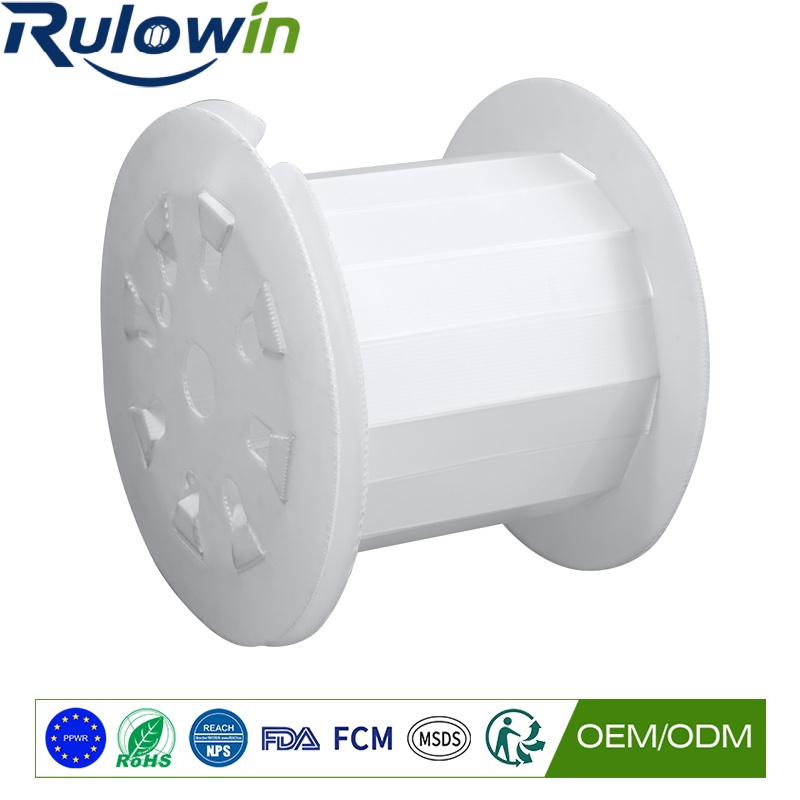
A reusable spool costs more than a single-use one and is supposed to be cheaper. Whether it actually is depends on one number that almost everybody over-estimates: how many trips it will make.
The model
Two comparisons over the same period:
- Single-use: unit price × number of shipments.
- Reusable: unit price ÷ realised trips, plus per-trip costs for return freight, washing or cleaning, repair, and the administration of tracking the fleet.
Everything contentious is in “realised trips”. A spool rated for a hundred trips that is lost after eight has the economics of a disposable one with extra logistics.
The four costs people leave out
Return freight
The best case is free — empties come back on a vehicle that was going that way anyway. The worst case is paying full freight to move air. Take-apart designs exist largely to attack this, and on a long lane the collapse ratio alone can decide the case.
Model it honestly: if the return leg is on your own transport, the marginal cost may be near zero; if it is on a common carrier, charge the real rate.
Cleaning
Where spools are cleaned between trips, cost per wash is water, energy, detergent, labour and amortised equipment. Small per unit, multiplied by every trip, so it lands directly on the comparison.
Note that not every programme needs cleaning. In a clean closed loop, a wipe-down or nothing is normal and legitimate. Requiring cleaning that the process does not need is the fastest way to make a good project look bad on paper.
Shrinkage
Fleets lose spools. They get damaged, they get taken by people who find them useful, and they end up at a customer with no process to return them. Annual shrinkage of five to fifteen per cent is not unusual in an open loop; captive fleets with marking and scanning do much better.
Shrinkage reduces realised trips, so it belongs in the denominator, and the replacement spend it creates is a real cost of the programme.
Administration
Somebody tracks the fleet. Even a light-touch system — a spreadsheet and a quarterly count — costs a person’s time. Put a number on it rather than pretending it is free, and compare it honestly against the alternative, which is buying disposable spools and not tracking anything.
Where break-even usually falls
Rather than a rule of thumb, use the ratio: break-even is approximately the reusable unit price divided by the single-use unit price, adjusted upward by the per-trip costs. If a reusable spool costs eight times a disposable one, you need meaningfully more than eight trips once freight and cleaning are included.
That is the whole calculation, and it is worth doing with your own numbers rather than anyone’s estimate — including this one.
Two levers that beat price negotiation
- Raise realised trips. Marking, a return obligation written into the contract, and a repair capability all push the denominator up. This is almost always the change that moves the number most.
- Cheapen the return leg. Take-apart or nested designs, consolidation, and backhaul on existing vehicles.
Before you commit
Run a pilot with enough spools to exercise the loop and few enough that you can learn something. Measure realised trips per month, shrinkage, and condition on return. Six weeks of real data beats any model.
Send us the unit prices you are comparing, your trip assumption and the freight arrangement, and we will run it with you — including telling you when the answer is to stay with disposables.