
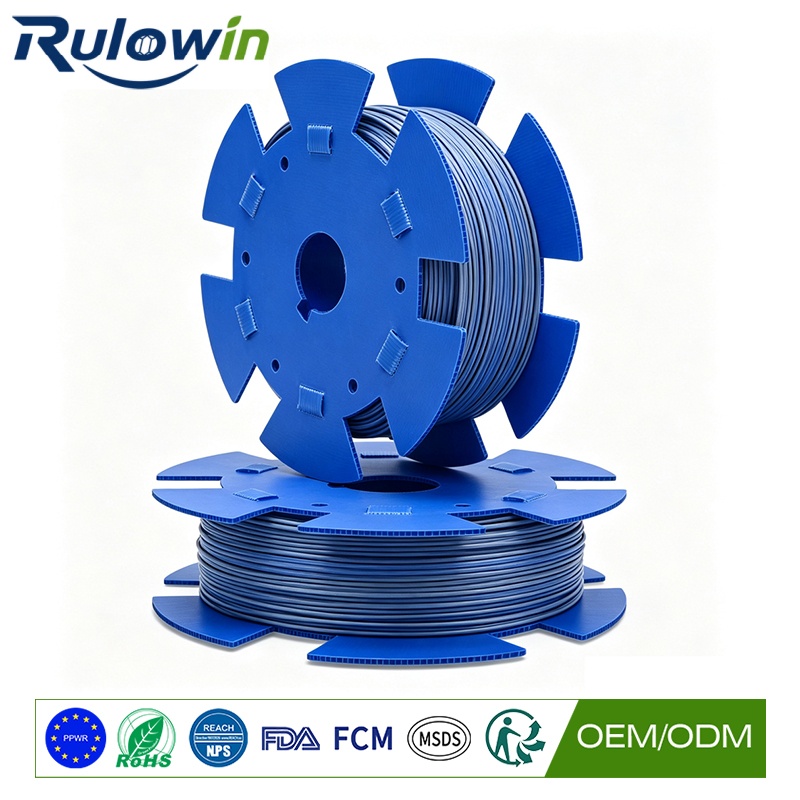
Spool pricing confuses buyers because it does not behave like a commodity. The unit price depends heavily on quantity in a way that has little to do with material, and the reason is tooling and setup rather than the plastic.
Tooling
A new spool design needs a tool — a mould, or dies and fixtures for a fabricated spool. That is a one-off cost, and it is amortised across the order. At low volumes it dominates the unit price; at high volumes it disappears into the noise.
Two practical implications. First, an existing design is dramatically cheaper than a new one, and it is worth asking what standard sizes are available before specifying something bespoke. Second, if you do need bespoke, the tool is worth owning or at least understanding — it affects what happens when you want to change the design or move supplier.
For fabricated hollow board spools the tooling is much cheaper than injection tooling, which is why they are often the right answer for moderate volumes and for designs that are still evolving.
Minimum order quantity
MOQ exists because of setup. Every production run has a setup cost — material change, machine setup, first-article checks — and below a certain quantity that cost is a large fraction of the order value. The supplier sets an MOQ so that the setup cost is a reasonable proportion of the job.
MOQ is usually more negotiable than tooling, particularly if you can be flexible on colour or on delivery timing. A supplier running a natural material next week may happily slot in a small quantity of the same; the same quantity in a special colour, in a dedicated run, will carry a much higher MOQ.
Colour is the most common driver of an unexpectedly high MOQ, because pigment has to be bought in and the machine has to be purged. Standardising on one or two colours across a fleet is a genuine cost saving and it simplifies the inventory too.
Lead time
Three components, and it is worth asking which one you are waiting for:
- Tooling — weeks, and only for new designs. This is the long pole on a first order.
- Production — days to weeks, depending on the queue.
- Freight — which on an international order can exceed both.
If you are planning a programme, work backwards from when you need spools in service and add a margin for first-article approval. The most common scheduling failure is assuming that tooling time and production time run concurrently, when they do not.
How to get a better number
- Use a standard size if one fits. This is the single biggest lever and it is often available.
- Standardise colour across the fleet.
- Consolidate quantities — one larger order beats three small ones, because setup is paid once.
- Be flexible on delivery where you can, which lets the supplier schedule efficiently.
- Commit to a volume, not an order — an annual volume against a call-off schedule often prices better than individual orders.
What is not negotiable
Material cost, largely, and freight. A supplier quoting below material cost is quoting something else, and it is worth asking what.
Also, do not push the price down by removing the specification you need. A cheaper spool that fails at half the trip count is more expensive per trip, and that is the number that matters.
Tell us the quantity, the timing and how flexible you can be on colour and size, and we will tell you what is achievable — including whether a standard spool would do the job at a much better price.