
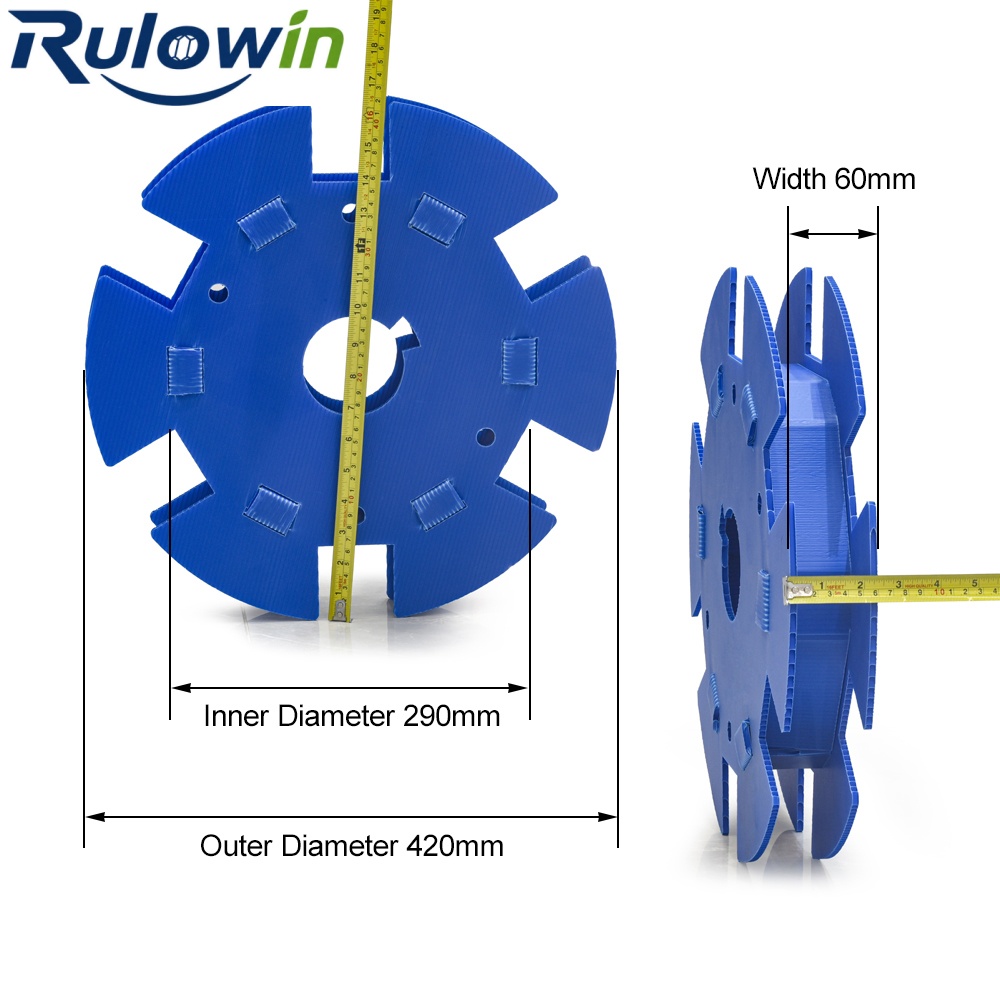
Wound product pulls inward on the flanges. It does this continuously, for the whole time the spool is full, and the amount of pull increases with tension and with the width of the pack. If the flange deflects, the outer layers get pinched; when the tension comes off, the flange springs back and the product can snag or bind on the way out.
The instinct is to specify a thicker flange. It works, but it is the expensive way — you add weight everywhere to solve a problem at the rim. Ribbing is usually the better answer, and it is worth understanding why before you accept a tooling quote.
Stiffness is geometry, not mass
A flat plate’s resistance to bending scales with the cube of its thickness. Double the thickness and you get roughly eight times the stiffness, for twice the material — which is why thickening works so well and costs so much in weight and cycle time.
A ribbed plate gets its stiffness from section depth instead. Material is moved away from the neutral axis, which is exactly where it does the least good in a flat plate, and into ribs that carry the bending load. The same weight, dramatically more stiffness.
Which rib pattern, and why
Three patterns turn up in practice, and they suit different load cases:
- Radial ribs running from hub to rim. Best for resisting the inward pull of wound product, because that load is radial. The common choice for winding duty.
- Concentric rings near the rim. Good for rim impact resistance and for keeping the rim true. Often combined with radial ribs.
- A dished or conical flange rather than a flat one. The dish itself is the stiffness — it is a very deep section without any added ribs. Cheap to mould, and it handles both cases reasonably.
For most winding applications, radial ribs plus a stiffened rim beats either alone. The rim is what gets hit in transit; the radial ribs are what resist the product.
Rim stiffness is a separate problem
Winding load deflects the flange face. Handling load damages the rim. They are different failure modes and one rib pattern rarely solves both well.
If your spools are getting damaged in transit rather than in service — chipped rims, cracked rim edges — the fix is rim section and rim radius, not more radial ribs. A slightly thicker, well-radiused rim survives forklift contact far better than a thin one with a sharp edge, and it costs almost nothing in material.
What to ask the supplier
- Expected flange deflection at your maximum winding tension, measured or modelled — not “it will be fine”
- Rib pattern, and whether the rim is separately reinforced
- What happens to deflection at your highest service temperature, because polymer stiffness falls as it warms
That last question is the one people skip. A spool that measures well in a cold warehouse can behave differently in a hot container or a sunlit yard, and the deflection that mattered is the one at the worst temperature.
When thicker really is the answer
Sometimes it is. Very heavy product, very high tension, or a spool that will be reused so many times that creep becomes the limiting factor — in those cases a heavier section with modest ribbing is more durable than a light, heavily ribbed design, because thin ribs have less material to lose to wear and impact over hundreds of cycles.
Tell the supplier the tension, the product weight and the number of expected trips. Those three numbers decide it, and no rib pattern rescues a design that was specified without them.