
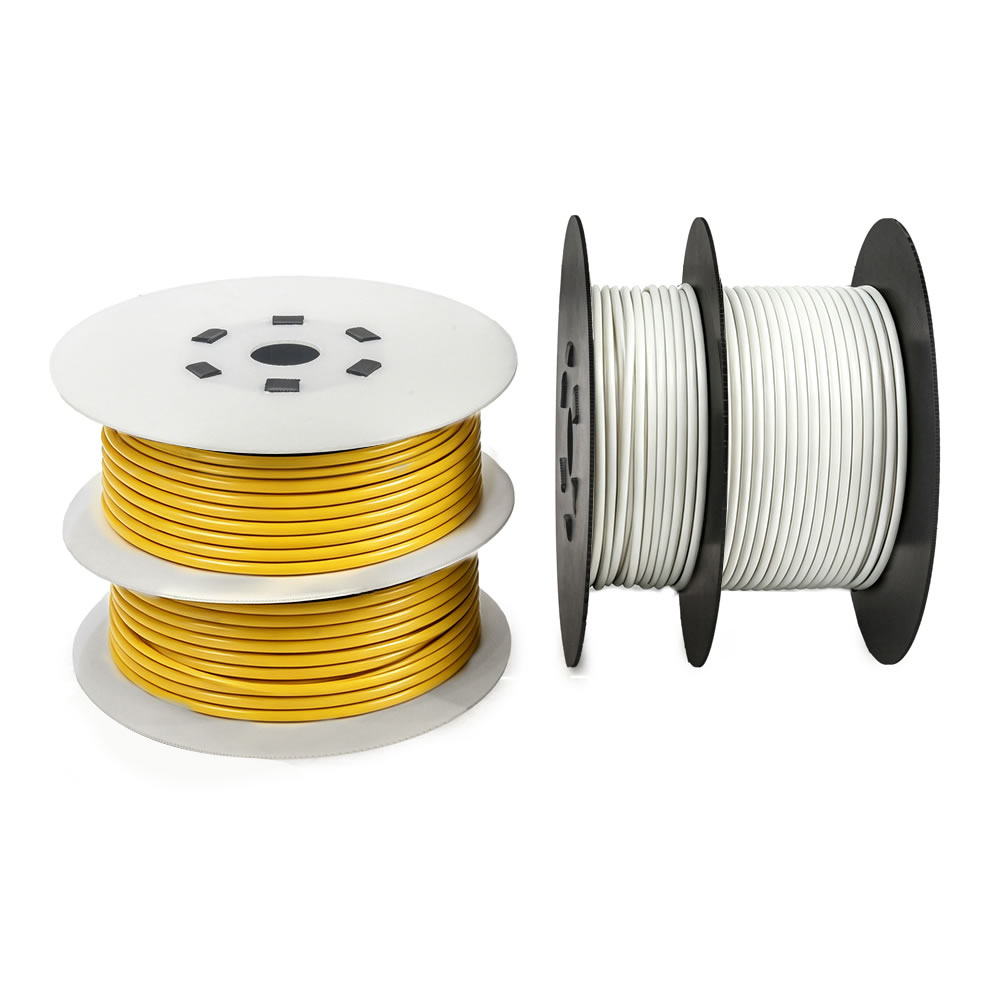
Ask why a spool has the core diameter it has and the answer is usually “that is the size we have always used” or “it is what fits the machine”. Both are real constraints. Neither is the reason the choice matters.
Core diameter does three things at once: it sets how much product fits, it sets how much the tension rises as the spool empties, and it sets the tightest bend the product sees at the flange. Those pull in different directions and the right answer depends on which one is limiting you.
The capacity cost
Product winds in the annulus between the core and the flange. Increase the core and you shrink that annulus, and because the layer circumference is what it is, the capacity loss is worse than it looks on paper — the layers nearest the core are the shortest ones, so removing them costs less length than removing outer layers, but it still costs.
If you are filling a container by volume and the spool is already at its maximum flange diameter, capacity is the binding constraint and you want the smallest core the product will tolerate.
The tension benefit
For a constant braking torque at the spool, tension in the product is inversely proportional to radius. As the spool empties, radius falls and tension rises. The ratio between full radius and empty radius is set entirely by the core: a small core means a big ratio, which means a big tension swing from full to empty. A large core flattens the curve.
Modern payoff equipment compensates for this, and does it well. But compensation has a range, and the wider the swing, the less headroom is left for transients. A flatter curve gives the control system room to work.
The bend radius benefit
At the end of the run the product approaches the flange at its steepest angle, and the tightest bend it sees in the whole operation is usually right there, at the flange face on the last layer. A larger core reduces that angle.
For copper cable this rarely matters. For fibre, for micro-duct, and for anything with a specified minimum bend radius, it absolutely does — and it is a cheaper fix than asking the customer to accept a shorter usable length.
How to decide
- Product with a minimum bend radius (fibre, micro-duct, some data cable): favour a larger core. Spend the capacity.
- Tension-sensitive product at high speed: favour a larger core. Flatten the curve.
- Robust product, container-limited freight: smaller core, more length per spool.
- Reusable programme with many trips: a mid-sized core is usually right, because the spool will spend most of its life neither full nor empty.
Two things that get missed
The core has to suit the payoff shaft or the spindle, and that is a mechanical fit question, not a capacity question. A core that is dimensionally right but does not seat on your equipment is worse than one that is slightly wrong.
And the core is what the innermost layer sits against. If the product is soft or has a sensitive jacket, the core surface finish matters — a rough core or a visible parting line will imprint on the first layer, which is the layer that comes off last and is often the one that ends up as scrap.
Give the supplier the product type, the maximum winding tension, the payoff speed and whether freight is volume-limited. That is enough to make the call, and it is much cheaper to settle at the drawing stage than after the tooling is cut.