
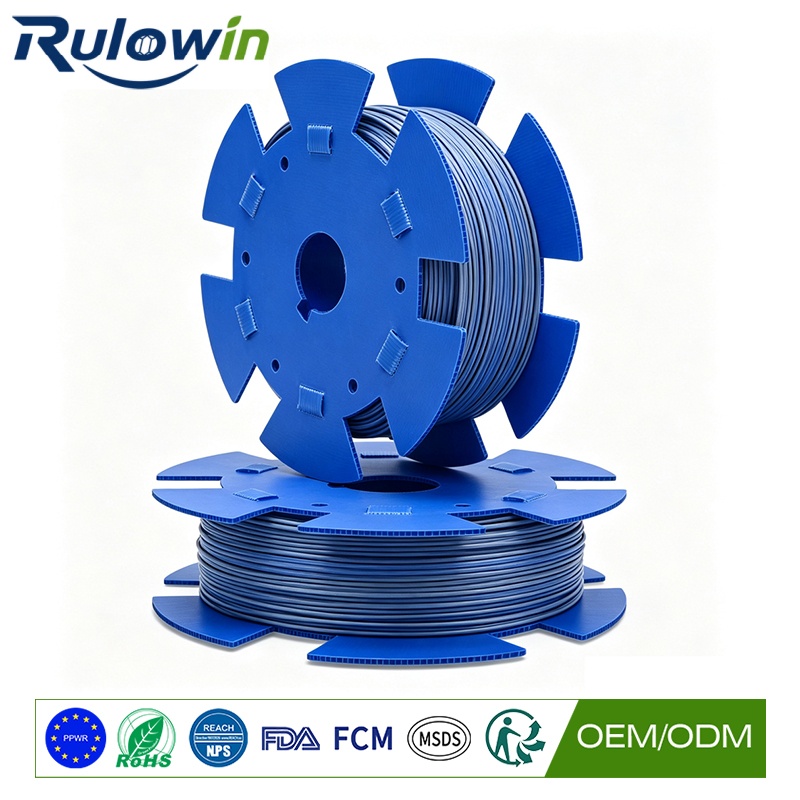
The difficulties at the small end are almost the inverse of the large end. Structurally a small spool is easy — the flange is stiff, the load is modest. What gets hard is precision, speed, and the fact that small spools get handled constantly.
Structurally, easy
Worth saying first, because it is the good news. At small diameters:
- Flange deflection is rarely an issue — short lever arms and small loads
- Material quantities are low, so weight and cost per unit are small
- Transport and storage are easy
Almost every structural concern in this series becomes minor below a certain size. What replaces them is a different set.
Tolerance becomes critical
A given absolute variation is a much larger proportion of a small dimension. Half a millimetre on a 300 mm flange is nothing; on a 40 mm bore it is significant.
Specifically:
- Bore fit dominates. Small spools are often on small shafts where the clearance is a larger fraction of the diameter, and the consequences of a loose fit are the same ones described in our bore wear article, arriving faster.
- Concentricity matters proportionally more. The same absolute runout is a bigger fraction of a small radius.
- Fabricated construction has a floor on achievable tolerance, which is the honest limitation discussed in our construction comparison.
That last point is the significant one. There is a size below which moulded construction is generally the better answer, and it is worth asking about rather than assuming a fabricated spool will do.
Speed
Small spools often run fast — more revolutions for the same linear speed. This brings:
- Runout consequences amplified by rotational speed
- Bore wear rates that are high in revolutions even where hours are modest
- Balance sensitivity, discussed in our balancing article
A small spool on a fast line is a high-cycle component, and it should be specified as one.
Handling dominates the economics
Because the unit cost is low, the cost that matters is handling. This is the argument from our changeover article in its purest form:
- Mounting speed matters more than unit price
- Threading and anchoring need to be quick and repeatable — see the start-up scrap article
- Consistency between units matters, because any adjustment is pure cost at high changeover rates
What is easy to get wrong
- Specifying by diameter alone without stating tolerance and speed
- Assuming low cost means low consequence — a small spool that stops a fast line is as expensive as a large one
- Forgetting that small spools get lost more easily, both physically and administratively
- Not considering whether reusability is worth it at low unit cost — sometimes it is not, which is a legitimate conclusion
That last point deserves emphasis. A very cheap spool on a long, uncertain return loop is often better treated as consumable. There is no virtue in a returnable programme that costs more to administer than it saves.
Where our construction fits
Honestly, the small end is where we are most often not the right answer. Our hollow board spools suit small-to-medium sizes where tolerance requirements are moderate and volumes do not justify tooling.
Below that, or where tolerance and speed dominate, moulded construction usually serves better — and we would rather tell you at quotation than sell you something that will cause trouble on a fast line.