
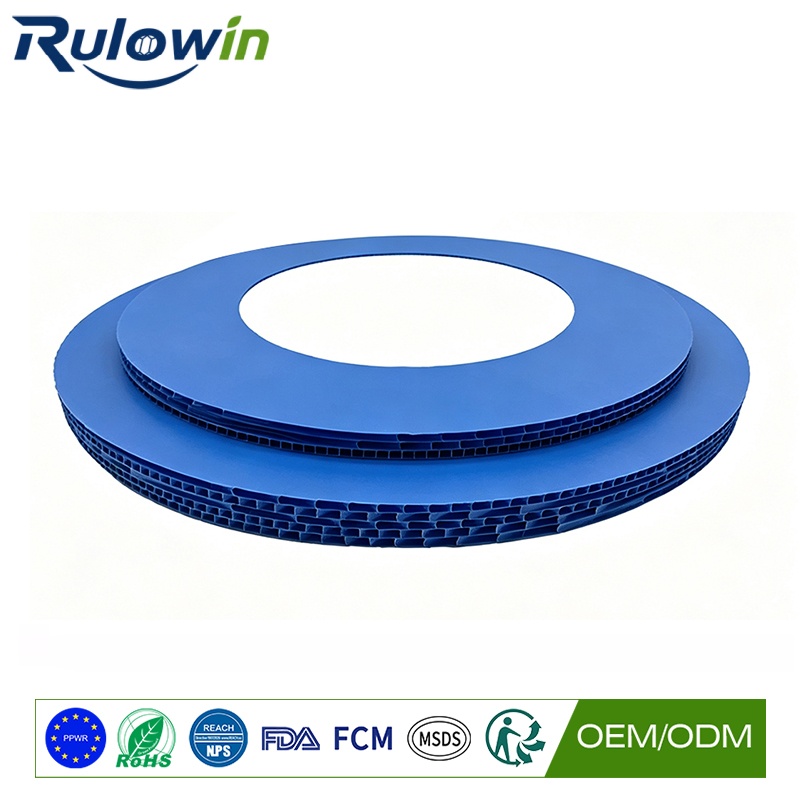
Ask someone what kills a spool and they will probably say a cracked flange. Flanges are visible and dramatic. But if you look at why spools actually get retired from a well-run fleet, bore wear is a strong contender — and it is the failure that gets least attention because it happens slowly and in a place nobody looks.
What the bore is doing
The bore is the interface between the spool and the machine. It has to locate the spool on the shaft, transmit the torque that either drives the spool or brakes it, and do all of that repeatedly without changing dimension.
It is also, on a plastic spool, the surface with the highest contact pressure and the most relative movement. Every mounting and dismounting is a wear event. Every start and stop is a small amount of fretting.
How it fails
Gradually. The bore goes slightly oversized, or slightly out of round, or develops a polished worn patch on the load side. Then:
- The spool no longer seats squarely, and runs with a wobble
- Runout appears, which at speed shows up as tension variation and, on sensitive product, as damage
- Under drive, the spool slips on the shaft instead of turning with it
- The bore wallows into an oval, at which point no amount of adjustment recovers it
The annoying part is that the spool looks fine. There is no crack, nothing is visibly broken, and the fault presents as a machine problem or a product-quality problem rather than a spool problem.
What accelerates it
- Loose fit from the start. A bore that is even slightly oversized for the shaft will move on every revolution, and movement is wear. This is why we push so hard on measuring the actual shaft rather than trusting the nominal size.
- Rough or damaged shafts. A scored or rusted shaft is a cutting tool. It will machine the bore out in a fraction of the normal time. Shaft condition is the cheapest intervention available and the most often ignored.
- Mounting under power. Starting rotation before the spool is fully seated chews the bore in a way that steady running does not.
- Steel shafts, high cycles. Steel on polypropylene is not a wonderful bearing combination. It works, and it is what most machines have, but it is worth knowing that the shaft material is part of the wear equation.
- Grit. In a dusty or outdoor environment, abrasive particles between shaft and bore accelerate everything.
What helps
- Get the fit right at specification. Measure the shaft, in several places, and tell us. Not the drawing size — the actual size.
- Maintain shafts. Smooth, clean, straight, and replaced when worn. Cheap and effective.
- Consider a bore insert or bush on high-cycle applications. A replaceable wear surface in the bore converts a spool-ending failure into a maintenance item. It adds cost, so it is not automatic — but where cycles are high and spools are expensive, it pays.
- Drive through the flange rather than the bore if the machine allows it. Drive pins engaging the flange take the torque load off the bore entirely. Not every machine can do this; where it can, bore life improves considerably.
- Do not over-tighten. Clamping the spool hard enough to deform the bore creates the clearance that causes the wear.
Inspection
It takes seconds. Push the spool onto the shaft and feel for play. Look at the bore surface for polishing, ovality, or a worn patch on one side. Anything you can see or feel is worth retiring the spool over — the alternative is finding out at speed, with product on it.
Add a bore check to whatever inspection spools get on return. It is the highest-value thirty seconds in the whole routine.
Where we would point you instead
If you are running very high cycle counts on driven shafts, an all-plastic bore may not be the right answer regardless of grade, and it is worth discussing a bushed or reinforced design. We would rather say that at quotation stage than sell you spools that wear out faster than the business case assumed.
Tell us your shaft diameter, whether the spool is driven or braked, and roughly how many cycles per year, and we will tell you honestly what we expect the bore life to look like on our PP hollow board spools — including the cases where we think you should go elsewhere.