
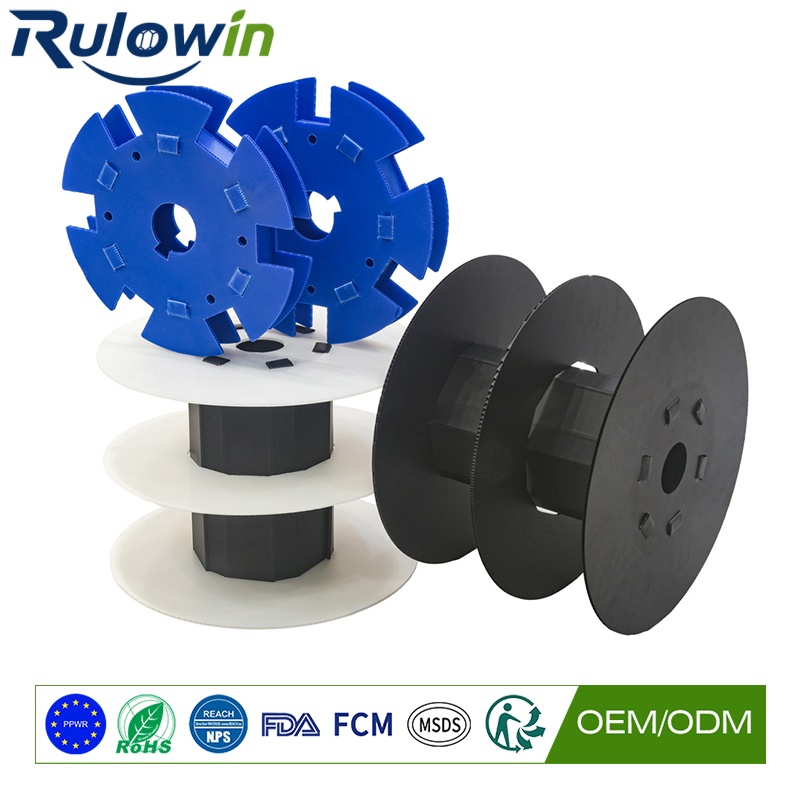
There is a size of power cable where the conversation about plastic spools changes, and it does not change gradually. Below it, plastic is a straightforward improvement on wood. Above it, the loads start to exceed what a polymer spool does economically, and pretending otherwise costs money.
This is worth being clear about, because suppliers who only make plastic will tell you plastic is always better. It is not.
What gets hard at large diameters
Three things compound as the spool gets bigger:
- Winding tension. A large power cable drum is wound under substantial tension, and that tension pulls the flanges inward across a long span. Flange deflection scales with the square of the span, so doubling the diameter quadruples the problem.
- Weight. Product weight grows with the volume of the pack, which grows faster than the spool’s dimensions. The spool ends up carrying a load that is large relative to its own mass.
- Handling loads. Big drums are moved by crane or by heavy equipment, and the impact energies involved are in a different league from a spool you can lift.
Each of these can be engineered around — more ribbing, a heavier section, a reinforced rim — and each solution adds weight and cost. At some point you have designed an expensive plastic spool that weighs nearly as much as the wooden one it was meant to replace.
Where plastic still wins
Medium-diameter power cable on reusable programmes. Distribution cable, building wire, and the smaller end of power cable all sit comfortably within what a well-designed plastic spool handles, and there the advantages are the usual ones: no moisture absorption, no ISPM 15, dimensional consistency, and a real reuse life.
Also: any lane where the drums come back. The reuse economics improve dramatically with trip count, and a plastic spool in a closed loop is hard to argue against.
Where wood wins
Transmission-size cable, very long lengths on a single drum, one-way shipments to remote sites, and anywhere the drum will be handled by equipment that does not care about its feelings. Plywood is stiff, cheap at large sizes, and repairable in the field with basic tools, which matters more the further the site is from a supplier.
The grey zone, and how to decide
The genuinely difficult band is the middle. There, the deciding questions are:
- How many trips? High trip count pushes hard toward plastic, because the material cost is amortised.
- Do they come back? If not, the reuse argument disappears and unit price wins.
- What is the humidity like on the route? Wet routes punish wood.
- Is the handling mechanised? Machines reward dimensional consistency; rough manual handling rewards cheap and repairable.
Answer those four and the middle band usually resolves itself. A supplier who will not discuss them is selling rather than specifying.
If you go plastic at the large end
Over-specify the rim, specify flange deflection as a number at your maximum tension, and ask what the spool weighs when empty — because at that size, the empty weight is part of your freight cost on every single shipment.
Send us the cable construction, the drum size, the tension and the handling method, and we will tell you honestly whether plastic is right — including when it is not.
The hybrid, where it exists
Some applications sit awkwardly in the middle: the product is too heavy for an all-plastic spool, but a steel one is over-specified and expensive to ship back. Where the geometry allows, a steel or heavy-wall core with plastic flanges can be a reasonable answer — the core takes the compressive load and the flanges stay light.
It is not always available or sensible, and the joint between the two materials is the part that needs thought. But if you have been told “plastic or steel” and neither fits well, it is worth asking whether a mixed construction is on the table.