
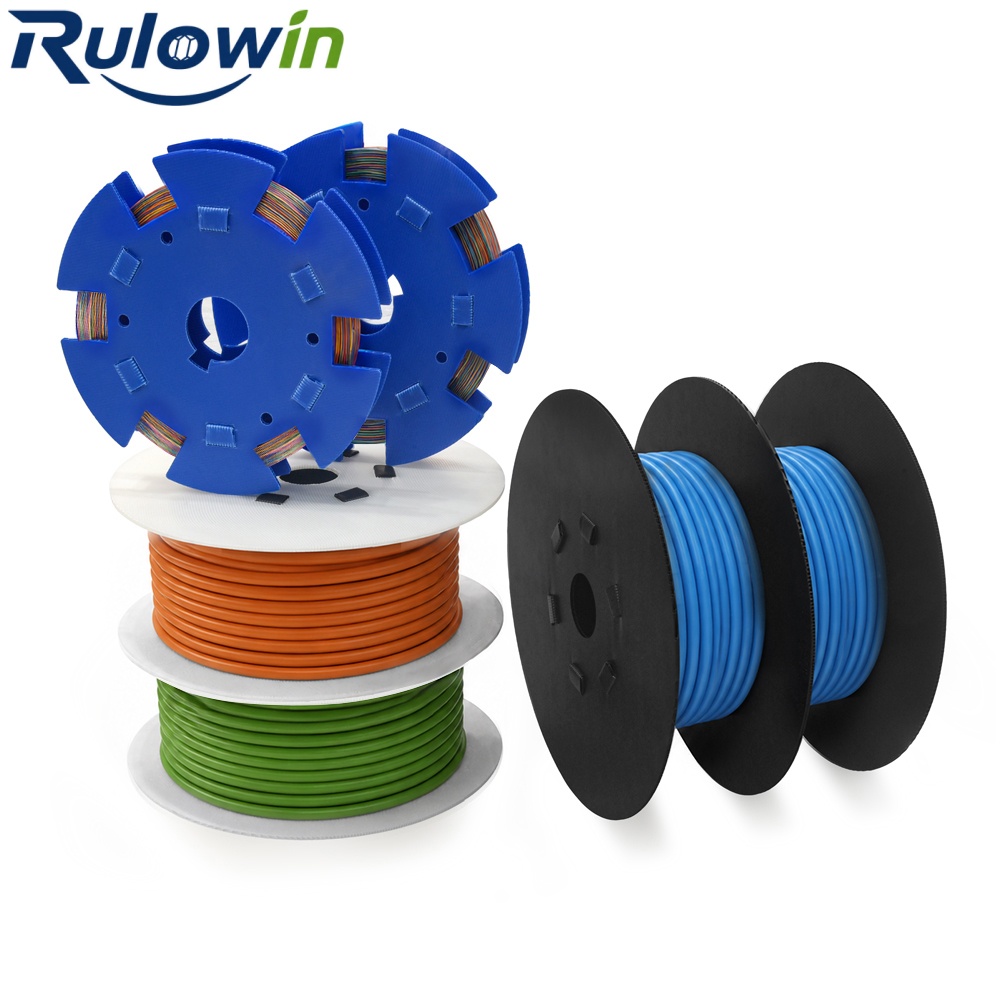
The question comes up every time storage space is tight, and it gets answered by what the racking allows or by how high somebody can reach. Neither of those is the binding constraint.
Two separate limits
Can the bottom spool carry the load? A structural question. The bottom flange is carrying everything above it, and it is carrying it as a column load rather than the hoop load it is designed for.
Will the stack stay standing? A stability question, and usually the one that binds first. A tall stack of round objects on an imperfectly level floor is unstable well before anything is crushed.
Checking only the first is how stacks end up on the floor.
What limits the bottom spool
- Flange stiffness and how it is supported — face-to-face stacking spreads load, rim-to-face concentrates it
- Whether the spools are full or empty. Empty spools stacked high are lighter, but a full spool at the bottom of an empty stack is carrying less than it would carrying other full spools
- Wall thickness and construction, discussed generally in our wall thickness article
- Condition. A spool with a crack or one that has taken a set is carrying less than a new one
- Temperature. Everything carries less warm
What limits stability
- Floor level. The dominant factor outdoors. Yards are rarely flat, and a leaning stack puts bending load on the lower spools that they would not see on a flat floor.
- Whether spools nest or register. Self-locating designs resist shifting; flat-on-flat stacking does not. This is one of the genuine advantages of certain flange profiles, as noted in our flange profile article.
- Height-to-base ratio. A tall narrow stack tips; a squat one does not.
- Vibration and traffic. Anything that shakes the stack — nearby machinery, a door track, a vehicle route.
- Wind, for outdoor storage of empty spools, which are light enough to be moved by it.
Practical guidance
We are not going to publish a number, because it depends on all of the above and a figure without those qualifications would be misleading. What we would suggest instead:
- Ask the supplier for a stack limit for the specific spool and duty, and ask what it is conditioned on.
- Test it. Build a stack to the height you intend, leave it a week, and measure whether the bottom spool has taken a set. The method is in our deflection test article.
- Reduce height outdoors. Whatever works indoors, use fewer outdoors.
- Keep stacks away from traffic routes and anything that vibrates.
- Level the ground or use bearers rather than accepting a slope.
Full versus empty
Empty spools are light and can usually be stacked higher structurally, but they are also more prone to wind movement and to being knocked. Full spools are heavy, stable against wind, and structurally more demanding.
In practice, most sites end up with a lower limit for empties than the structure would allow, purely because empties get moved around more.
Signs you have gone too high
- Lower spools showing flange deformation after a few weeks
- Stacks that lean visibly
- Spools that have shifted or partly rotated in the stack
- Damage concentrated in the bottom two or three
That last one is diagnostic. Damage at the bottom of stacks is a stack-height problem; damage distributed through the stack is a handling problem.
What to ask us
Tell us the size and whether they will be stored full or empty, indoors or out, and we will give you a defensible figure for our hollow board spools — with the conditions stated, so you know what you are relying on.