
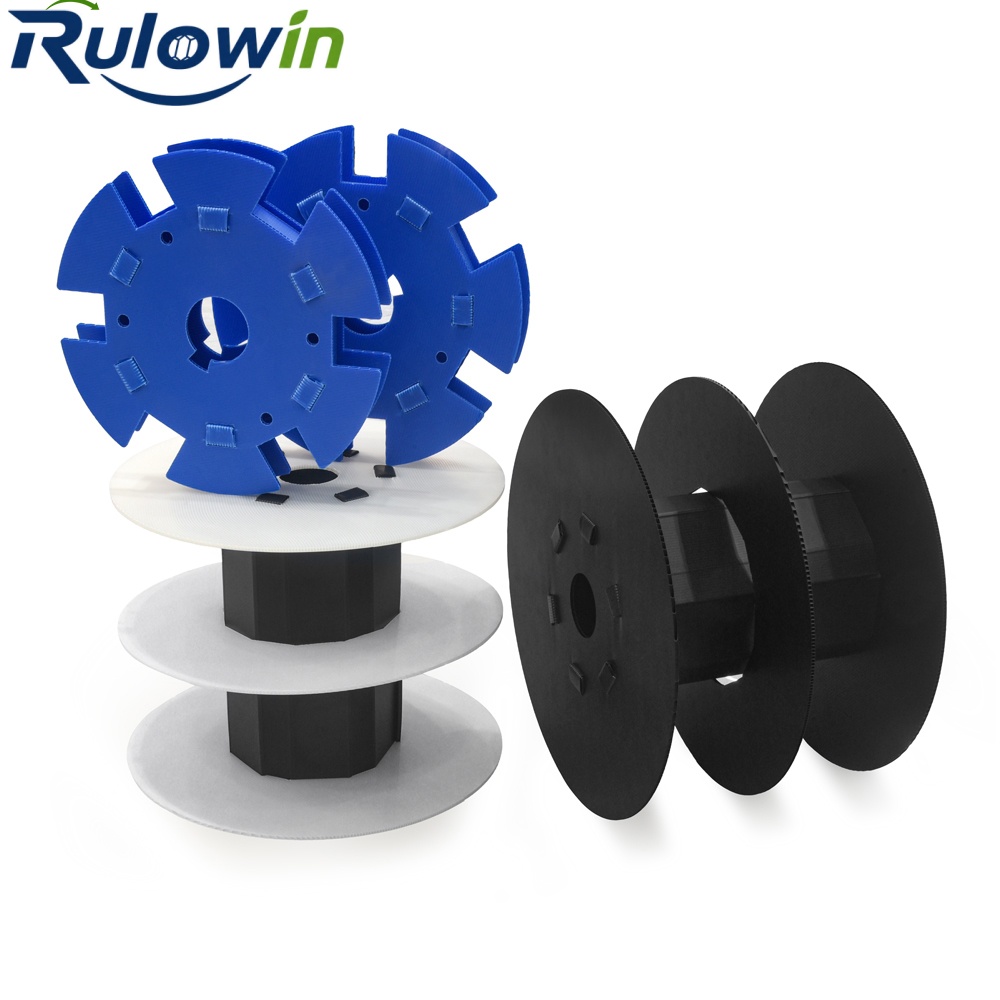
Stiffness is the property that decides whether a flange deflects under load, and deflection is what opens the gap that lets turns migrate. It is also something you can measure in your own workshop with things you already have — which matters, because stiffness is rarely quoted in a way you can check.
The basic test
Unloaded reading. Lay the spool on its side, supported at the hub so nothing loads the flange. Put a straightedge across the flange from hub to rim and measure the gap at the rim with feeler gauges or a ruler. Record it.
Loaded reading. Support the spool at the rim with the hub free, and hang a known weight from the hub — or simply lean progressively more of your own weight on it, though that is harder to repeat. Measure the deflection.
What you get is a stiffness figure in millimetres per kilogram. Comparing two spools that way is meaningful even if the absolute number is not.
Note that this measures the flange as a disc. It is not a simulation of hoop load. It correlates well enough to rank options, which is the useful thing.
Why the loaded-plus-recovery version matters more
The genuinely useful variant: load the flange, hold it for a while, unload, and measure whether it came back.
A flange that deflects and fully recovers is elastic, and elasticity is generally acceptable. A flange that keeps even a small permanent set after a day under load is being loaded beyond what it handles — and that set grows with repeated cycles, which is the mechanism discussed in our article on long-term wound storage.
This is why we suggest leaving loaded spools overnight for this test rather than measuring immediately.
Testing with actual product
Better than weights: wind to full specified load, leave it 24 hours, and measure rim position before and after unwinding. That tests the real load path rather than a simulated one, and it catches things no bench test will — core crush, flange bow from actual hoop load, and joint issues on take-apart designs.
It costs you one production cycle and gives you the most honest answer available.
What to compare
This test is comparative by nature. Useful comparisons:
- Two candidate designs before committing to an order
- A new supplier against your incumbent
- A spool at the start of its life against one after fifty trips — this finds cumulative damage nobody else catches
- Thicker against thinner board, to see whether the extra cost buys measurable stiffness or just weight
Temperature again
Polypropylene stiffens when cold and softens when warm. A stiffness measured at 30 °C is not the same spool you have at 5 °C, and the difference is not negligible. Measure at the temperature you run at, or record the temperature alongside the reading so you know how optimistic it is.
Turning it into a specification
If you want suppliers to meet a stiffness requirement, this test is a reasonable way to define it — far better than specifying board thickness and hoping. “Flange deflection under 50 kg at the hub shall not exceed X mm, with full recovery after 24 hours” is objective, checkable, and lets suppliers find the cheapest way to achieve it.
It also avoids the trap of specifying construction and getting exactly what you asked for rather than what you needed. Our piece on tolerances makes the same argument more generally.
Limits of the method
It will not tell you anything about fatigue life, impact resistance or long-term creep beyond the simple recovery check. It is a snapshot of one property. Treat it as one input, not as acceptance testing on its own — that broader topic is covered in our article on sampling and qualification.
Practical note
If you run this on several of our hollow board spools, expect some variation between samples. That is normal for fabricated construction, and it is why we suggest testing several rather than drawing conclusions from one.