
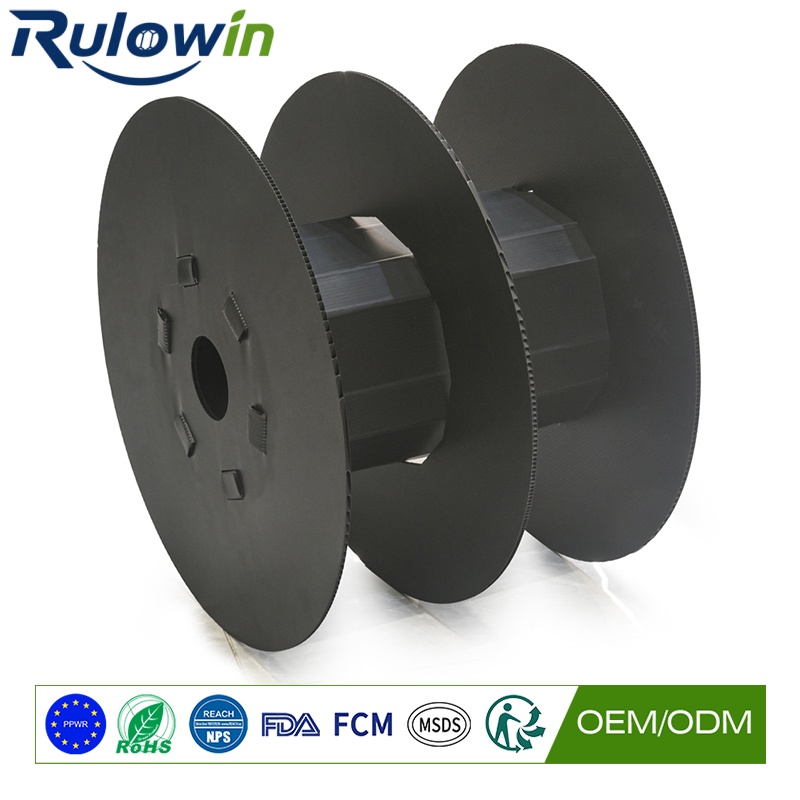
A spool on a vehicle is a round object that wants to roll. Most load securing tries to hold it in place with downward force and friction; the more reliable approach is to stop it being able to move in the first place.
Why round loads are different
A box resists movement through friction across its whole base. A spool contacts the deck along a line, and any small rotation reduces that contact further. Once a spool starts to roll, friction is working for it rather than against it.
This is why loads that were secure at departure arrive shifted. The straps did not fail; the load found a way to move that strapping across the top does not prevent.
The principle: block, then restrain
Chocks and blocking prevent movement. Strapping and lashing then resist what remains. Doing it in that order means the straps do far less work, which means less tension, which means less damage — the connection to our banding article.
What to use
- Chocks — wedges or blocks at the base preventing roll. The primary restraint for a spool standing on its rim.
- Cradles or saddles which locate the spool and prevent movement in any direction. Best where they are reusable and part of the vehicle or container fit-out.
- Blocking — timber or board filled against the load to take up voids, particularly against container walls and doors.
- Dunnage — material used to fill gaps and spread load. Usually timber, sometimes inflatable bags.
- Anti-slip material under the load, which increases friction enough to matter and costs very little.
What to avoid
- Holding down instead of blocking. High strap tension onto an unblocked round load damages the spool and does not reliably secure it.
- Unfilled voids. A gap of a few centimetres at a container wall is where movement starts, and movement propagates.
- Dunnage that crushes or shifts. Material that compacts under load leaves the gap it was filling.
- Chocks that are not secured. A chock that can slide is not a chock.
Number of restraint points
For spools standing on the rim in a container, a workable arrangement is chocking at the base of every spool in the outermost row, blocking the void at the doors, and anti-slip material under the load. For spools laid flat and stacked, the stack itself is the restraint and the work goes into keeping the stack square and filled against the walls.
The specific method matters less than the principle: nothing should be able to move before something stops it.
Timber and export
Much dunnage is timber, and timber in international shipping carries treatment requirements. Our ISPM 15 article makes the point that the plastic spool usually avoids the paperwork — worth noting that the dunnage holding it may not.
If you are using untreated timber for export dunnage, that is worth checking.
Checking the load
Worth doing at loading, and it takes a minute:
- Push the load. Anything that moves is not secured.
- Look for gaps at the walls and doors.
- Check chocks are actually against the spool rather than near it.
- Confirm strap tension is enough to hold but not enough to cut — the failure described in the banding article.
What we can help with
Not much directly, honestly — this is a loading discipline rather than a spool design issue. What we can do is tell you the weight and dimensions of our hollow board spools accurately, so whoever plans the load is working from real numbers rather than estimates. Inaccurate weights are a common cause of under-specified restraint.