
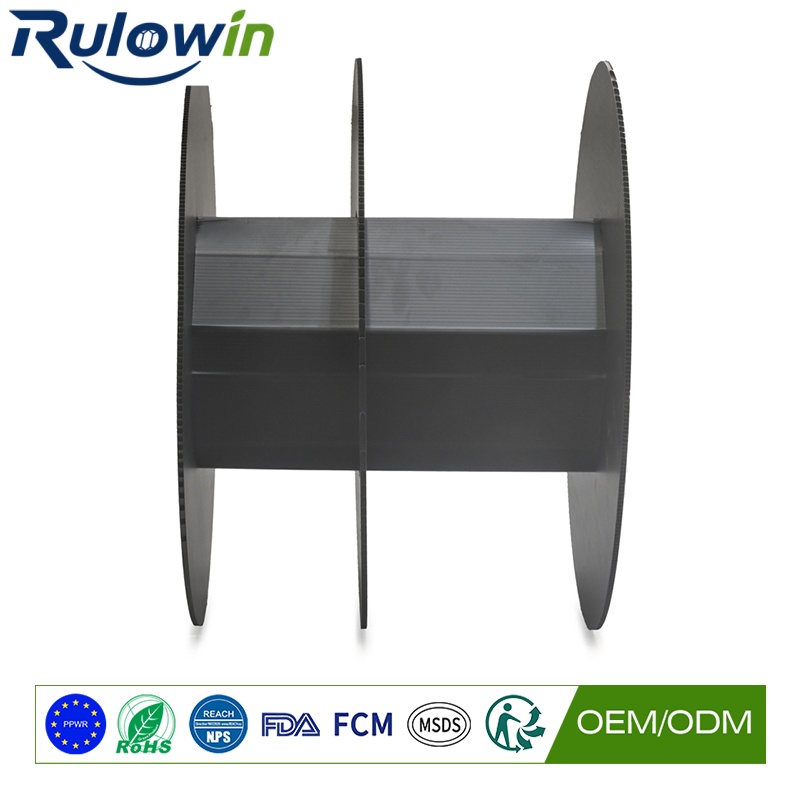
Spools are round, bulky and awkward to store, and standard pallet racking is designed for boxes. The mismatch causes handling inefficiency, damage, and a certain amount of improvised engineering that nobody is happy with.
Worth stating at the outset: for many operations the best answer is not racking at all, and it is worth considering the alternatives before buying anything.
The two arrangements that work
On the flange face, laid flat. Spools lie on their side, stacked on top of each other or on a shelf. Stable, easy to access from above, and the load is spread across the flange rather than concentrated at the rim. Requires horizontal space and limits stack height.
On the rim, rolling in a cradle. Spools sit in angled rails or purpose-built cradles and roll to the picking face. Excellent for first-in-first-out rotation, which matters for the reasons in our storage article. Requires purpose-built fittings and suits a narrower range of sizes.
What does not work well: spools balanced on open shelving with nothing preventing them rolling, or stored upright on a narrow rim with no lateral support.
What to look for in racking
- Beam or shelf surfaces that prevent rolling. Flat steel beams with round spools on them is an accident waiting for a nudge.
- Load rating that accounts for the concentrated load. A spool resting on two beams puts its whole weight on two lines, not distributed across a pallet footprint.
- Depth that accommodates the diameter without overhang, for the same reasons as the pallet discussion in our pallet article.
- Protection at contact points. Steel beam edges are hard and sharp relative to a plastic flange; a strip or pad changes the damage rate noticeably.
- Access that does not require lifting over other spools. The handling problem that racking usually introduces.
Load on the spool itself
Worth remembering what stacking does to the spool. Spools stacked face to face put load through the flange of the one at the bottom, and while flanges are designed to take load, they are designed to take it as hoop load from winding rather than as a column load from above.
How many you can stack depends on the spool and its duty. Ask rather than assuming — and note that a spool that is fine stacked five high when full may not be when the flange has been weakened by a season outdoors.
Alternatives to racking
Often cheaper and better:
- Floor storage with marked bays, which is what most high-volume operations end up with. Cheap, flexible, and the handling equipment already suits it.
- Palletised storage — keep them on pallets and move pallets. Simple, works with existing equipment, and makes counting easier.
- Purpose-built cradles where rotation discipline is important and volumes justify the fabrication.
Racking tends to be chosen because a building has height available, and then discovers that lifting spools to height is the hard part rather than storing them there.
Manual handling constraints
Anything above shoulder height becomes a manual handling problem, and spools are awkward shapes to lift. The weight limits discussed in our manual handling article apply, and they usually rule out high-level manual storage well before the racking’s load limit does.
What to decide first
Before choosing storage: how many spools, what sizes, how fast they turn over, and what equipment already exists. Fast turnover with mixed sizes wants floor bays. Slow turnover with consistent sizes can justify racking. Mixed fleets with occasional large spools usually end up on the floor whatever you buy.
What we can tell you
Stack heights and weights for our hollow board spools at the size you use, and how they behave stacked face to face versus nested. That is the input you need before specifying anything, and it costs nothing to ask.