
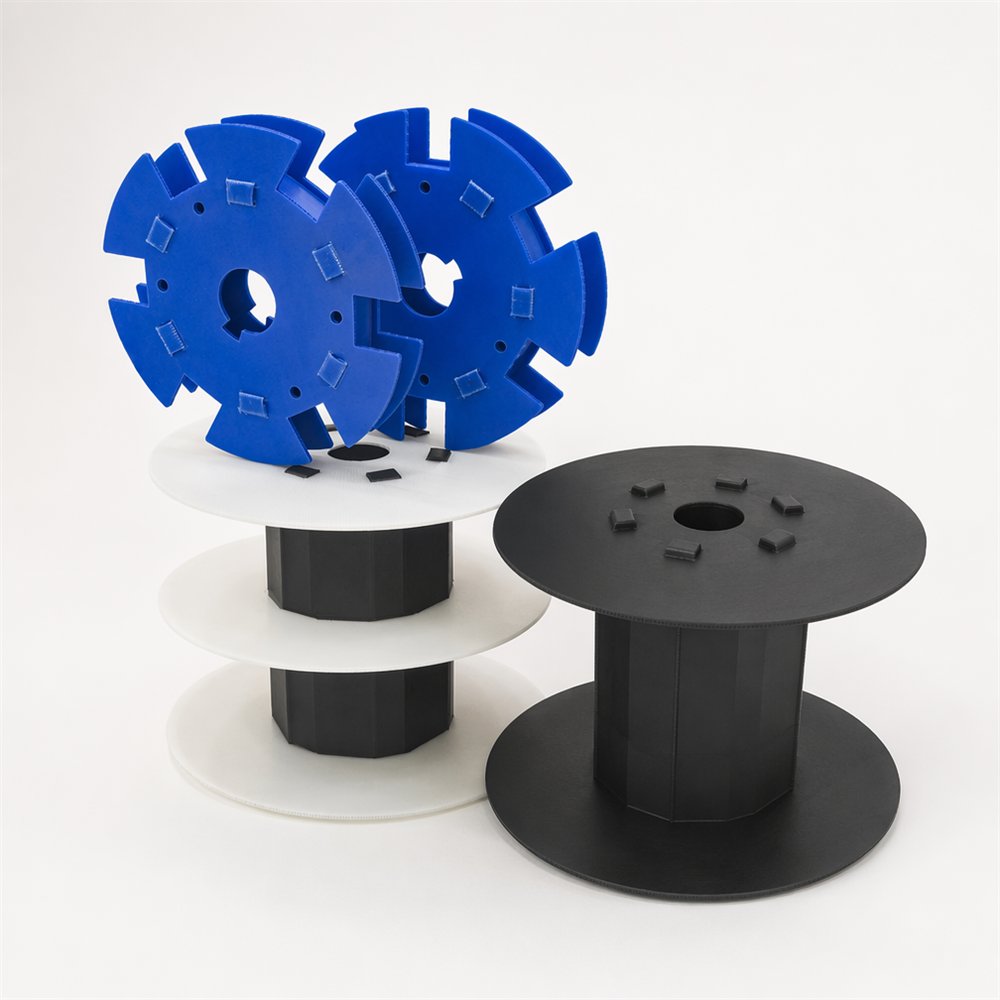
Spools sit in yards for months at a time, and yards are where fleets quietly degrade. Not through any single event but through a combination of stacking that loads the wrong surfaces, rotation that never happens, and exposure that nobody has priced.
How to stack them
The rule follows the load path. Spools are strong through the rim and weak across the flanges, so:
- On the rim (axis horizontal) is the strong direction and the right way to stack more than two or three high. They roll, so they need chocks or a frame.
- Flat, stacked face to face is fine for two or three, and increasingly wrong above that. Flange creep under sustained load is real, and it is worse in the heat.
- Never on the flange edge alone. A spool stood on its rim and leaning against a wall will deform at the contact point over months.
A simple rack or stillage that holds spools on their rims converts a floor-space problem into a tidy, safe, countable arrangement, and it pays for itself in damage avoided in most yards within a year.
Rotation
The spools at the back are the oldest, the most weathered, and the least likely to be used — and then one day they are the only ones left and they go out on a customer order.
First-in-first-out is not exciting but it is the difference between a fleet that ages evenly and one with a degraded pocket at the back. If FIFO is genuinely impractical, at least identify and quarantine the oldest stock rather than letting it enter the active fleet by accident.
Layout
Three practical points that most yards get wrong:
- Access. If reaching the third row requires moving the first two, the third row will never be reached. Leave aisles wide enough for the handling equipment, not just for the spools.
- Segregation. Separate by product type, by owner, and — critically — by condition. A bay for damaged spools awaiting repair stops them being issued by mistake.
- Surface. Standing spools on soil or gravel means they sink slightly, lean, and take in water at the contact point. Hardstanding or timber bears is worth it.
Exposure
Sun and standing water are the two that matter. Some cover — even partial — removes most of the UV damage, and a slight slope or a bearers system keeps the bottom row out of puddles. Both are cheap compared with replacing a weathered fleet early.
Counting
A yard you cannot count is a fleet you do not control. Mark bays, keep a simple map, and do a physical count regularly enough that a discrepancy is noticed while it is still small. Quarterly is usually right; monthly if the fleet is large or the loop is open.
The count is also the moment to inspect. Sorting into fine, repairable and scrap once a quarter is less work than discovering the state of the fleet when you urgently need two hundred spools.
What good looks like
A yard where you can say how many spools you have, how many are serviceable, where the oldest ones are, and how many you lost last quarter — without walking around to find out. That is a management outcome rather than a tidiness one, and it is what makes a reusable fleet behave like an asset instead of a pile.