
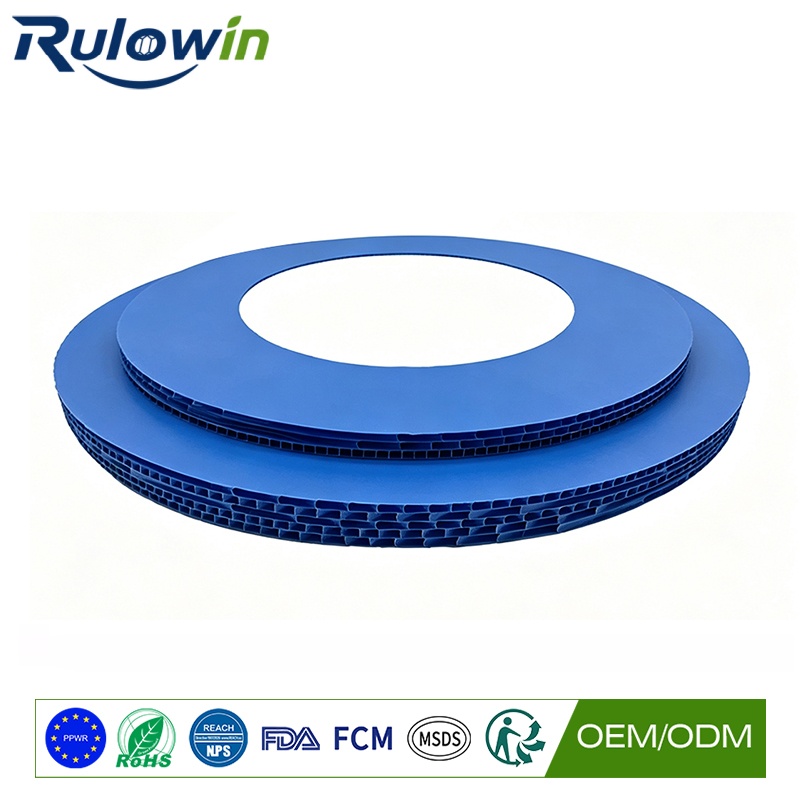
Strapping is how most spools are secured, and it is a regular cause of damage that gets attributed to transit. A strap under tension is a concentrated line load, and polypropylene deforms under sustained concentrated load — particularly in the heat.
What strapping does to a spool
It cuts into the rim. The most common damage. A steel or polyester band tensioned across a flange edge bears on a narrow line, and over hours or days in a warm container it sinks in.
It crushes the flange. Where a band passes over the flange face and is tensioned down onto the pack, it presses the flange toward the core. On a heavily wound spool this adds to the load the flange is already carrying.
It distorts the bore region if the band route passes over the hub and presses inward.
It marks the product where it presses the pack rather than the spool.
Why it gets worse in transit
Strap tension is applied once, but the load it creates persists for the whole journey, and two things make it worse over time:
- Vibration works the band against the surface, turning pressure into abrasion
- Heat softens polypropylene, so a tension that was acceptable at despatch cuts in by arrival
This is why damage is often found on arrival rather than at loading, and why it looks like a transit event.
Steel versus polyester versus cord
Steel banding is the strongest and the least forgiving. It does not stretch, so it does not accommodate any settling, and its edges are sharp. It cuts most.
Polyester strapping has some elasticity, which means it retains tension as a load settles rather than going slack, and it is less aggressive on edges. Generally the better choice for spools.
Cord or woven strapping is gentlest and adequate for lighter loads, but it has more stretch and less tension retention over long journeys.
What actually helps
- Use edge protectors. The single most effective measure. Something as simple as a cut piece of board between band and rim spreads a line load over an area, and it transforms the outcome.
- Band over the flange face, not across the rim edge, where the geometry allows.
- Do not over-tension. More tension than needed causes damage without improving security.
- Check tension on arrival if you are seeing damage — over-tensioned application is common and nobody notices at the loading end.
- Use more bands at lower tension rather than two bands cranked down.
Alternatives worth considering
Depending on the configuration:
- Stretch wrap for unitising spools on a pallet, distributing load rather than concentrating it
- Pallet collars or frames where the container does the restraining
- Interlocking or nesting so the load is self-restraining — partly covered in our container loading article
- Chocks and blocking so spools cannot move rather than being held down, which is discussed in our dunnage article
The last of those is the better principle. Restraining an object so it cannot move is kinder to it than clamping it in place.
What to check on arrival
Look at the rims and at any point a band crossed. Cuts, crush marks and deformation there are banding damage rather than handling damage, and telling them apart matters if you are pursuing a claim — the evidence approach in our photography article applies directly.
What we would specify
For our hollow board spools, we would rather you used polyester strapping with edge protection at moderate tension than steel at high tension. And if your current packing damages spools, send us a photograph of where the band sat — that usually tells us more than a description.