
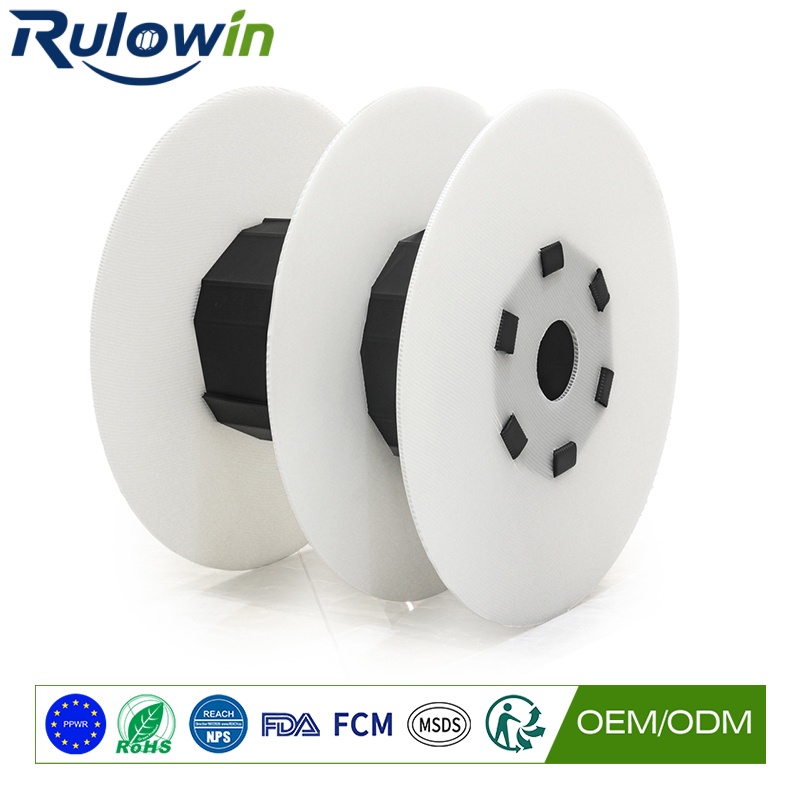
A spool works at one size, you need the same thing bigger or smaller, and the natural move is to scale the drawing. Sometimes that is fine. Often enough it produces something that looks right and does not work.
What scales reasonably well
- Proportions. The ratio of core diameter to flange diameter, where it was chosen for a reason, usually transfers.
- Material choice. Mostly — though the UV and impact considerations change with how and where a different-sized spool gets used.
- Surface features like drainage or cut-out placement, provided they stay proportionally in the same region.
- Marking methods and identification approach.
What does not scale
Flange stiffness. The big one. Deflection increases much faster than diameter for a given thickness, which is the central point of our large spool article. Scaling the thickness proportionally with the diameter does not hold stiffness constant.
Tolerance. The same absolute tolerance is a larger fraction of a smaller dimension and a smaller fraction of a larger one. Scaling tolerances with size is usually wrong in both directions — see the tolerance article.
Bore and shaft interface. Shaft sizes do not scale with spool size. A bigger spool may run on the same shaft, which means the bore stays and everything else changes around it.
Handling. A larger version stops being manually handled; a smaller one may become a high-cycle, high-speed component. Both are discussed in their own articles — small spools and manual handling.
Fill and capacity. Capacity changes with the square of the radius difference, so a modest diameter increase produces a large capacity change. That sounds like good news and it changes the load case, the handling weight, and sometimes whether the spool is manual at all.
Two directions, different problems
Scaling up is mostly a stiffness and handling problem. The structure has to work harder and the object becomes harder to move.
Scaling down is mostly a tolerance and speed problem. The structure is easy; the precision gets demanding, and small spools tend to run fast and get handled constantly.
They are genuinely different exercises and they fail in different ways.
What to recompute rather than scale
- Core diameter against the product’s minimum bend radius — this does not scale with the spool, it belongs to the product. See the bend radius article.
- Bore against the shaft — belongs to the machine
- Flange thickness or stiffness against the actual load
- Capacity and therefore fill weight and hoop load
When scaling is the right approach
- Modest changes — say within 20 or 30 per cent — where nothing about the duty changes
- A range of sizes intended to share tooling or construction, where the design was planned for it
- Where the original was over-specified and has margin to give
A better approach than scaling
Treat the existing spool as a source of constraints rather than a template. What you are carrying over is:
- The machine interface
- The product’s requirements
- The duty and environment
- What you learned using it
Then design to those. The result may look similar, and it will have been derived rather than copied — which matters, because a scaled design inherits the original’s margins, including the ones that were accidental.
Testing the new size
Worth more effort than people expect, because the assumption is that it is the same thing in a different size. Run the deflection test from our deflection article and mount it on the machine before committing. Those two catch most of what scaling gets wrong.
What we can tell you
Whether our hollow board spools at a new size need a different construction or just different dimensions, and where we would expect the change to cause problems. Often the answer is that it scales fine. Sometimes it is that the wall thickness or the core needs to change out of proportion, and it is better to know that before the samples are made.