
The gap between deciding you need a new spool and holding one is usually longer than people plan for, and the stages are not always obvious. Knowing what they are makes the timeline predictable and makes the expensive iterations avoidable.
Stage one: establishing the constraints
Before anything is drawn. The inputs that fix most of the design:
- The machine interface — shaft diameter and type, drive or brake arrangement, available width. This is not negotiable and it is where most designs start.
- The product’s minimum bend radius, which sets the core. Covered in our bend radius article.
- The duty — fill weight, tension, speed, temperature, handling.
- Anything existing it has to fit — racking, pallets, containers.
Half of development time that gets wasted is spent drawing something that was never going to satisfy one of these.
Stage two: dimensions and material
Flange diameter, core diameter, traverse width, bore, material grade. Most of it follows from stage one rather than being chosen freely.
Where there is genuine choice, it is usually in flange diameter, wall thickness and construction method — the trade-offs discussed in our sign-off questions article.
Stage three: drawing and review
This is the stage to spend time on, because changes here are free. Worth having:
- Tolerances stated on the dimensions that matter, per the tolerance article
- Material specified by grade and property rather than generically
- Any features — markings, drainage, cut-outs, reinforcement — included now rather than added later
- Review by whoever will use it and whoever maintains the machine
Stage four: sample production
Where the lead time actually goes. Depending on construction, this may involve setting up cutting or forming, and for anything moulded, tooling. The tooling economics are covered in our tooling article, and they are the reason some designs take weeks and others take months.
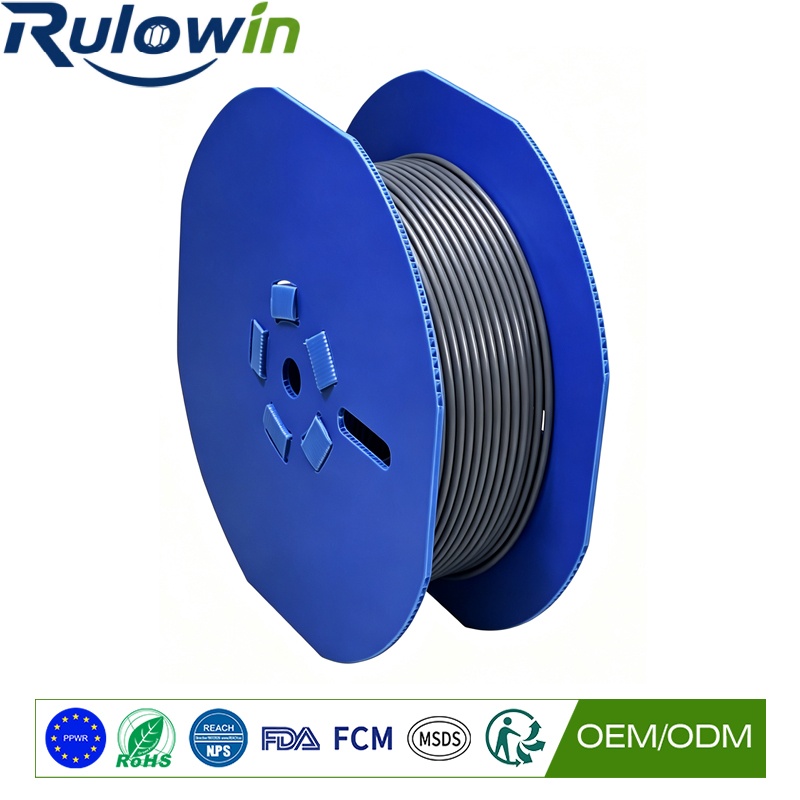
For fabricated hollow board spools, samples are comparatively quick because there is no hard tooling to make. That is a genuine advantage of the construction at the development stage, and it is worth using — iterate on a fabricated design before committing to tooling for a moulded version, if that is the eventual plan.
Stage five: evaluation
Where prototypes usually get under-tested. What is worth doing with a sample:
- Mount it on the actual machine. Everything else is secondary.
- Wind product on it and unwind it. Not visually — actually.
- Check concentricity using the methods in our concentricity article.
- Load it and leave it — the recovery test from our deflection article.
- Handle it the way it will be handled, including dropping it if that is realistic.
Stage six: revision
Expected, and worth planning for. Most first samples need one change. The changes are usually small — a dimension, a clearance, a feature — and they are cheap if caught here.
What is expensive is discovering a change is needed after the first production run, which is why the pilot in our pilot article is worth running before volume.
Where the time actually goes
In our experience, ranked:
- Waiting for decisions — approvals, internal agreement, getting shaft dimensions measured
- Sample production and shipping
- Tooling where it applies
- Evaluation on your side — fitting it into a production schedule
- Actual design work, which is usually the smallest item
The top item is nearly always the biggest, which is worth knowing before blaming the supplier for the timeline.
How to make it faster
- Measure the machine interface before starting. Repeatedly the thing that holds everything up.
- Decide who approves before there is something to approve.
- Ask whether something standard exists close to what you want, which is the highest-yield question in our cost drivers article
- Accept the first sensible design rather than optimising — a spool that works now beats a better one next quarter
What we do
For our hollow board spools we will tell you at the start what is standard and what is not, whether samples will be production-representative, and honestly how long each stage takes. We will also tell you when we think you are designing something that already exists under a different number.