
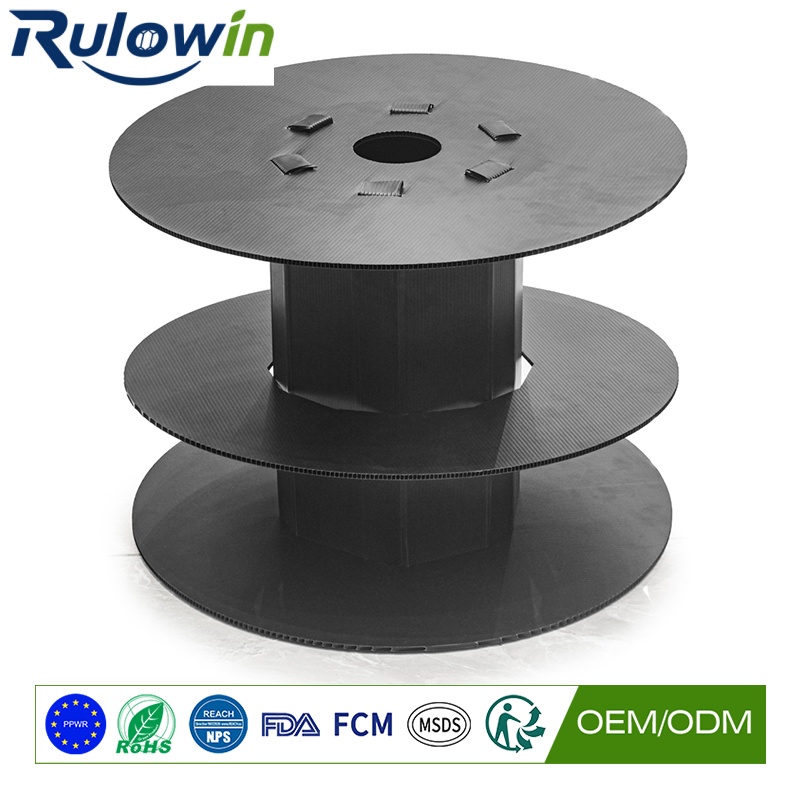
A spool drawing is usually signed off quickly because it looks simple. Four dimensions, a material note, done. Everything expensive about a spool programme is decided in that ten minutes, and most of it goes unexamined.
In rough order of how much money each question protects.
1. What is the product’s minimum bend radius, in writing?
Everything else about core diameter follows from it. If nobody has obtained this number, the core diameter is a guess. Covered at length in our bend radius article.
2. What is the shaft?
Measured, not nominal. Diameter in several places around the circumference, keyed or pinned or plain, and its condition. Our bore wear article is essentially an extended argument for this question.
3. Driven or braked, and roughly what torque?
Determines whether a plain bore is adequate or whether you need drive features — see the drive options article.
4. What holds at full load and which of these actually matter?
The tolerance question. Probably three or four dimensions, not twenty. Answered properly in our tolerance article.
5. How many trips, realistically?
Nobody knows exactly, but “maybe twenty” and “we need a hundred” produce different spools. Specify the core and the joint for the end of life, not the start.
6. Will it ever see freezing, or sustained sun?
Grade selection depends on it. Our pieces on cold and UV cover both, and specifying for neither when both will happen is common.
7. Assembled or nested for return?
A construction decision that has to be designed in. Discussed in our take-apart article and the shipping comparison.
8. How does anybody know whose it is?
Marking gets decided after the drawing is signed, and it should not be. See the markings article.
9. How many changeovers a day?
Determines whether handling speed matters more than unit cost, and nobody asks suppliers this. It is the central point of our changeover article.
10. What happens next time we need these?
Is anything on the drawing going to be available in three years? Niche colourants, unusual sizes, single-source material grades. A drawing that can only be made this year is a commitment to repeat ordering.
Two questions that are not about the drawing
Who has to agree to this? Somebody in quality, somebody in stores, whoever maintains the machines. Each one has veto power later and none was consulted.
What does the existing spool do wrong? If you are replacing something, knowing what actually failed prevents copying its faults. Most replacement drawings reproduce whatever the last one did, including the parts nobody liked.
Using this list
You do not need a formal review. Ten minutes with whoever knows the process, going through and answering honestly. Anywhere the answer is “nobody knows”, that is the item to resolve before signing rather than the one to assume.
Half an hour spent here typically prevents the majority of problems described across this whole series.
If you send us a drawing
We will ask several of these. It costs you twenty minutes of answering and it is genuinely why our hollow board spools tend to arrive fitting what the process needs rather than fitting the drawing. And if some of your answers point away from hollow board, we will say that too — earlier is cheaper for everyone.