
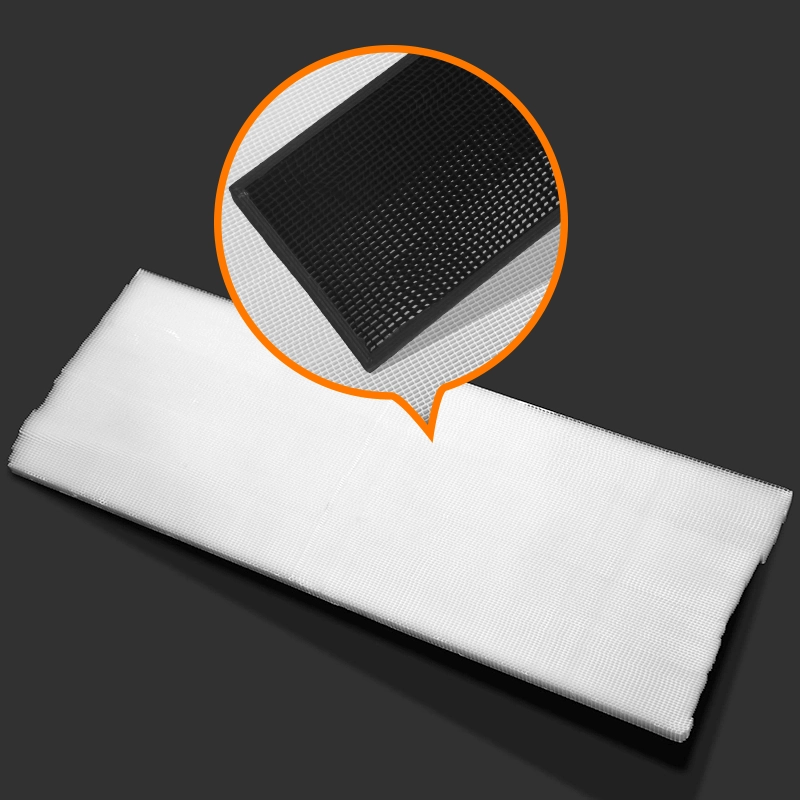
Nearly every split or window air conditioner has a coarse screen behind the return air grille. It is there to keep lint and dust off the coil, it is almost always a thin disposable mesh, and it is the part most owners forget exists until airflow drops. Replacing it with a washable panel cut to the same opening is a small change with a long payback.
What the return screen does
The coil is a dense fin block with narrow gaps. Lint bridges those gaps, and once bridged, airflow through that section stops. The unit then delivers less air, the coil runs colder, and in cooling mode you get icing on a portion of the coil – which reduces airflow further. The failure looks like a refrigerant problem and is a housekeeping one.
A return screen intercepts that material before it reaches the fin block. It is not there to clean room air. It is protecting the heat exchanger, and judged on that basis it is the cheapest protection in the system.
Why the original screen is usually inadequate
Supplied screens tend to be very open – rightly, because the manufacturer’s priority is not to restrict airflow and cause warranty complaints. That also means they catch relatively little. They catch the fluff that would visibly bridge fins and miss a good deal of finer loading that still accumulates on the coil over a season.
A washable honeycomb panel can be specified with more capture at similar resistance, because the cell geometry does the work rather than a woven mesh. The gain is real but not unlimited: the coil will still need cleaning, just less often.
Fitting one
Measure the opening, not the old screen. Original screens are often smaller than the aperture and sit in a slot with air leaking around them. A cut-to-fit panel made to the actual aperture removes that bypass, which is usually a bigger improvement than the change in media.
It must sit flat and be retained properly. A panel that bows inward under fan suction will chatter, and a panel that is not secured can be drawn against the coil. Most installations need nothing more than the existing grille to hold it.
Washing
Rinse from the downstream side, warm water, mild detergent if it is greasy. Air conditioner screens collect kitchen film in open-plan spaces, which needs detergent rather than water alone. Dry before refitting – a wet panel against a cold coil is asking for mould, and the smell that follows is often misdiagnosed as a dirty coil.
Where a panel will not fit
Some air conditioners leave no room. In a number of slim wall units the coil sits close behind the grille, with only the thickness of the original mesh between them. A rigid honeycomb panel a few millimetres thicker will not clear the fins, and forcing it risks contact that rattles or wears.
Cassette and concealed units are usually worse. The filter sits in a slide-in cassette with a specific profile, the opening is accessed from below, and anything not matching the original shape will not seat. Those are better served by a replacement of the same profile than by a cut panel.
Before ordering, measure the depth available behind the grille as well as the aperture – a tape or even a bent piece of card against the coil face will tell you. It is the dimension people forget, and it is the one that decides whether this approach works.
What we can do
We supply washable PP honeycomb pre-filter panels cut for air conditioner return grilles. Send us the aperture dimensions – the opening, not the old screen – and whether the unit is in a kitchen or a workshop, and we will tell you what gauge and open area to use.