
A box footprint chosen for the part usually leaves a gap on the pallet. A footprint chosen for the pallet usually fits the part well enough. Since the pallet is the thing that has to travel, get the module right first and then check the part fits – the reverse order produces a dozen box sizes and a warehouse full of unusable gaps.
Work from the pallet, in one orientation
On a 1200 x 800 pallet, footprints that work are 600 x 400 (six across), 400 x 300 (eight across with margin) and 300 x 200 for small parts. On a 1200 x 1000 the useful set is different again. Pick one pallet size as the standard for the loop and derive the box footprints from it. Allowing two pallet sizes doubles the number of box sizes needed and halves the chance that any given box is on the right pallet.
Turn the alternate layer
A footprint that does not tile a pallet in one orientation often tiles it when alternate layers are rotated ninety degrees, and this also interlocks the stack, which raises safe stack height. The cost is that the top layer has to be planned and that an odd number of boxes per layer leaves a hole. If the box count per layer is small – under six – rotation is more trouble than it is worth.
Overhang is worse than a gap
A gap wastes cube. Overhang risks the load: a box hanging past the pallet edge has no support under its outer corner, takes the strap load there, and is the box that gets hit by a rack upright or a doorway. If a footprint will not tile, size down to one that leaves a gap rather than up to one that overhangs. Ten millimetres of total gap is fine; ten millimetres of overhang is not.
How many sizes is enough
Most plants need two, occasionally three: a small for fasteners and small parts, a standard for the bulk of components, and a large for awkward light items. Every size beyond three adds to the fleet complexity, the wash sorting and the chance the wrong box is at the wrong station – and the wrong box at line side is worse than no box. The same consolidation logic is set out in box sizes that actually match the pallet.
What to do with the gap you cannot design out
Some footprints will not tile the pallet however you arrange them, usually because the part dictates a dimension that has no relationship to 1200 or 800 millimetres. When that happens the gap is permanent and the question is what to do with it. Three options, in order of usefulness. Make the gap deliberate and central, so the load is balanced rather than asymmetric – an off-centre load is a stability problem, a central one is just lost cube. Size the box down so the gap becomes a full extra box per layer rather than a strip too narrow to use. Or accept the gap and fill it with dunnage on the outbound leg.
What should not happen is ignoring it. An unfilled gap in a stack lets layers shift, and shifting layers are how a strap comes loose in transit. If the gap is more than about forty millimetres across a layer, it needs filling with something – a packing piece, a smaller box, or an air bag – rather than being left as slack that will work loose over a long road leg.
What we can do
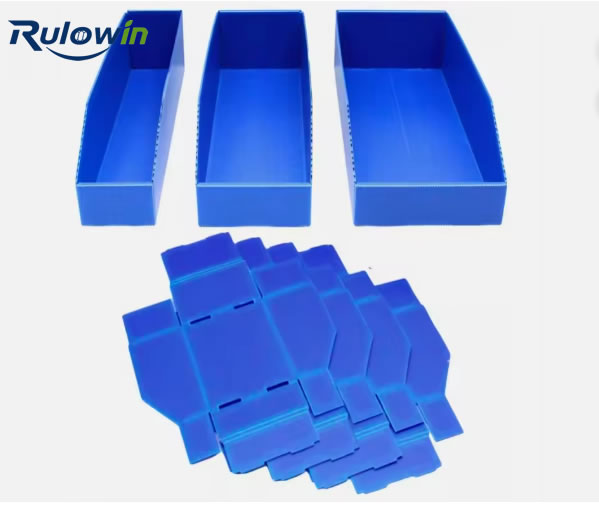
We make PP corrugated turnover boxes to a footprint derived from your standard pallet. Tell us the pallet, the part envelope and how many sizes you are willing to manage, and we will propose the smallest set that tiles – and show you the gap each one leaves.