
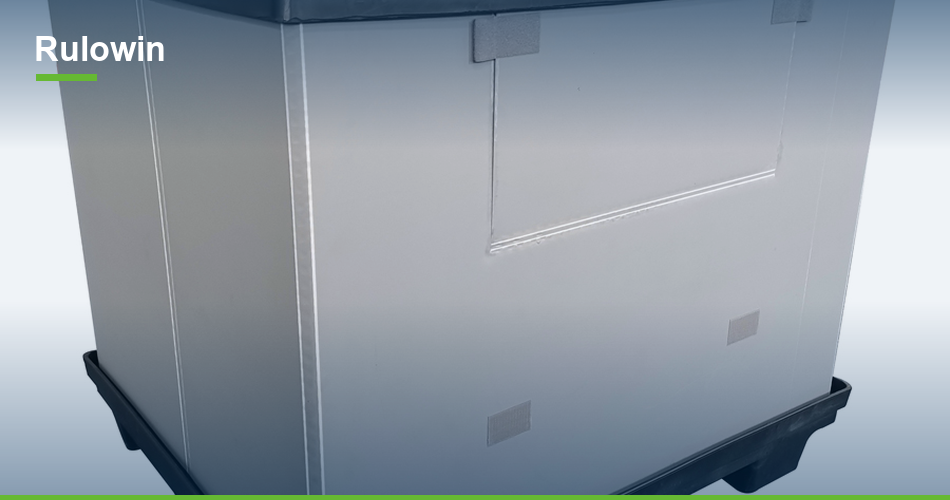
Stacking tests are done with full boxes. Real warehouses stack part-filled boxes constantly, because the last box on a job is never full and because pick faces are replenished from part-filled stock. That is the condition stacks actually fail in, and it is the condition nobody specifies for.
What changes when a box is half empty
A full box with a flat top surface transfers the load above it through its contents and its walls together. A half-empty box does not: the contents sit in the bottom, the top of the box is unsupported, and the load from above lands on the rim alone. If the rim was designed to locate a lid rather than carry a stack, the box above sinks into the box below, the stack leans, and the whole thing has to be re-worked by hand.
A lid that carries load changes everything
The cheapest fix is a lid designed to transfer stack load to the box rim rather than to the contents. That makes stack height independent of fill level, which means the warehouse can stack mixed-fullness boxes without a rule, and it removes an entire class of leaning-stack incidents. It costs a lid per box and it is almost always worth it in any operation that stacks more than two high.
The alternative is an operating rule
If lids are not affordable across the fleet, the alternative is a rule: part-filled boxes go on top, not on the bottom, and never more than two part-filled boxes in a stack. Rules work if they are written on the rack upright and if the stack height is low enough to see. They stop working the moment a stack goes above eye height, because nobody can see whether the second box is full.
What a part-filled box does to the truck
The outbound leg has the same problem at larger scale. A trailer loaded with boxes at mixed fill levels is carrying the air in the part-filled ones, and it also has a lower safe stack height because of the unsupported rims. Consolidating part-filled boxes before loading – two halves into one full – costs fifteen minutes at the dock and can recover measurable trailer cube. The height-waste argument is the same one made for sleeve box heights that waste trailer space.
When the answer is a rule about fill level
If a load-carrying lid is not affordable across the fleet, the alternative is to stop creating part-filled boxes in the first place. Most part-filled boxes exist because a job finished with an odd quantity, and the odd quantity went out as it was rather than being consolidated. A consolidation step at the packing bench – two part-filled boxes become one full and one empty – takes a minute and removes the part-filled box from the stack entirely.
Where consolidation is not possible, mark the box. A fill line moulded or printed on the inside wall gives the packer a target and gives the stacker a visual rule: below the line, top of the stack only. It is cheap, it survives washing, and it converts a judgement call into something anyone can apply in two seconds. The plants that struggle most with leaning stacks are almost always the ones where part-filled boxes are indistinguishable from full ones until somebody lifts them.
Why part-filled boxes happen at the end of a run
Part-filled boxes are generated at predictable moments: the end of a production run, the last box of a pick wave, and the box that gets topped up because it was nearest. That predictability is useful, because it means the problem can be addressed at the moment it is created rather than managed downstream.
The cheapest intervention is at the end of the run: a consolidation table where the last few boxes of a job get combined before they are closed. It takes a minute per job and it removes part-filled boxes from the outbound stream entirely. Where consolidation is genuinely impractical, mark the part-filled box at the moment of packing – a lid of a different colour, or a tag – so that the stacker knows where it can go. Marking at creation is far more reliable than asking a stacker to judge fill level by lifting.
What we can do
We supply PP corrugated turnover boxes with load-carrying lids that make stack height independent of fill level, and we will quote the stack height with and without the lid so you can see what the rule would cost you instead.