
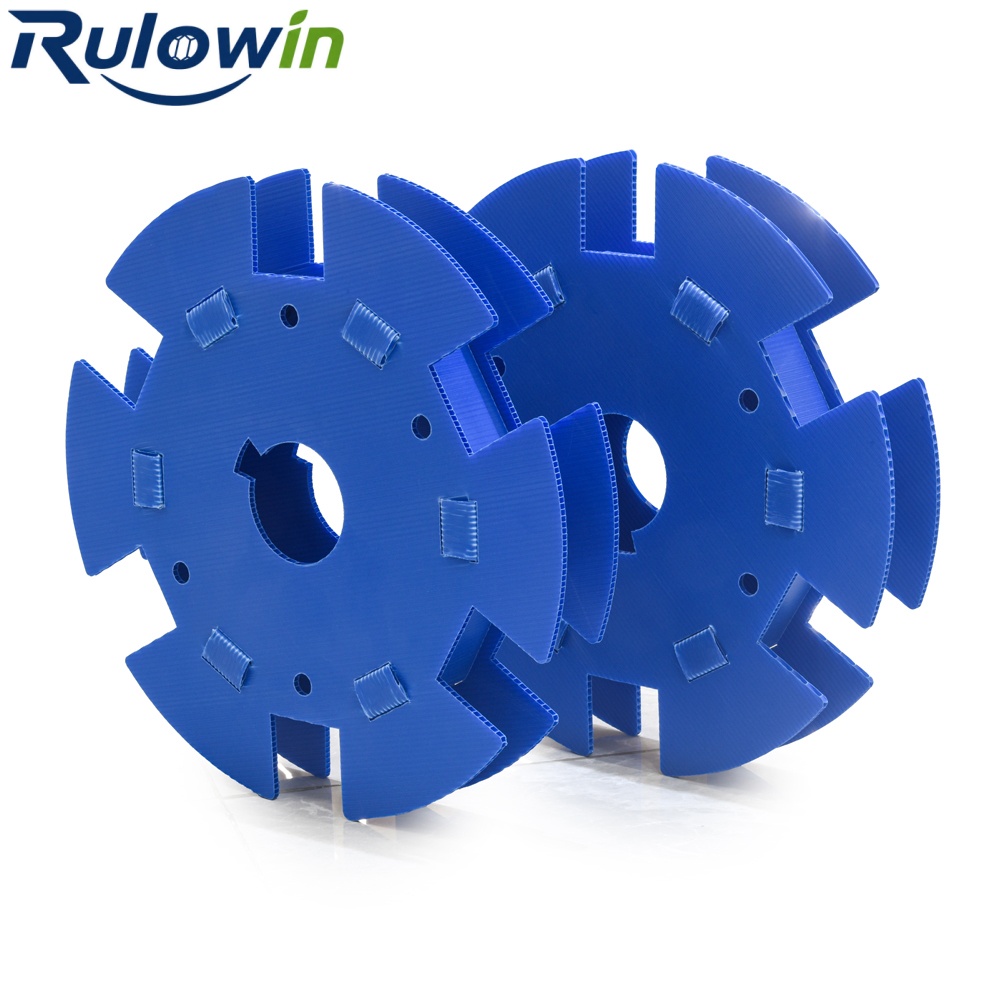
Reusable spools are assumed to be dimensionally stable because they look unchanged. They are not. Several dimensions move measurably over a service life, and knowing which ones move — and roughly when — is what lets you set inspection intervals rather than guessing.
What drifts, and in which direction
The bore gets bigger. The most consistent change and the most consequential. Every mounting cycle removes a little material, and any grit accelerates it. Described at length in our article on bore wear. It moves in one direction only: looser.
The flange takes a permanent set outward. Sustained load plus time, as covered in the deflection test article. Usually small, and it matters mainly because it opens the gap at the rim.
The core compresses very slightly under repeated winding. On a well-specified core this is negligible; on one that is marginal it accumulates.
Joints loosen on take-apart designs, through a combination of creep and wear at the interface — discussed in our take-apart article.
Overall dimensions change with temperature and humidity by small amounts, which matters only if you are measuring to tight tolerance in varying conditions.
Why it matters more than it sounds
None of these changes is individually large. The problem is that they interact with a process tuned to the original condition:
- A bore 0.3 mm larger than specified produces play, and play produces runout
- Runout at speed produces product quality problems that get attributed to the product
- A flange that has taken a set outward allows turns to migrate that previously could not
So a small dimensional drift shows up as an unexplained quality issue, which is the expensive way to discover it.
How fast
This depends so heavily on duty that we will not publish a rate. What we can say is that the useful way to find out is to measure.
Practical approach:
- Measure a sample of new spools when they arrive and record the numbers — the point made in our first-article article
- Re-measure the same identified spools after a known number of trips
- Plot it roughly. Three data points is enough to see whether the drift is fast enough to matter
Most people who do this discover either that drift is slower than feared, which justifies longer inspection intervals, or that it is faster, which is worth knowing before it becomes a quality problem. Either outcome is useful.
Setting a limit
Once you have a rough rate, set a rejection threshold on the dimension that moves fastest — usually the bore. Something like “retire when bore exceeds X” is objective, checkable, and removes judgement from a decision that is otherwise argued about.
The threshold should come from what your process tolerates rather than from a round number. If runout becomes visible above some play, that is your limit.
Inspection intervals
Do not inspect every spool every cycle unless the value justifies it. A workable arrangement:
- Every return: visual, plus a feel test on the bore — takes seconds
- Every N trips: measured check on a sample
- On any quality incident: measure the spool involved
The third one is the most useful habit. When something goes wrong, the spool is one of the few things you can still measure.
What this does to fleet planning
Drift means a fleet in steady state is always a mix of ages and conditions, and the oldest spools set the practical performance limit. This is part of the reason the fleet sizing discussion in our fleet article ends up recommending a buffer — you are not just covering quantity, you are covering the fact that a proportion of the fleet at any time is near the end of usable dimension.
What we do
We specify our hollow board spools knowing they will drift, and we will tell you honestly which dimension we expect to go first for your duty. We will also say when we think a spool is being asked to hold tolerance for longer than the construction reasonably will — better at quotation than at trip forty.