
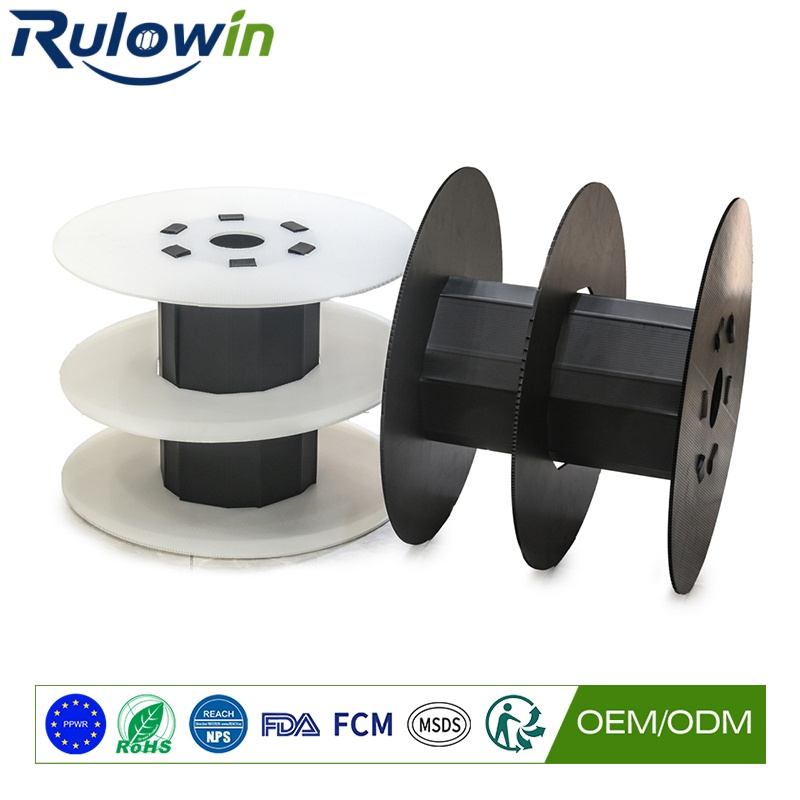
Most spool inspection regimes fail because they are designed for a quality department that never sees the spools. The person who sees them constantly is the operator, and the check needs to fit into the time they actually have.
What follows is deliberately short. A checklist that takes three minutes does not get done.
Before mounting: ten seconds
Pick the spool up and look at it once, turning it in your hands:
- Any crack reaching inward from the rim? If you can see a crack running towards the centre, it is scrap. Not “probably fine” — the flange is carrying load and the crack will grow.
- Is the rim deformed? A visible flat or a bend in the rim means it has been dropped hard.
- Anything loose? On take-apart designs, check the joint has engaged. Shake it gently.
- Anything protruding on the flange face? Burrs, lifted edges, adhesive. Anything that will mark product.
Mounting: ten seconds
- Does it go on without forcing? If you have to push hard, stop. Forcing indicates a mismatch that will get worse, and it damages the bore.
- Does it seat square? If it goes on at an angle, take it off and check why.
- Any play once secured? Wiggle it. Movement now is runout later.
Before winding: ten seconds
- Core surface clean and smooth? Run a hand over it. Anything raised will telegraph into the first layers.
- Flange faces clean? Debris here presses into product.
- Is it the right spool? Obvious and frequently wrong, which is why the colour coding discussed in our colour coding article earns its keep.
That is the whole routine
Nine items, half a minute, and it catches the large majority of what goes wrong. It is not a substitute for periodic measured inspection, which is covered in our piece on dimensional drift, but it catches sudden damage that measurement intervals miss.
What to do with a rejection
This is where routines collapse. A rejected spool with nowhere to go gets put back in the pile. Two things are needed:
- A marked reject location that is physically separate, not a corner of the same stack
- A tally. A mark on a board. The reason we keep recommending this is in our records article — a tally turns individual rejections into a pattern you can act on.
Writing it down
Put it on the wall at the point where spools are picked up, not in a folder. Three lines and nine bullets, laminated. Anything longer will not be read.
Involve whoever does the job in writing it. They know which failures actually occur, and a checklist written by somebody else usually lists the failures that are theoretically possible rather than the ones that happen.
What not to include
- Measurements requiring tools the operator does not have
- Judgements requiring experience — “assess whether flange is adequately stiff” is not checkable
- Anything about product quality, which is a different inspection
- More than about ten items in total
Reviewing it
Once or twice a year, look at the reject tally and ask whether the checklist is catching the right things. If most rejections are for one reason not on the list, add it. If an item has never rejected anything in a year, consider whether it is worth the time.
What we can help with
If you want a version specific to our hollow board spools, tell us the duty and we will tell you which failure modes are realistic for it — which is usually a shorter list than people expect, and a shorter list is a checklist that gets used.