
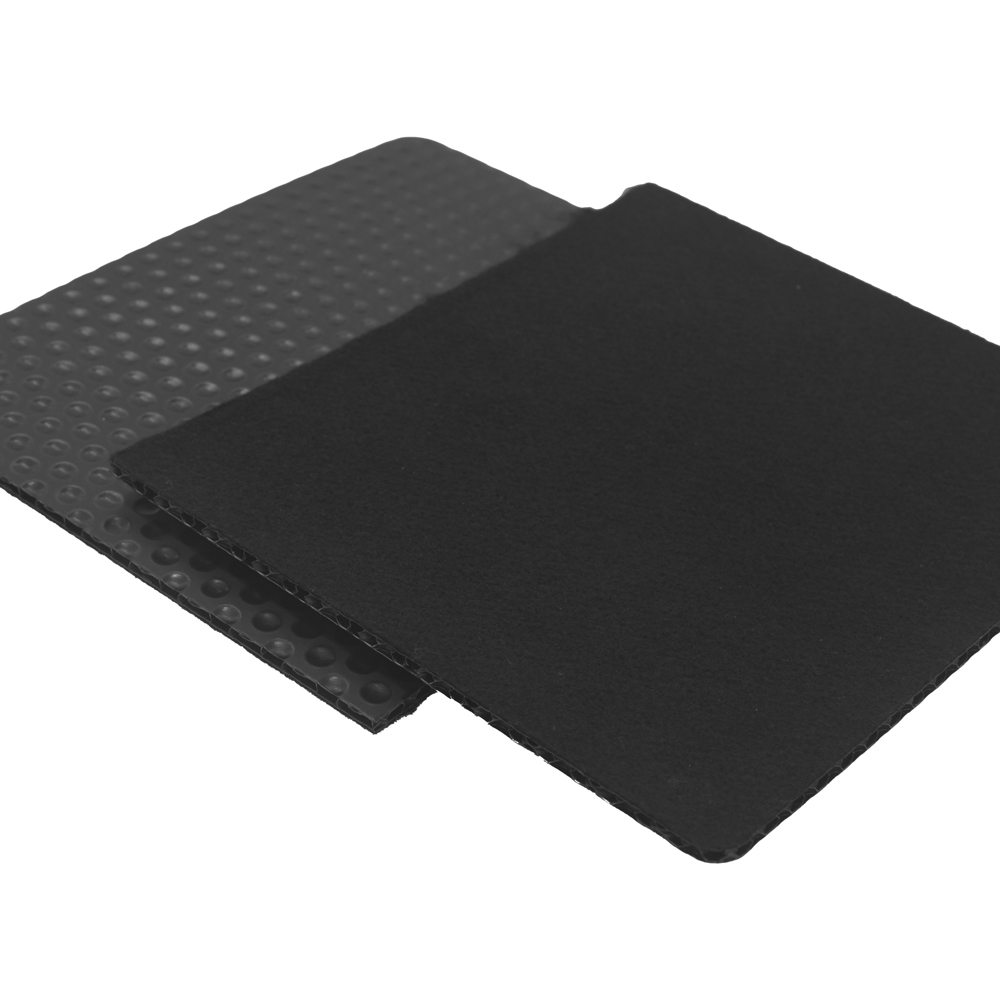
Protection laid over a floor during wet trades or in bad weather collects water, and smooth protection holds it as a film. That film is slippery, it tracks into every area people walk to, and it migrates to the joints where it gets underneath. A raised face changes all three behaviours without costing anything extra in installation.
What the pattern actually does
A field of small raised studs creates channels between them. Water sits in the channels rather than as a continuous film, contact area with a shoe is broken up, and there is always a path for water to run to the panel edge. The practical effect on a wet site is that walking surfaces stay walkable instead of becoming a skating surface after the first shower.
Grip in both directions
Ribbed patterns grip well in one direction and poorly across it, which is a real problem wherever people turn or push trolleys sideways. A studded field gives roughly equal grip in any direction. If you specify anything other than a stud field, check which way the ribs run against the main traffic direction.
The air gap underneath
Turn the embossed face down and the same pattern holds the panel slightly off the floor, creating a drainage and ventilation path. On damp substrates – a screed still losing moisture, a slab after rain – that gap is more valuable than the anti-slip benefit on top. Choosing face orientation is therefore a real decision, not a default, and we cover the general case in which face goes down on finished floors.
Cleaning a textured face
The trade-off is real: a studded face holds dirt in its channels and takes longer to wash than a smooth one. Where panels get pressure washed between phases it is not a problem; where they are wiped by hand daily, expect the extra time. Mud and grout residue needs a stiff brush rather than a mop.
Where the pattern is not enough
On a smooth panel with standing water and a slope, no embossed pattern rescues the situation. Slopes, entrance thresholds and external ramps still need the entrance matting and drainage described in slip resistance on protection panels. The face helps; it does not replace good detailing.
How much water a pattern actually moves
An embossed face is not a drainage system; it moves a film, not a flow. Where water is genuinely running across a floor – a leaking roof, a failed temporary downpipe – no panel surface will cope and the answer is to stop the water rather than to specify a better face. What the pattern does is deal with the water that arrives on boots and wheels, which is the normal case on site, and it does that well.
The pattern collects what it drains
Water moved sideways ends up at the panel edges, and whatever is dissolved in it – clay, cement, salt – is left behind when the water evaporates. Over a long wet programme the joints and edges accumulate a deposit that has to be cleaned off, and left alone it becomes a hard ridge that lifts the panel edge. Washing the joints is a smaller job than washing a whole floor, but it is not optional. Method and frequency are covered in how to clean PP honeycomb panels.
What we can do
We supply honeycomb panels with a studded face on one side, and can quote the same panel with felt on the reverse so you choose orientation per area. Tell us whether water is coming from above or below and we will size it accordingly.