
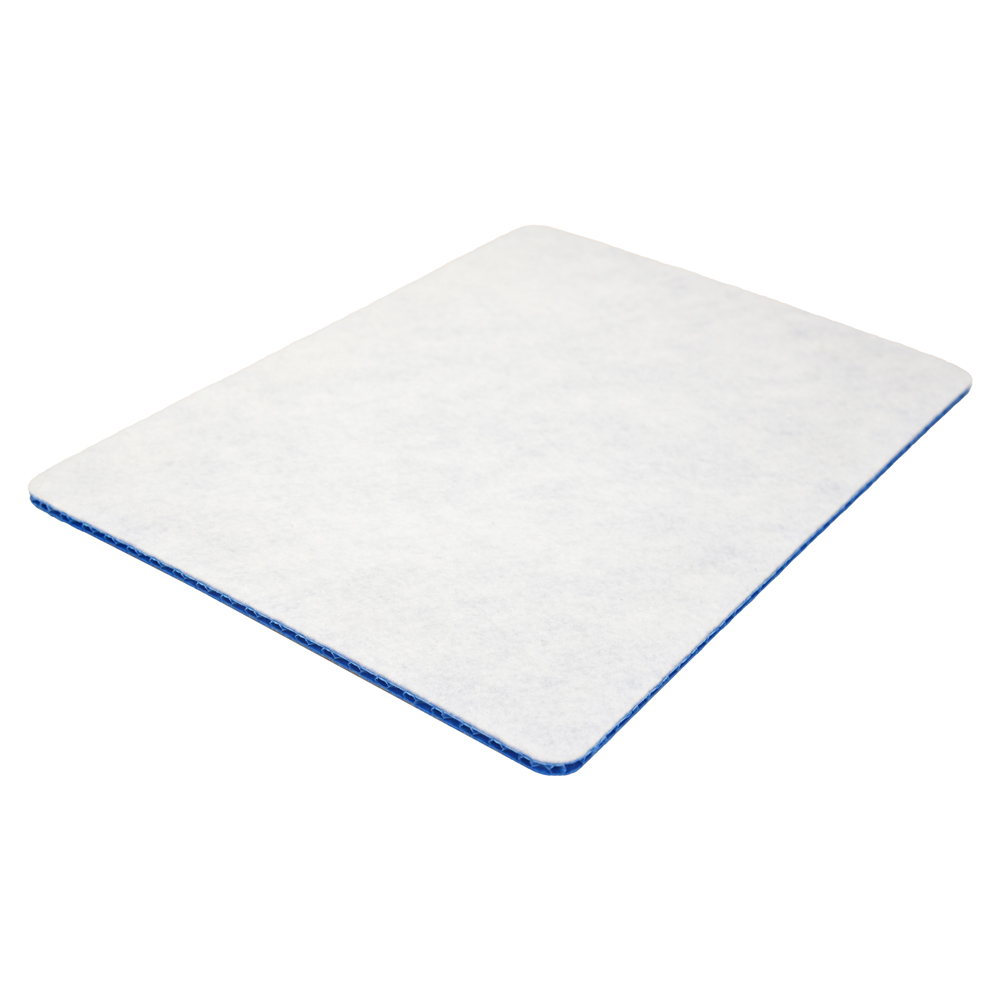
Decoration goes on late and everything still has to move past it afterwards. The marks that appear are rarely from a single impact – they are from repeated light contact: shoulders, tool belts, materials turned in a corridor, trolleys brushing past. A hard protection face stops dents and does nothing for scuffing, which is the decoration defect clients actually notice.
Why paint scuffs so easily
Most modern paints are soft by design – durable enough to wash, soft enough that they burnish under rubbing. Anything harder rubbing against them leaves a shiny mark that will not wash off. Protection that is itself hard just transfers the problem: the panel survives, the paint underneath still marks from whatever gets behind it.
What the felt face changes
Two things. It is softer than the paint film, so contact burnishes the felt rather than the decoration. And it does not rattle or squeak against the wall when the building moves or a trolley passes – a genuinely underrated point in occupied buildings, where a clicking panel gets complained about within a day.
Fixing panels without touching the decoration
The felt face only helps if the fixing does not damage what it protects. Adhesive on fresh paint pulls it. Screws into plasterboard need making good. Where the wall is decorated and staying, compression-fit between floor and soffit, or battens at the top and bottom only, keep everything off the painted surface. The corridor-specific version of this is in wall protection panels in live corridors.
Gaps and ventilation behind
Panels flat against a wall trap dust and, in humid conditions, can hold moisture against a freshly painted surface. A small standing gap at top and bottom lets air move. Where panels are compression-fitted this happens naturally; where they are battened, leave the gap deliberately.
Where the soft face is the wrong choice
In kitchens, plant rooms or anywhere with grease and heavy soiling, felt holds contamination and is harder to clean than a smooth face. In those areas a smooth face that wipes down beats a soft one that absorbs, even though it protects the decoration less well. Choose per area rather than once for the whole project.
New paint is not cured paint
Paint that feels dry is not necessarily cured, and most emulsions take a week or more to reach full hardness. Pressing anything against a fresh film – protection, tape, a panel leaned against a wall – leaves a permanent impression. Where decoration runs late in the programme, wall protection either goes up after the curing period or it stands off the surface rather than contacting it. The decorating programme is the input that decides this, and it is rarely available early enough to plan around.
Condensation behind wall panels
A panel held flat against an external wall in a drying building gets wet on its back face, and if the felt is against the decoration that moisture sits on the paint. The fix is a standoff – a batten or a spacer at intervals so air moves behind the panel – and it costs almost nothing. Where wall protection is specified on external walls in winter, this detail decides whether it helps or causes a snag list. The same mechanism is set out from the floor side in moisture trapping under floor protection.
What we can do
We supply felt-faced honeycomb panels for decorated surfaces, cut to height with sealed edges. Tell us the decoration type and whether the area is occupied, and we will suggest a fixing method that keeps everything off the paint.