
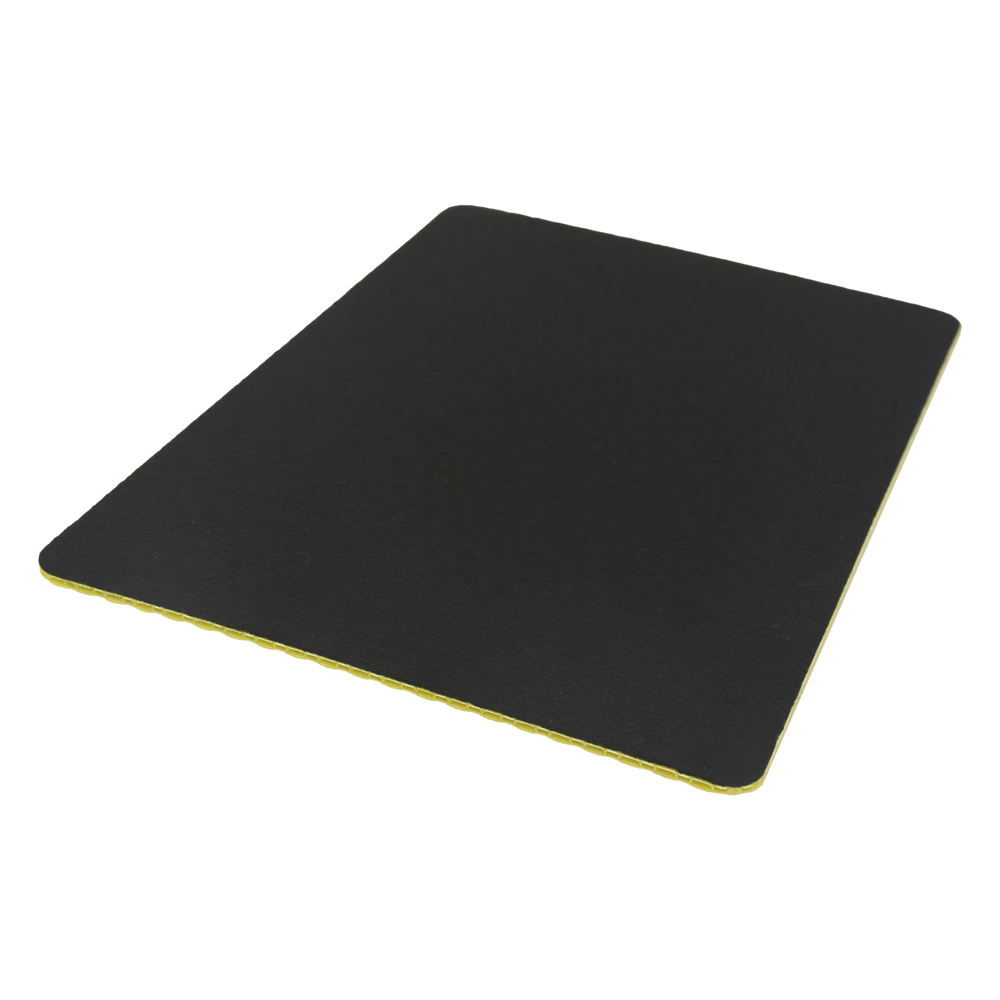
A stack of smooth panels is a sliding hazard. On a flatbed, on a pallet truck and in a site store, smooth-on-smooth has very little friction, and a forklift braking or a lorry cornering is enough to shift the whole load. Panels that slide damage their own edges, which are the parts you paid to have sealed.
Why smooth stacks move
Two smooth polypropylene faces against each other have a low coefficient of friction, and it drops further with dust or water between them. A strap tightened over a stack helps, but straps loosen with vibration, and a stack that has shifted inside its strapping is still a stack that has shifted.
What the raised face does
Turning every panel so the studded face bears on the one below puts thousands of small contact points between layers. The panels bed into each other slightly under load and resist sliding in any direction. On a moving vehicle this is the difference between a stack arriving as it left and a stack arriving as a heap with damaged corners.
Stacking for transport
Alternate orientation only where you need to: a stud-to-stud interface grips, felt-to-felt also grips reasonably because the fibres key together, and stud-to-felt grips best of all. The weakest combination is smooth face to smooth face, which is what happens by accident when panels are stacked without thinking.
Loading and strapping still matter
Friction is not a substitute for restraint. Strap stacks, block them against the vehicle sides, and keep stack heights to something an operative can work from. The grip between layers is cheap insurance against small movements, not a licence to load badly. Transport damage generally is covered in shipping and container loading of protection panels.
Store the same way
Stacks in a site store shift for the same reason. Orient panels consistently, keep stacks low and level, and do not stack on a slope – friction stops small movements, not a persistent downhill pull.
What grip between panels does for a loaded stack
A stack of panels on a truck bed is a system that has to survive braking, cornering and a bad road. If the interfaces between panels are smooth, the stack behaves like a deck of cards and the load shifts. With the raised face down against the face below, each interface has a much higher friction coefficient and the stack moves as a block. It is the cheapest load security available and it costs nothing but attention at loading time.
Why the bottom of the stack matters most
The interface carrying the most load and with the most to lose is the one against the deck or the pallet, and it is the one people forget, because face orientation only controls panel-to-panel contact. A non-slip mat or a timber pallet under the stack, and the stack strapped to it, does more for load security than any face orientation. Panel-on-panel friction stops the top half sliding; deck friction and strapping stop all of it.
When smooth-on-smooth is actually wanted
One exception: where panels are slid off a stack rather than lifted, a smooth interface makes that possible and a raised face turns it into a two-person job. On sites that lay directly off the pallet by dragging, a mixed stack – smooth face to smooth face – is easier to work with, at the cost of grip in transit. Decide which matters before loading, not after.
What we can do
We supply honeycomb protection panels faced so that friction between layers is available either way round, and we can band and label stacks for dispatch. Tell us how the material reaches site and we will suggest a stacking orientation that arrives intact.