
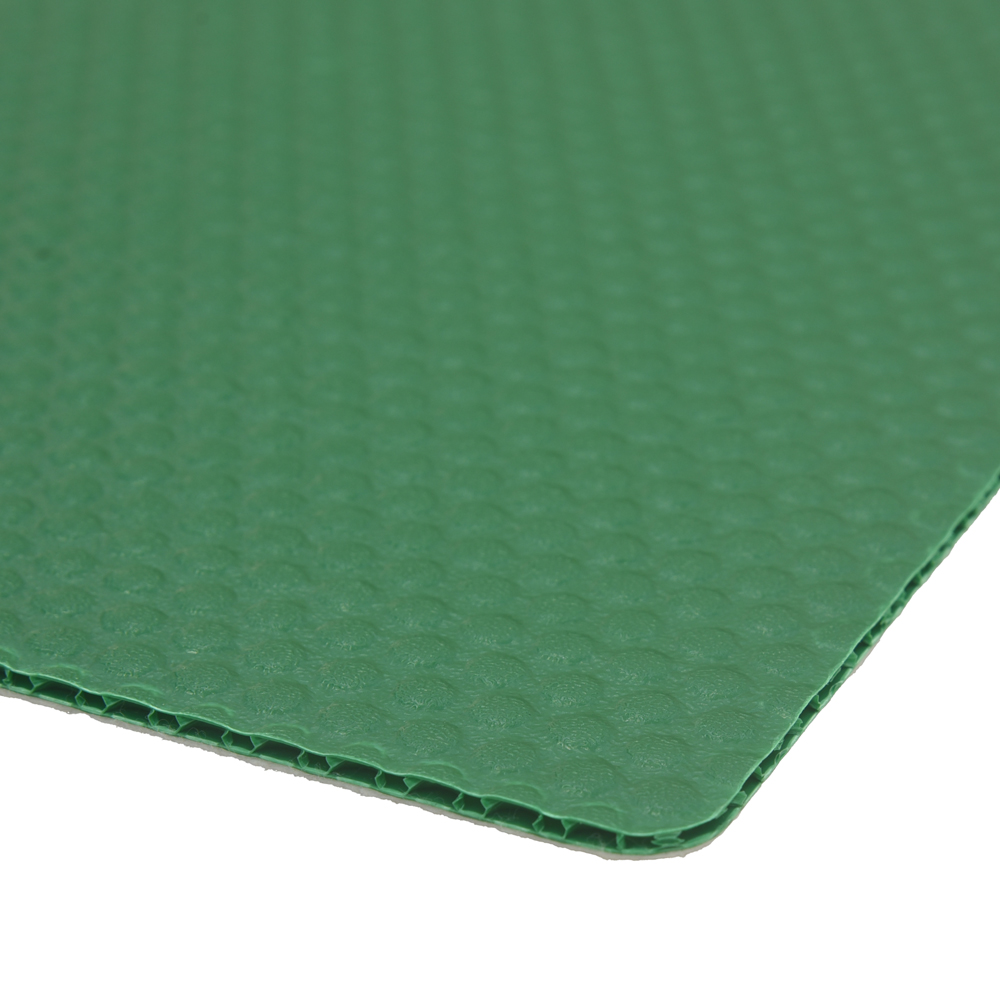
Covering a floor with a smooth panel replaces a known surface with an unknown one. Most of the time nothing happens. Occasionally it creates a hazard on a sloping route, near an entrance where water is tracked in, or on a stair – and by then there is usually an incident report rather than a specification decision.
Why the panel is not the whole story
Slip resistance is a property of the combination: panel surface, footwear, contaminants, slope and how people are moving. A panel with a perfectly reasonable dry rating can be problematic with water or dust on it. So the question is never “what is the rating” but “what is the rating, wet, in this location, with this contaminant”.
Where it actually matters
Four recurring locations: external entrances and lobbies where water is brought in, ramps and sloped routes, stairs and landings, and any area where cleaning happens while people are present. Internal flat corridors under dry conditions are low risk and rarely justify spending on rated surface treatments.
Testing options at different budgets
A full pendulum test on site gives a defensible number and costs a site visit. Suppliers may hold laboratory data for the material. For most projects, a pragmatic middle path works: install a trial area, wet it, walk it in the footwear actually used on site, and see. It is not a certificate, but it catches the situations that cause incidents, and it is free.
Embossed and textured surfaces
Surface texture improves wet grip substantially and costs a little more. The trade-off tends to be cleanability – deep textures hold dirt and are harder to wash, which matters in healthcare and food environments. Choose the smoother option where cleaning frequency is high and the textured one where wet contamination is likely.
Cleaning residue is a slip hazard
A surprising number of “slippery protection” reports trace back to cleaning: detergent film left on the surface, or polish applied to a floor and tracked onto protection. Agree what cleaning products are used and make sure the protection is rinsed rather than left with residue.
Document the decision
Whoever signs off the RAMS should record what surface was chosen and why, particularly if the area stays in use. If something does happen, a documented consideration of slip behaviour is a very different position from an undocumented one. The general principle of testing what you can yourself is set out in testing without a laboratory.
Entrances are the hardest case
The worst combination anywhere is a smooth panel, a sloping entrance and rain. Water gets tracked onto protection that was never intended to be walked on wet, and the first metre inside the door becomes the incident location. Mitigation is mostly about stopping water and grit arriving: effective entrance matting outside the protected area, and stripping that section more often.
Where a wet entrance cannot be avoided, use the most textured surface available in that section and accept the cleaning penalty locally rather than specifying a smooth surface throughout for ease of cleaning.
What we can do
We supply protection panels with smooth or embossed faces and will tell you which suits your location. Tell us whether it rains on it, gets cleaned daily, or goes on a ramp, and we will recommend accordingly – including suggesting a different product where we think ours is the wrong choice.