
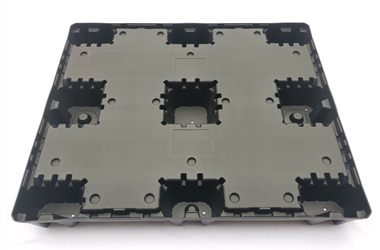
Pallet weight works exactly like box tare weight: on a weight-limited lane, every kilogram of pallet is a kilogram of product that did not ship. The figure is easy to calculate and almost never calculated, because the pallet is treated as infrastructure rather than as packaging.
The numbers
A wood pallet weighs 15 to 25 kg depending on the timber and its moisture content. A plastic pallet is 10 to 20 kg. A metal one can be 40 kg or more. On a 33-pallet trailer the difference between the lightest and heaviest option is several hundred kilograms, which is several hundred kilograms of product not shipped, every trip.
Moisture is the hidden variable
A wood pallet absorbs water, and a wet one can weigh several kilograms more than a dry one. That is a variable payload penalty that changes with the weather and the storage conditions. Where weight is the binding constraint, it is worth knowing what the pallets actually weigh rather than what they weighed when they were new.
When it does not matter
On volume-limited lanes, pallet weight is irrelevant – the trailer is full before it is heavy. In closed loops where the same pallets circulate, the weight is a fixed cost of the loop rather than a marginal freight cost. And where the part is heavy, the pallet weight disappears into the noise.
The export version
On export lanes the calculation changes, because wood pallets carry treatment requirements and plastic pallets carry a capital cost that has to be recovered across a return leg that may not exist. One-way pallets avoid the return but repeat the purchase. There is no universally right answer, only a right answer per lane.
What to specify
The pallet type, its maximum height, and its maximum weight, on the box drawing or the packing instruction. Where the box is rated against a stated pallet, a change of pallet is a change to the load case and should be treated as one.
How to decide which side you are on
Weigh a full load and compare it with the vehicle’s payload limit. If the load is near the limit with space left over, weight governs and pallet mass matters. If the load fills the vehicle first, cube governs and pallet height matters more than pallet mass.
Most high-cube lanes turn out to be volume-limited, which is worth checking before spending money on a lighter pallet. The two are often confused, and the confusion sends the optimisation effort to the wrong place.
Where the weight is
Mostly in the base, because it is the thickest panel, and then in any reinforcement: corner posts, feet, edge protection. Wall thickness is usually the small contributor, which is why chasing thinner walls tends to disappoint. Where weight matters, ask which panel can be re-specified and what that does to the stack rating.
What it means for the box
Where weight governs, a lighter box is worth real money on every trip. Where cube governs, it is worth almost nothing, and the specification should chase volume instead. Knowing which applies is a two-minute calculation and it decides what the optimisation programme should be trying to achieve.
What we can do
We build PP corrugated turnover boxes and will state the pallet assumptions behind every base rating we quote. Tell us your pallet and we will confirm the rating applies. The wider comparison is set out in choosing a pallet material. See also the companion piece, which is the other half of the same sum.