
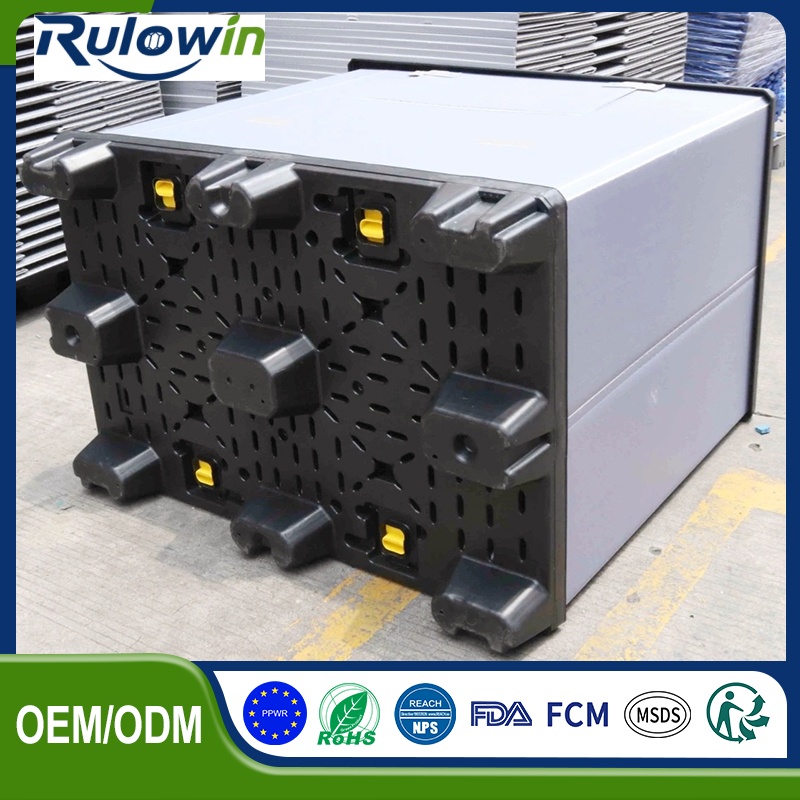
The pallet under a reusable box is usually treated as a given – whatever the site uses. It is worth choosing deliberately, because the pallet determines the support the box base receives, and that is one of the two things the base has to be designed around.
What the box base needs from the pallet
Two things: even support across the footprint, and no gaps wide enough for the base to bridge under load. Everything else – the pallet’s own durability, its cost, its compliance status – matters to the operation but not to the box.
Wood
Cheap, available everywhere, repairable and familiar. Against it: variable dimensions, deck boards that split or go missing, and treatment requirements on export lanes. The variability is the real problem for a box, because a pattern designed for a good pallet does not fit a repaired one.
Plastic
Consistent dimensions, which matters more than anything else on this list. Hygienic and washable, longer-lived than wood, and exempt from wood-packaging treatment rules. Against it: higher capital cost, and a slippery surface that reduces inter-layer friction unless the box or a pad compensates.
Metal
Very stiff and strong, dimensionally stable, and used where loads are heavy or hot. Against it: weight, cost, and a hard surface that concentrates contact pressure on the box base. Usually only justified where the part or the process demands it.
Closed pools versus open yards
A pallet pool with an inspection and repair regime delivers consistency close to plastic at a lower cost. An open yard of mixed pallets delivers the worst of both. The question to ask is not what the pallet is made of but whether its dimensions can be relied on.
What to check
Deck board width and gap, overall height, and whether the pallets arriving on the lane are consistent. Three measurements that say more about how the box will behave than the pallet material does.
What the box base is asking for
Even support across the footprint and no gap wide enough to matter. A plastic pallet with a solid deck gives both, consistently, for years. A wood pallet gives both when it is new and progressively less as boards split and go missing. A metal pallet gives both, at a weight penalty that is usually not worth carrying.
Where the lane uses an open pool of mixed pallets, the practical answer is to line the deck. A sheet on the pallet costs very little and removes most of the variability, which is the actual problem rather than the pallet material.
Choosing per lane rather than per site
A closed loop with controlled pallets can run a box designed for even support. An open route with unknown pallets needs a base that tolerates gaps. Specifying one box for both cases means over-specifying for the closed loop or under-specifying for the open one – which is why the lane, not the site, is the right unit of decision.
What to write into the specification
The pallet type the box was rated against, and the surface condition that rating assumes. Where a fleet runs on mixed pallets, say so and specify the base for the worst case. A rating quoted without its supporting conditions is a number, not a specification.
What we can do
We build PP corrugated turnover boxes and will state the deck assumptions behind the base rating, so the pallet choice and the box specification can be made together. Tell us what your lane uses. The height side of the choice is in what pallet height costs in cube.