
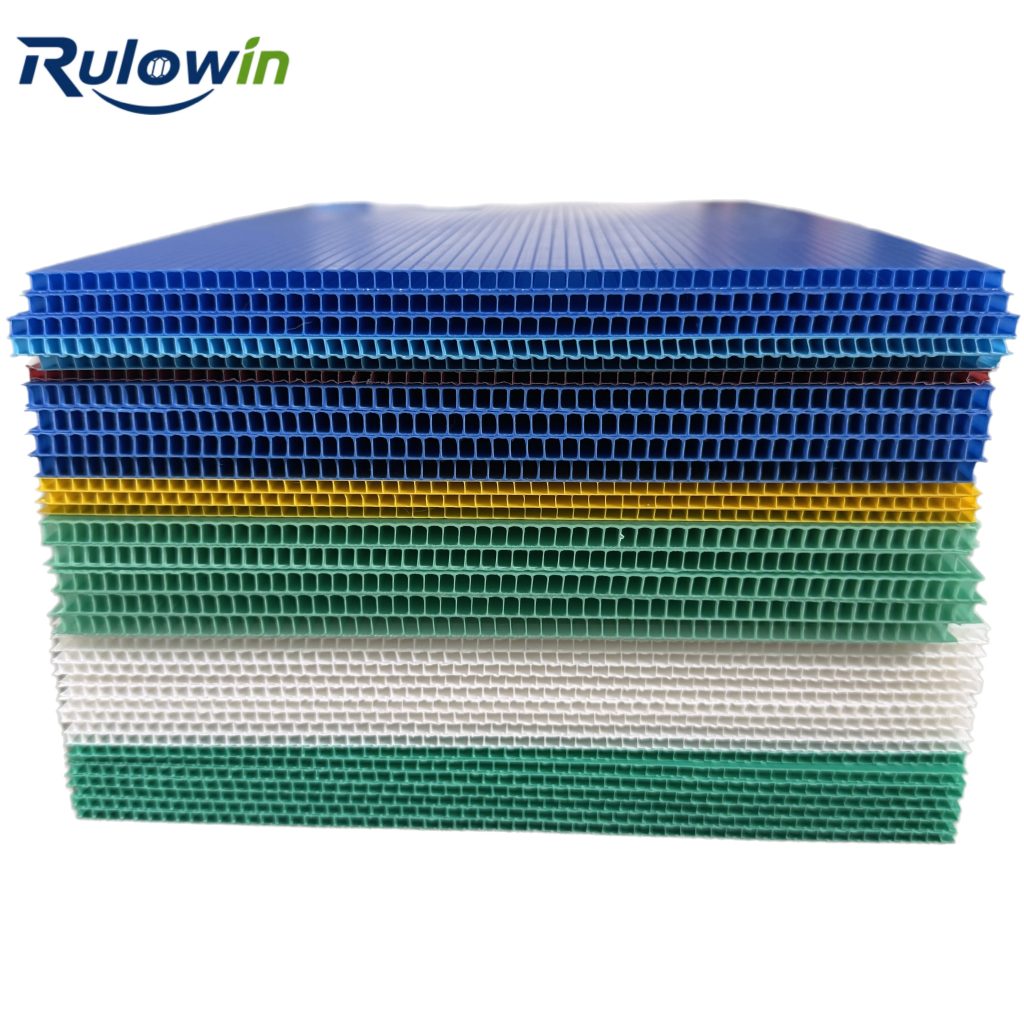
Temporary signage on construction sites, events and temporary works gets made from all sorts of things, and corrugated PP sheet is one of the better choices. It is light, it takes a knock, it does not absorb water, and it is cheap enough to treat as disposable. What it is not is permanent.
Why it works
Weather resistance, mainly. Paper-based signage fails at the first serious rain; PP sheet does not care. It also survives being knocked and bent, which matters on a site, and it can be cut to shape on site with a knife.
And it is light enough to cable-tie to a fence without any structure behind it, which is how most site signage gets fixed.
How long it lasts
A season outdoors is realistic for a UV-stabilised grade and noticeably less for one that is not. The failure is fading and then surface chalking, followed by brittleness at the edges. For genuinely temporary signage that is fine – the sign is usually obsolete before the sheet is.
For anything that has to be legible for more than a year, use a rigid plate or a properly printed panel. PP sheet is a temporary material and treating it as permanent wastes it.
Printing and marking
Print it, if the run justifies it, on a treated surface. Stencil or paint-marker it if it does not – the methods are covered in stencil-marking corrugated PP sheet on site.
A printed label also works and is the cheapest option for a handful of signs, provided the surface is clean and the label is a low-energy-surface type.
Fixing it
Cable ties through holes, or screws with washers. A screw through PP sheet without a washer pulls through fairly quickly, particularly in wind, where the sheet flexes at the fixing.
Space the fixings. A sheet fixed at four corners flaps in the middle and eventually tears at a corner. Six fixings on a large sign is not excessive.
Wind
The real enemy. A large flat sheet is a sail, and a sheet that flaps tears at its fixings within days. Reduce the area, add fixings, or in exposed locations use mesh or a perforated alternative that lets air through.
What it is bad at
Fire-rated applications – standard PP is combustible and there are places that will not accept it. And anything requiring a rigid, flat, printed surface in a formal setting, where it looks like what it is.
Temporary floor and surface protection is a related use and covered in sheet for temporary floor protection.
Size and thickness
A larger sign needs a thicker sheet, because wind loading increases with area and a thin sheet flexes until it tears at a fixing. For anything above about half a square metre, go up a thickness – the sheet is cheap and the failure is not.
And the fixings increase with size. Four fixings on a small sign, six or more on a large one, all with washers.
Afterwards
Sheet signage is recyclable and it is worth putting in a separate stream rather than general waste. It is clean single-material PP, which is what recyclers want.
What we can do
We supply PP corrugated sheet in UV-stabilised grades suitable for outdoor signage. Tell us how long the sign needs to last and where it is going – if a year is the answer, we will tell you sheet is the wrong material.