
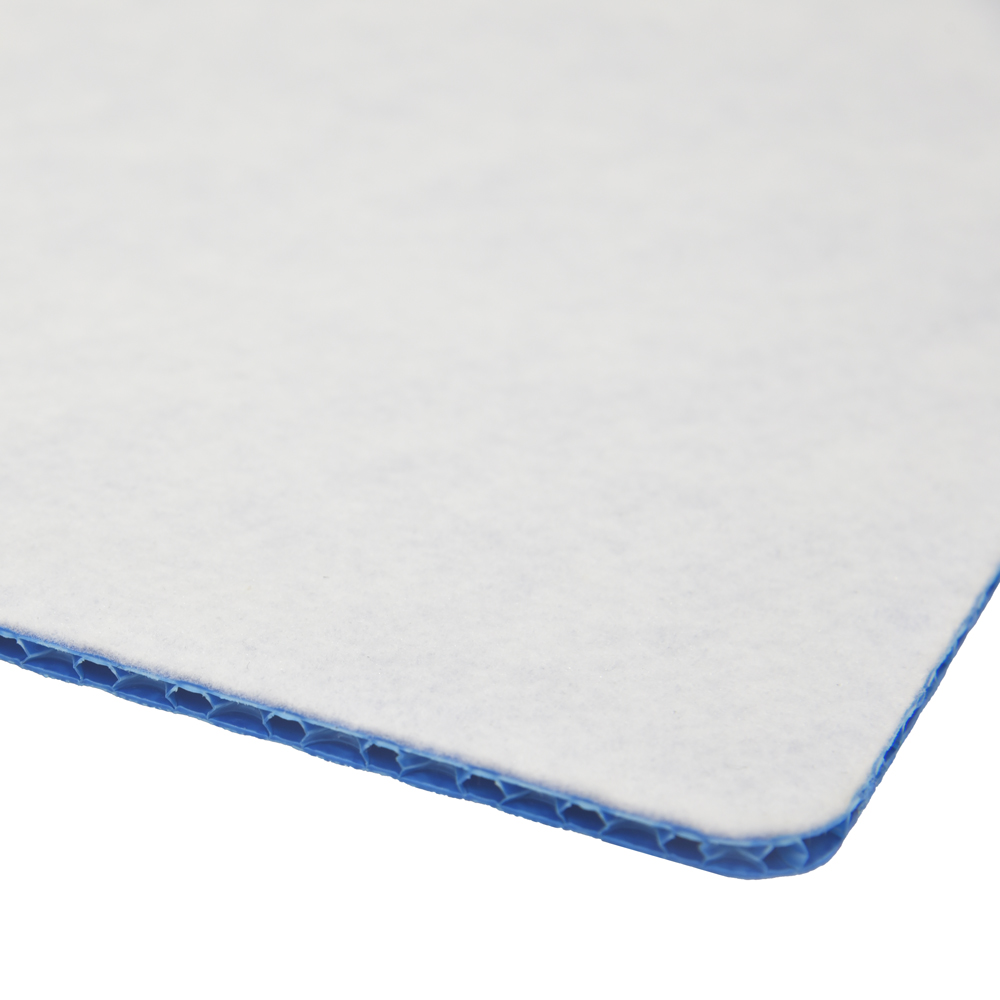
Honeycomb panel is stiff, light and good at carrying distributed load. It is comparatively poor at carrying a load concentrated on a small area, and this is the single most common reason a panel application disappoints. Worth understanding before specifying rather than after.
Why point loads are the problem
The panel works by having two faces held apart by a cell structure. Under a distributed load, the whole structure shares the work. Under a point load, a small number of cells take everything, they crush, and the faces above them lose support.
Once the cells have crushed, the deformation is permanent. This is the mechanism behind most of the damage described in do honeycomb panels bow in hot shipping containers – heat softens it, but the point load is what does the damage.
What counts as a point load
A machine foot. A coil or a roll lying on its side. A carton with a small base resting on a corner. A bolt head under a panel. Anything where the contact area is small relative to the panel area and the load is significant.
Rough guide: if the contact area is smaller than a few square centimetres per significant kilogram, treat it as a point load.
The fix: spread it
A spreader plate, a larger footprint under the item, or an additional layer pad on top of the panel. All three work and all are cheaper than going up a panel grade.
A piece of the same panel, or an offcut, is the cheapest spreader available and it is what most operations should use. Spreading a load is almost always the right first move.
The fix: more density
If a load genuinely cannot be spread, the answer is a denser panel rather than a thicker one. Cell wall thickness is what resists local crushing, and that is density, not overall thickness.
What that means on a specification is covered in what honeycomb panel density tolerance means.
What thickness does and does not do
Thickness helps with span and with bending. It does much less for local crushing than people expect, because the crushing happens at the top face regardless of how thick the panel is below it. Going thicker for a point load problem is the common expensive mistake.
How to test
Put the panel on a flat surface, place the load on it, and leave it overnight. Then lift the load and look for an indentation. An indentation that does not recover means the cells have crushed and the specification is wrong for that load.
When to accept it
Sometimes local deformation is fine. A layer pad under a machine that will never move is not required to stay flat afterwards – it just has to have carried the load once. Being clear about whether the panel needs to recover changes what you specify.
A rule of thumb
If you can press the loaded contact point into the panel face with a thumb and see an indentation, the load is too concentrated for that panel. It is crude and it works, and it is a better guide than any calculation at the specification stage.
Then spread it and test again. Most point-load problems are solved by a piece of offcut rather than by a specification change.
What we can do
We supply PP honeycomb panels and will tell you honestly whether your load is a point load problem and what it needs. Describe what is sitting on the panel and over what area – we would rather suggest a spreader than sell you a denser panel.