
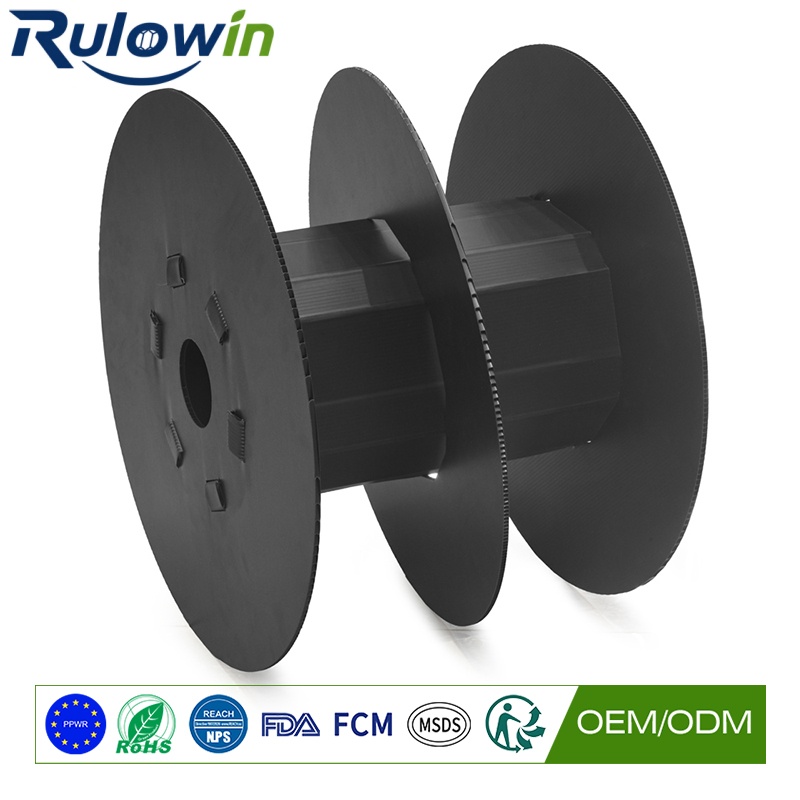
The core — hub, barrel, whatever you call it — is what the product is actually wound onto. It takes the entire inward compression of the pack, it sets the minimum bend the product sees, and it is the reference everything else is concentric to. It gets far less discussion than the flanges, which is odd given that a failed core is a dead spool.
Wound tube
A strip of PP wound spirally and bonded. It is the common construction for hollow board core, and it is economical at a range of diameters.
Where it works: moderate loads, most general spooling. It is light, cheap, and available in a wide range of diameters without tooling.
What to watch: the seam is a continuous spiral, and under sustained heavy compression a poorly bonded seam is the first thing to give. There is also more dimensional variation than the other two methods, which matters if your process is sensitive to concentricity — and it will show up as runout, the thing discussed throughout our article on balancing for high-speed payoff.
Extruded tube
Continuous extrusion cut to length. More consistent wall thickness, no seam in the compressive direction, better roundness.
Where it works: anything where consistency matters more than cost — driven applications, higher speeds, processes where core crush would be expensive.
What to watch: diameter and wall are limited by extrusion capability, so unusual sizes may not be available without a minimum quantity. Cost is higher than wound tube, sometimes substantially at large diameters.
Moulded core
Injection moulded, usually with features integrated — bearing surfaces, drive features, even partial flange geometry.
Where it works: high volume with a settled design, where you want features that cannot be produced any other way. Moulded cores give the best dimensional consistency by some distance.
What to watch: tooling cost. This is the consideration covered in our piece on tooling, MOQ and lead time — below a certain annual volume the tooling will not amortise, and a wound or extruded core will serve you better.
Specifying core rather than copying it
The useful questions:
- What compression will it see? Driven by tension and number of layers, not by the total weight on the spool. High tension on a small core crushes more than low tension on a large one.
- Is the core outside diameter set by the product’s minimum bend radius? Usually yes, and that figure belongs to the product manufacturer rather than to us. Our article on minimum bend radius covers why this drives the whole design.
- Does the spool get reused, and how many times? A core that is adequate for five trips may not be adequate for fifty.
- Is it driven or braked through the core? Changes everything about what the surface has to tolerate.
The failure we see most
Core crush on reuse. A spool is specified for the first trip, the core survives it comfortably, and then the cumulative compression of subsequent winds — plus storage between them, plus whatever it got subjected to in transit — takes it slowly past where it was happy. Then the flanges lose their inner support and start doing work they were not designed for.
If a spool is going to be reused many times, specify the core for the end of its life, not the beginning.
What we build
Our hollow board spools most commonly use wound or extruded core depending on diameter and duty, and we will tell you which applies to the size you are asking about. If your application genuinely needs a moulded core, we will say so rather than stretching a wound one into a job it will not do — though that is a conversation worth having early, because it changes lead time.