
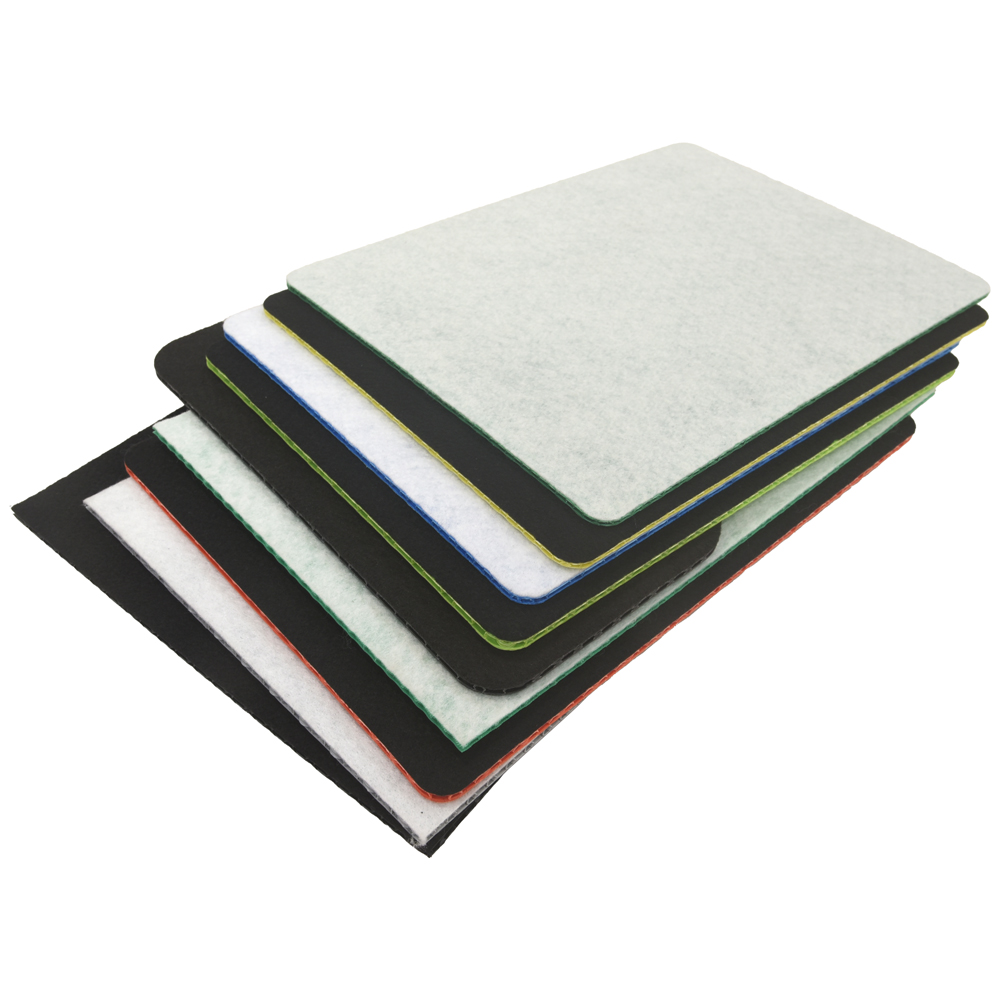
Protection laid the wrong way up still protects against impacts. What it stops doing is protecting against abrasion – and abrasion is what ruins finished floors. A hard embossed face laid directly on a polished surface, with site grit working between the two, is a lapping machine.
What the hard face does to a finish
Two mechanisms. First, the raised pattern concentrates contact into its stud tips, so the load that would have been spread over the whole panel arrives at thousands of small high-pressure points. Second, grit that works its way between panel and floor is harder than most finishes and gets ground in by every footfall. Neither is dramatic on day one; both are obvious at handover.
What the soft face does instead
The felt face conforms slightly, so contact is spread rather than pointed. More importantly it traps grit in its own structure: particles that would have been dragged across the finish get held in the fibres until somebody lifts the panel and cleans it. That single property is why felt-faced protection is specified on polished concrete, terrazzo and lacquered timber in the first place.
Reading which face is which
Visually obvious up close, less so from standing height in poor light, which is why mistakes happen. Felt is matte and slightly fuzzy; the embossed face has a regular pattern and catches the light. Where panels will be laid by rotating teams, ask for the two faces in different colours – a grey felt and a darker embossed face is readable at a glance from across a room.
When the raised face goes down deliberately
There is one common exception: over a damp or curing surface where airflow underneath matters more than surface protection. The studded face down creates a drainage and ventilation gap so moisture is not held against the floor. That trade is real, and it is the right call on green screeds even though it sacrifices some abrasion protection. The moisture question is covered in moisture trapping under floor protection.
Checking after installation
Lift one panel per room after the first week and look at the finish. If there are scuff tracks, someone laid the wrong face, and re-laying now costs far less than repairing later. It is a two-minute check on a walk-round that should be happening anyway.
What to do when the panel has no obvious face
Some protection board has two faces that look alike: lightly textured both sides, or a felt face that has been compressed flat in storage. The test that works is a fingernail drag – a fibrous face resists slightly and sounds dull, an embossed or film face is smooth and sounds harder. Where panels genuinely have no distinguishable face, treat them as hard on both sides and put a separate soft layer underneath rather than guessing.
Underfloor heating changes the answer
On a floor with underfloor heating commissioned and running, raised face down is usually wrong even though the drainage argument applies, because the air gap it creates insulates the floor and heating performance drops noticeably. Felt face down, and accept slightly slower drying of any residual screed moisture. Where heating is not yet commissioned the drainage argument wins and the position reverses – so the commissioning sequence matters more than the floor type.
What we can do
We supply felt-faced honeycomb panels and can make the two faces visually distinct so orientation errors are obvious on site. Tell us the finish being protected and whether the surface is dry, and we will confirm which way round the panel should go.