
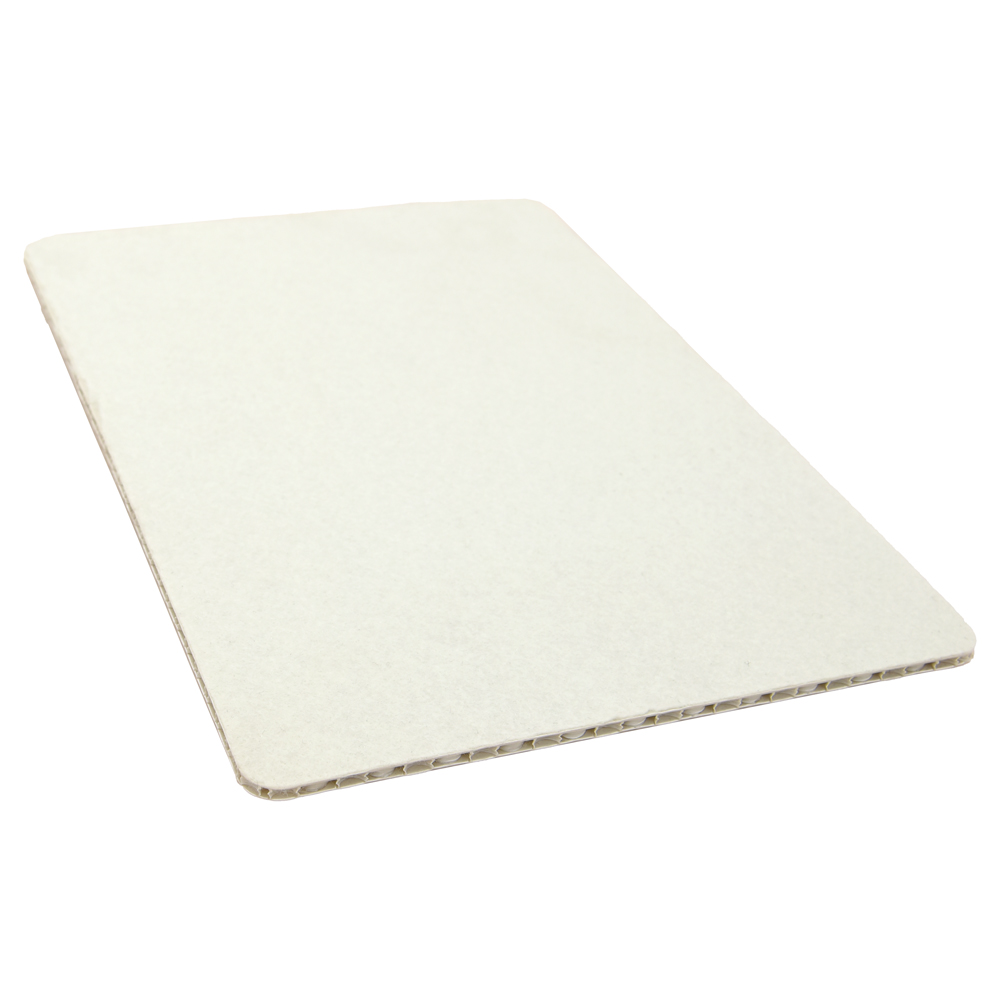
Temporary protection has to do two contradictory things at once. Against the surface it is protecting it must be soft, so it does not scuff, scratch or print. Under the people and trolleys walking on it, it must be grippy, because a smooth hard panel with dust or water on it is a genuine hazard. A single-face product forces a compromise; a two-face panel does not.
What the soft face is for
The felt or fleece face is a needled non-woven bonded to one side of the panel. It has no hard edges to catch a finish, it compresses slightly so it spreads contact rather than concentrating it, and it holds grit particles inside its structure instead of dragging them across the floor. Put it down against polished concrete, lacquered timber, coated metal or glass and it does not mark them.
What the raised face is for
The other face carries an embossed pattern – usually a regular field of small raised studs or ribs. Underfoot it gives grip in both directions, including when wet. It also creates a standing air gap, so anything resting on the panel is not sitting in a film of water, and water that gets on top migrates across the face to the edges rather than pooling.
Why the core matters as much as the faces
A honeycomb core between the two faces is what lets a light panel behave like a stiff one. Load applied to the raised face is spread through the core before it reaches the soft face, so the pressure that actually arrives at the floor is spread over a much larger area. That is the mechanism: the faces handle contact, the core handles load.
Where the two-face construction is wasted
Two cases. On a rough concrete slab in a plant room, nobody needs a soft face and a plain panel is cheaper. On a surface that is permanently covered and never walked on, the anti-slip face does nothing. We say both at enquiry – it is not a difficult calculation, and buying two faces where one would do is wasted money.
Getting the faces the right way round
It sounds obvious and it happens wrong surprisingly often, usually because panels were stacked face-down and laid without looking. Felt down against the finish, studs up under the traffic. Where a run is laid by several people over a week, a note on the stack and a colour difference between the faces removes the error – more on face orientation in which face goes down on finished floors.
Does the soft face wear out
It abrades slowly, and once the felt has worn through in the traffic lanes the panel is effectively single-faced. On a long programme that is typically the second or third phase rather than the first, and worn panels are still serviceable on rougher surfaces – which is the argument for grading them rather than scrapping them, as described in when to write off a protection panel.
What the second face costs
A felt face adds material and a bonding step, so a two-face panel costs more than a plain one – typically somewhere between a fifth and a third more per square metre, varying with face weight. Against that, a plain panel in a traffic area often needs a separate anti-slip treatment or a mat laid on top, which costs more than the difference and gets replaced more often. Where neither face is needed – a plant room, a surface that will be covered – the plain panel is the right buy, and we will say so rather than upsell.
What we can do
We make PP honeycomb panels with a felt face one side and an embossed face the other, cut to size with sealed edges. Tell us what the panel protects and what walks on it, and we will tell you whether you need both faces or whether one will do.