
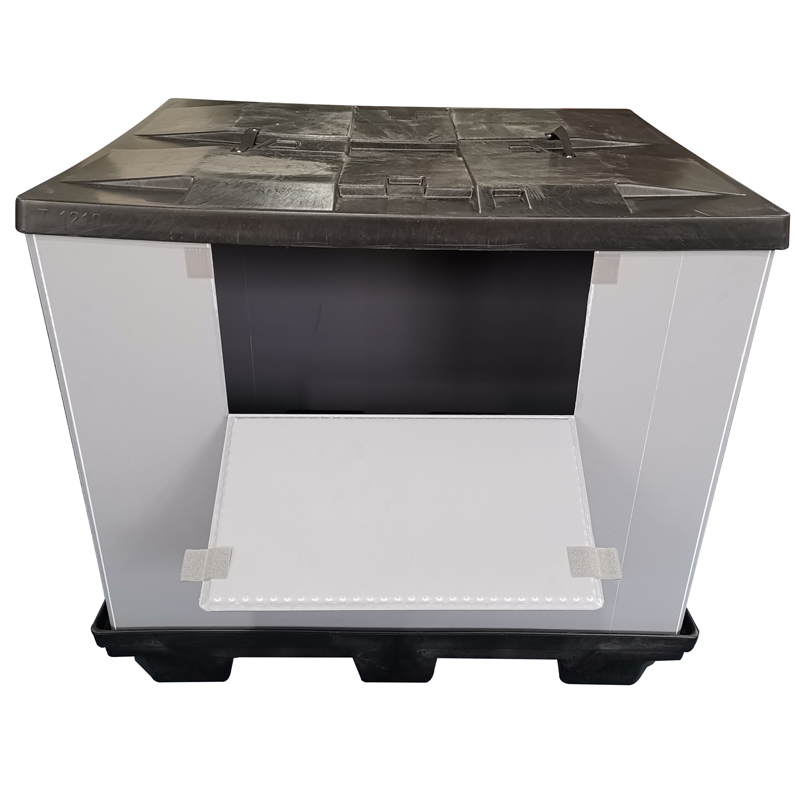
A sleeve box that has gone out of square is frustrating because it still holds together but will not assemble cleanly. The instinct is to blame the wall construction. In most cases the wall is fine and the panel has crept while stored.
Creep is the mechanism
Polypropylene deforms slowly and permanently under sustained load, and the rate increases with temperature. A stack of collapsed sleeves stored flat under the weight of the stack above, in a warm shed, is an ideal creep condition. Nothing was overloaded at any moment; the deformation accumulated quietly over months.
This is why the problem appears suddenly across a whole batch, rather than progressively on the units in heaviest service.
Storage position matters more than wall thickness
Storing collapsed sleeves on edge, or standing them, removes the sustained compressive load through the panel faces. It takes more floor area and it is the single biggest improvement available for this failure. Where space does not allow it, limit stack height and rotate stock – first in, first out genuinely matters here.
Increasing wall thickness delays the problem without removing it, because the mechanism is unchanged.
Heat amplifies everything
A stack against an external wall in summer, or near a roof that radiates, is far hotter than the ambient figure suggests. Local hot spots produce local deformation. Measuring the temperature where stock actually sits, rather than in the aisle, often explains why one bay is worse than the rest.
Loaded and collapsed are different cases
A loaded sleeve is supported by its contents and by the pallet, and it is in that state for days rather than months. Collapsed storage is unsupported and lasts far longer. The duty that damages them is very often the quiet one.
Corner geometry and assembly
Once panels have bowed, corners are what bind. Sleeves with generous corner tolerances assemble more forgivingly, and folded corners that have taken a set can sometimes be worked back – though re-setting a crept panel usually only works once, and never fully. Guidance on what to accept sits in why sleeve edges fray.
When to scrap
A sleeve that will not sit square cannot be strapped safely, because strapping a distorted box produces uneven tension and unpredictable load transfer. If it needs coaxing to assemble, it is finished. The alternative – forcing it – is how product ends up on the floor.
Shelf life is a specification
Collapsed stock has a shelf life in the same sense that anything else does, and it is worth stating as one: maximum stack height, maximum storage duration, and a temperature limit. Written down, those three become a procedure rather than a habit, and habits are what change quietly when space gets tight.
Rotate stock on the same basis. A first-in-first-out rule applied to collapsed sleeves is cheap insurance, and it is the difference between stock that has sat in one position for two years and stock that has been moved regularly – the second one still assembles squarely.
What we can do
We supply pallet sleeve boxes and advise honestly on storage, because storage is what usually determines whether they last three years or ten. Tell us how and where you keep collapsed stock and we will tell you whether the shelf life will be a problem before you buy.