
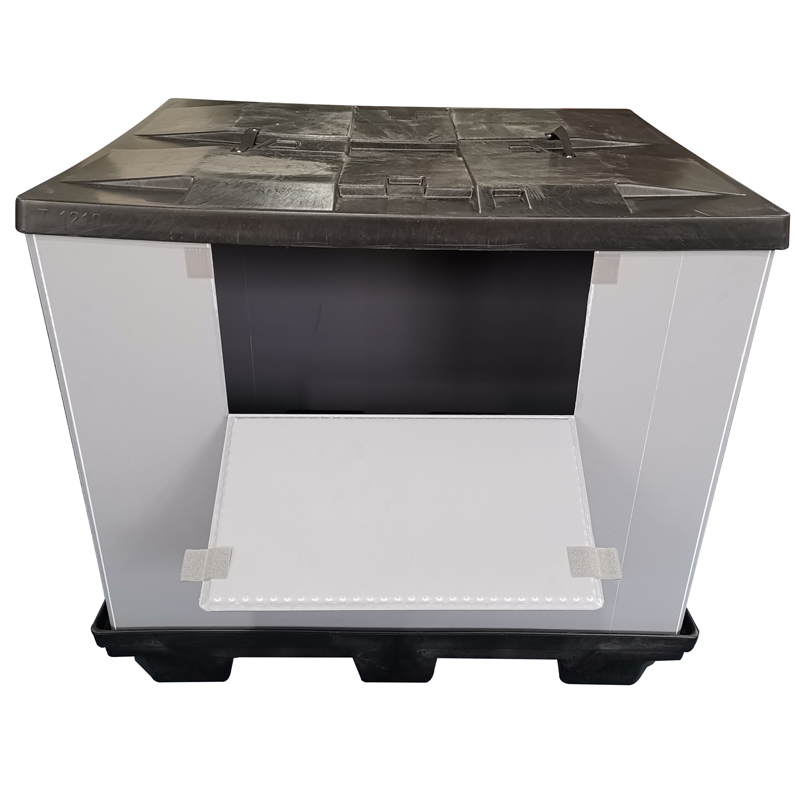
A pallet sleeve box folds flat along four hinges, and those hinges are where the box wears out first. Not because the material there is weaker – it is usually the same sheet – but because the hinge is the only part of the box that moves while under load, and movement is what wears plastic.
What the hinge actually is
In most designs it is a crease formed in the panel, sometimes with a reduced section, sometimes just a pressed line. It flexes every time the box is assembled or collapsed, and it flexes again every time a loaded box shifts slightly in transit.
So the cycle count is high. A box making fifty trips has been folded a hundred times, and each fold works the same line.
Cause one: abrasion against the pallet
The bottom edge of the sleeve sits on the pallet base and rubs against it every time the box is nudged. If the base has a rough surface or a lip, the sleeve edge wears against it and the hinge line, being the thinnest part, goes first.
This is the most common cause and it is largely avoidable: check that the base seating surface is smooth and that the sleeve is seated properly rather than resting on an edge. Assembly detail is in how to assemble a pallet sleeve box.
Cause two: folding under load
Collapsing a box that still has something in it, or that is being pushed sideways while someone folds it, puts load into the hinge at the worst possible moment. The hinge is designed to fold empty. Folding loaded boxes is the fastest way to destroy them and it is done more often than anyone admits.
Same with dragging a loaded box to reposition it rather than lifting it.
Cause three: the geometry
Some wear is design rather than handling. A hinge line that sits exactly where the strap passes will fray, because the strap rubs on every trip. Moving the strap placement, or protecting that point, fixes it permanently rather than slowing it down.
If you see fraying concentrated at one specific spot on every box in the fleet, it is almost always this – something is rubbing at a fixed point.
What normal wear looks like
A hinge that has gone white along the crease is working; that is stress whitening and it is cosmetic. A hinge that has gone soft and started to separate is at the end of its life. The difference is whether the panel still holds together when you pull gently on either side of the line.
Expected service life and what ends it is covered in how many times you can reuse a pallet sleeve box.
What actually extends hinge life
Train people to collapse boxes empty and flat, and give them somewhere to put empties that does not involve dragging. Then check the base surface. Those two actions do more than any specification change, and both are free.
A fleet-level habit that helps
Rotate the fleet. Boxes that always travel the same lane wear in the same places, and rotating them spreads the wear across the whole fleet rather than retiring a subset early. It costs nothing if boxes are already being pooled.
And inspect on a schedule tied to trips rather than to time – a box doing fifty trips a year and one doing five need looking at on completely different schedules.
What we can do
We supply pallet sleeve boxes for warehouse distribution and will tell you what hinge construction suits your cycle count. Describe how your boxes get collapsed and moved – we will tell you whether the wear you are seeing is normal, and when it is not.