
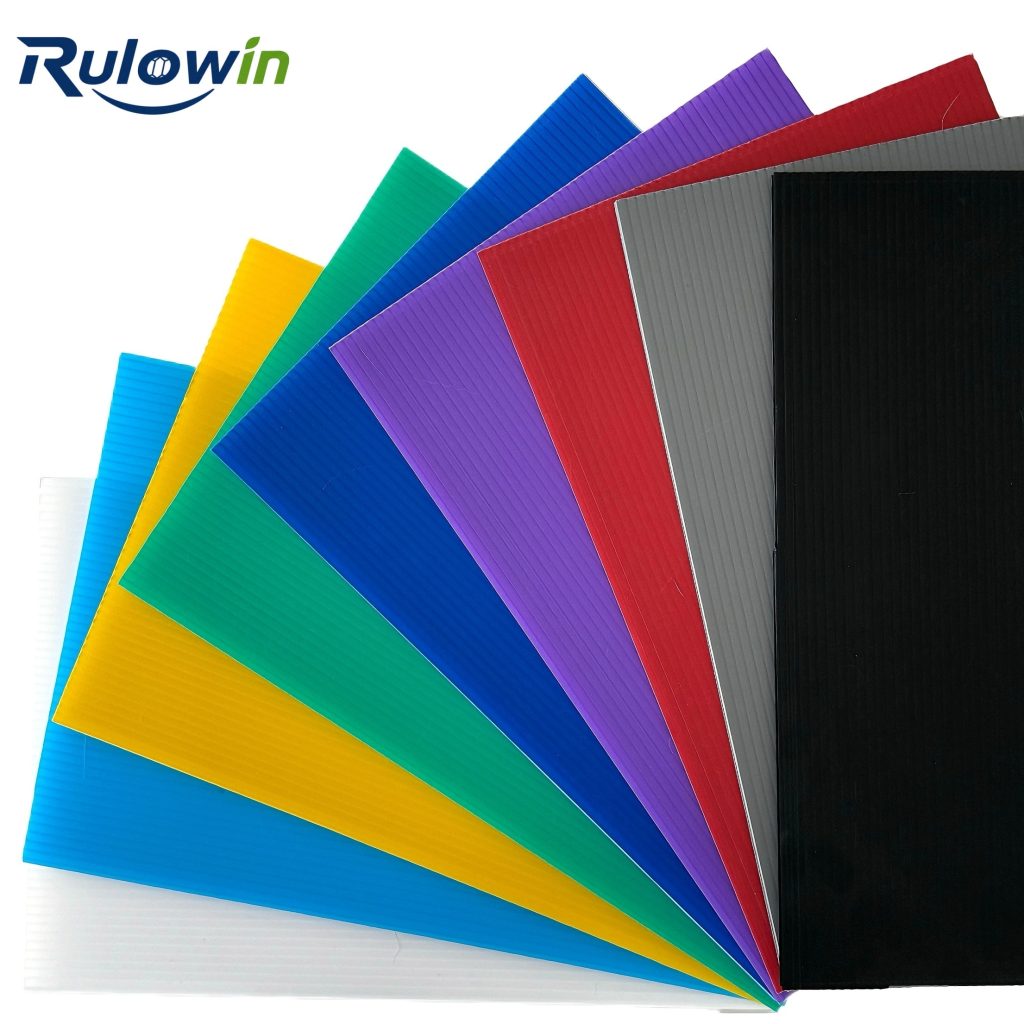
Corrugated PP sheet behaves differently in a freezer than at ambient, and the difference is not the one people worry about. It does not lose strength in the cold – it gains stiffness and loses impact resistance, which is a different problem with a different fix.
Stiffer, and less forgiving
In a cold room the sheet gets noticeably more rigid. That sounds like an improvement and for pure load carrying it is. What it loses is the ability to absorb a knock.
The practical consequence: a sheet that would shrug off being dropped at ambient will crack at freezer temperature, and a sheet that flexes around a corner when cold will split along a flute line. Impact is the failure mode, not load.
Why crates crack and sheet does not always
The distinction is worth making because the two get treated the same. A moulded PP crate in a freezer fails at stress concentrators – corners, handle roots, thin sections. Sheet fails differently, usually along a flute where a bend was forced.
The crate version is covered in why PP crates crack in cold storage, and it is worth reading if you are specifying both, because the mitigations are not identical.
The grade matters more than the thickness
Standard homopolymer PP gets brittle at freezer temperatures sooner than an impact-modified or copolymer grade. If the sheet is going into a cold environment, the resin choice is the first decision and the thickness is the second – and specifying the wrong resin cannot be fixed by going thicker.
This is one of the few cases where we would push a buyer up in grade rather than down in quantity. It is genuinely the difference between a sheet that lasts and one that cracks.
Handling is the usual culprit
Most cold-room sheet failures we hear about happen during handling rather than in service. A sheet carried by one corner in a cold room cracks; the same sheet at ambient bends. Cold rooms are also usually tight spaces with hard edges, both of which increase the number of knocks.
Train for two-handed carrying and it removes most of it. That is not a materials answer, but it is the honest one.
What about condensation and frost
PP does not absorb water and frost does not damage it. What frost does is make surfaces slippery, so sheets slide off each other in a stack and get dropped. A stack of frozen sheet is a handling hazard rather than a material one.
Outdoor and cold exposure more generally is discussed in can corrugated plastic sheet be used outdoors.
How to test before committing
Put a sample in the freezer overnight and drop it on a corner from waist height the next morning. That single test tells you more about whether the grade suits than any data sheet, and it costs one sheet and one night.
Moving in and out of the cold
Thermal cycling is harder on sheet than steady cold. A sheet that goes from freezer to ambient and back repeatedly picks up condensation each time it warms, and the wet-dry cycle is what carries contamination into the flutes.
If your process cycles, dry between cycles rather than only at the end. Steady cold with no cycling is the gentler condition, and a sheet that lives in a cold room is better off than one that visits it.
What we can do
We supply PP corrugated sheet in grades suited to cold storage and will tell you which is needed rather than selling the thickest option. Tell us the temperature and how the sheet gets handled – if the answer is roughly, we will say a different grade is worth more than extra thickness.