
A pallet is a passive piece of equipment that makes a load liftable by almost anything with two forks. Take it away and the lifting method has to change. Most pallet-free programmes underestimate this, because the saving in pallet cost is easy to count and the cost of changing the handling is not.
The attachment question
The two common answers are a push-pull unit, which grips the slip sheet lip and drags the load onto a platens, and a clamp, which squeezes the load from the sides. Push-pull needs a sheet with a lip and a reasonably square load. Clamping needs a load that tolerates side pressure, which a full box of loose parts often does not.
Fork pockets as the third option
Where the box itself has fork tunnels or a base designed for entry, no attachment is needed at all. This is the cleanest answer for a closed loop, because it uses standard trucks at both ends. It does add structure to the base, which is a cost, and it only works where the box is being lifted from the same two points every time.
The surface underneath
A pallet-free load sits directly on whatever is there. Rough concrete abrades the base. Debris punctures it. Water sits against it. Any of these will shorten the life of the box far faster than the load itself will. Checking the floor at both ends is part of the decision, not an afterthought.
Operator time
Push-pull is slower than a standard fork entry, and clamping is slower still when the load has to be positioned carefully. On a route where the pallet-free load is handled five times, that difference is paid five times. It belongs in the calculation alongside the pallet saving.
What to specify
The entry method the box is designed for, the maximum fork or platen dimensions it accepts, and the surface conditions the rating assumes. Where a supplier has not been told how the load will be lifted, they have designed for the easiest case, which is usually not the one in use.
When to keep the pallet
Where the route is short, pallets are pooled, or the transfer points are unknown, the pallet is still the cheaper answer. The gain from dropping it is real but it is not universal, and the decision should be made per lane rather than as a policy. The sizing side of this is in what the two footprints do to a design.
What it does to the box base
Without a pallet, the base goes from being supported to being the support. It has to spread the stack load over the floor rather than receive it from the deck, and it has to do that while the load is being dragged or gripped. That is a different specification from the same box on a pallet, and it is the part most often missed.
The practical answer is a flat, reinforced underside with no feet or ribs in the load path. Where a box already has feet for stacking, they have to be arranged so the load goes to the floor through them evenly rather than at four points.
What we can do
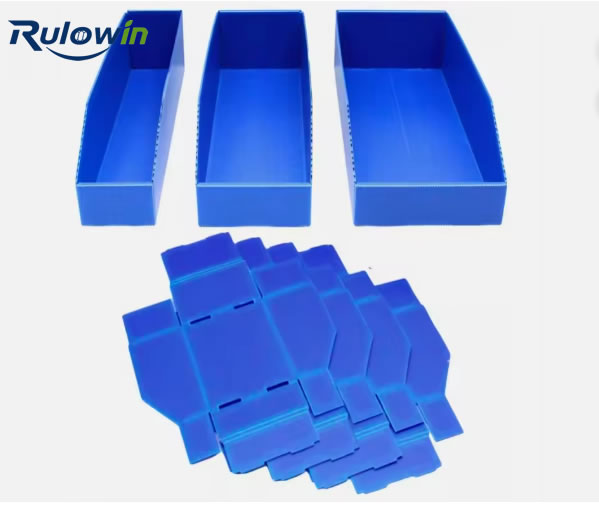
We build PP corrugated turnover boxes with fork entry designed in, so no special attachment is needed. Tell us what trucks you have at each end and we will design to them.