
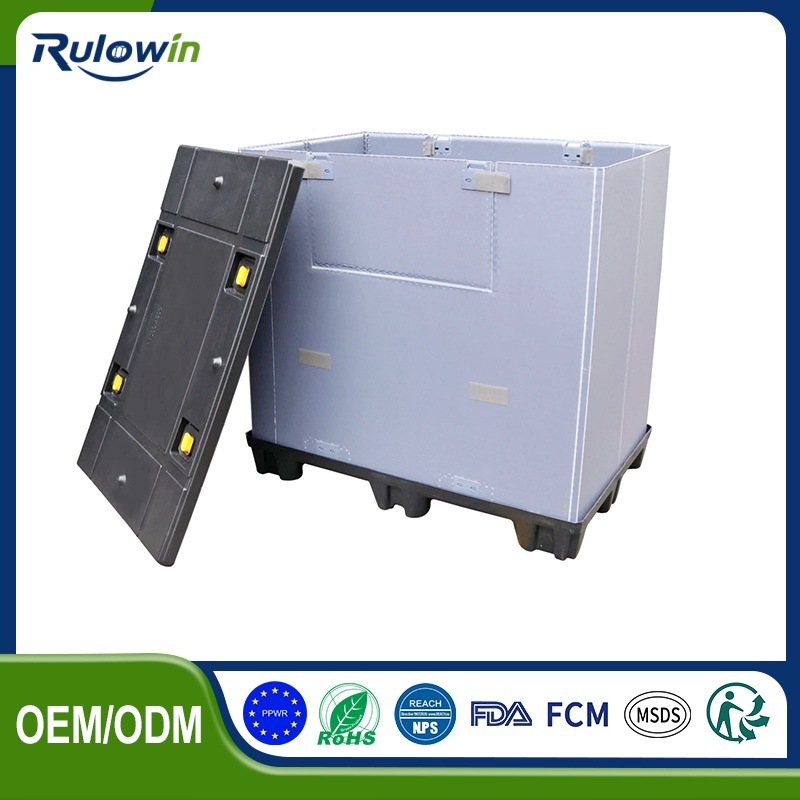
Two pallet footprints dominate European freight: 1200 x 800, the euro pallet, and 1200 x 1000, the industrial pallet. They are close in area and very different in what they reward, and a box designed against one rarely performs well against the other. The choice has to be made before the first panel is cut, because it determines the aspect ratio of everything downstream.
Two footprints, two logics
The euro pallet is 800 deep, which favours boxes that divide cleanly into 400 or 800 one way and 300, 400 or 600 the other. The industrial pallet is 1000 x 1200, which opens up 500 and 250 divisions and gives slightly more deck area. The difference in usable area is about 25%, which sounds decisive until a box shape turns out to waste more on one than the other. Shape, not area, decides it.
What happens to the aspect ratio
A box designed for a 1200 x 800 deck usually ends up noticeably non-square, because it is filling a rectangle that is 1.5:1. A box designed for 1200 x 1000 sits closer to square. Non-square boxes with a long side are more prone to bulging under load and need more attention to the wall, which is a real cost. Square boxes waste less board for the same volume but can be harder to handle at the line.
Rotation and the second-best pattern
Most boxes can be rotated 90° on the deck, which gives a second pattern with different integers. In practice one of the two is usually better and the other is the fallback for odd quantities. It is worth asking which of the two the supplier assumed, because a load plan built on the rotation that suits a full pallet will fall apart on the part-pallet that actually ships most weeks.
Mixed formats inside one fleet
Few plants run one pallet format. A fleet that has to work on both footprints is usually better served by a box that divides into 400, since 400 goes into both 800 and 1200. That constrains the design more than a single-format box would, and it is the reason some fleets end up with a slightly larger box than the part needs. The alternative is two sizes and a sorting problem.
What it costs to change later
A footprint change after tooling is not a paperwork exercise. Dies, print plates and any moulded corner or foot are all sized to the panel, and a change in footprint usually means a change in panel. The cost is measured in weeks and in tooling, which is why the pallet question belongs at the start of a project rather than at the end of a drawing.
Deck condition is part of the calculation
Pallets in a closed pool are consistent. Pallets that have been repaired, or that came in with the load, are not. A box pattern with no tolerance for deck variation will jam on the worst pallet in the yard, and the packer will solve it by leaving a box out. Asking what condition the pallets arrive in is as important as knowing their nominal size.
Reading the pattern against the part
The cleanest test is to draw the deck, place the boxes, and then check whether the part still fits inside the box after the dunnage is in. Working in that order – deck, box, dunnage, part – catches most of the errors that appear when the part is the starting point. It also makes the trade visible: a slightly larger box may buy a whole extra unit per layer.
What we can do
We build PP corrugated turnover boxes sized against a specific deck, and we will show the pattern for both common footprints before a size is fixed. Send us the part dimensions and the pallet formats in use, and we will tell you which one the box should be designed around. The sizing sequence is described in working backwards from the part.