
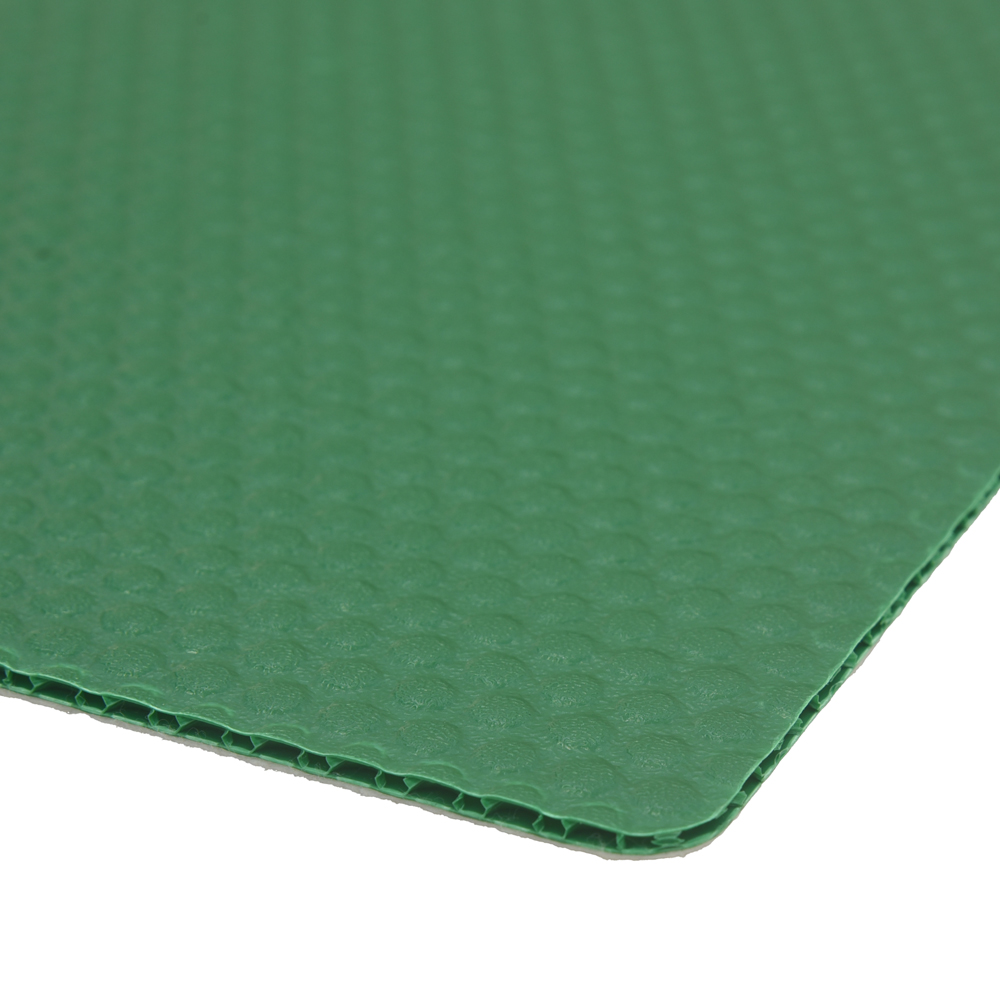
The most common reason reusable protection does not get reused is that nobody arranged to clean it. Panels come up at the end of a phase covered in set plaster, paint specks and a mat of grit, they get stacked in a corner, and six weeks later somebody decides they are not worth recovering and skips them. The cleaning is the cheap part; the decision to do it is the hard part.
When a panel has actually stopped working
Three signals. The face no longer feels fibrous because it is loaded with fine dust. There is set material – plaster, grout, adhesive – bonded to the surface, which is now harder than the finish it is protecting. And the panel no longer grips when walked on, because the grit between face and floor is acting like ball bearings. Any one of these means the panel is now causing damage rather than preventing it.
What washing actually involves
A hose, a stiff brush and somewhere to put the water. Polypropylene does not absorb, so a panel is dry within minutes of being washed and can go straight back down. Set plaster softens with water and comes off with the brush; paint needs scraping and will not come off fully, which is fine – a panel with paint specks on its wearing face is cosmetically poor and functionally fine, provided the specks are on the top face and not the one against the floor.
What not to do
Solvent cleaners are unnecessary and on some panels attack the face bonding. Pressure washing at close range lifts felt faces. And stacking wet panels face to face traps moisture between them and produces a smell and, on a felt face, mildew within a week. Wash, stand them on edge to drain for an hour, then stack. The standing-on-edge part is the one that gets skipped when space is tight.
How many times a panel survives this
Realistically the felt face is the limiting component, not the core. A needled felt on a busy traffic route starts to wear through in the lanes somewhere in the second or third phase, and at that point the panel is effectively single-faced. It is still perfectly good on rough surfaces and in low-traffic areas, which is the argument for grading cleaned panels into two piles rather than judging them pass or fail. Recovery rates and what to expect are discussed in recovery rates on reusable floor protection.
Who is going to do it
The single biggest determinant. If cleaning is nobody’s named responsibility it will not happen, and the reusable panel becomes a single-use panel at several times the cost of the cardboard it replaced. Naming it in the programme, with an hour allocated at each phase boundary, is worth more than any specification detail.
What to do with the wash water
Washing panels produces water carrying cement, plaster and grit, and on most sites it cannot go down a drain or into a surface water system. Settling it in a temporary pit or bunker and disposing of the solids is the normal answer, and it needs arranging before the first wash rather than during it. It is an environmental compliance point, and it is the reason some sites quietly stop washing panels altogether.
What we can do
We supply PP honeycomb panels built to be washed and re-laid, and we will state which face weight suits how many cycles. Tell us how many phases and how long each runs, and we will give an honest estimate of how many panels come back each time – including the ones that will not.