
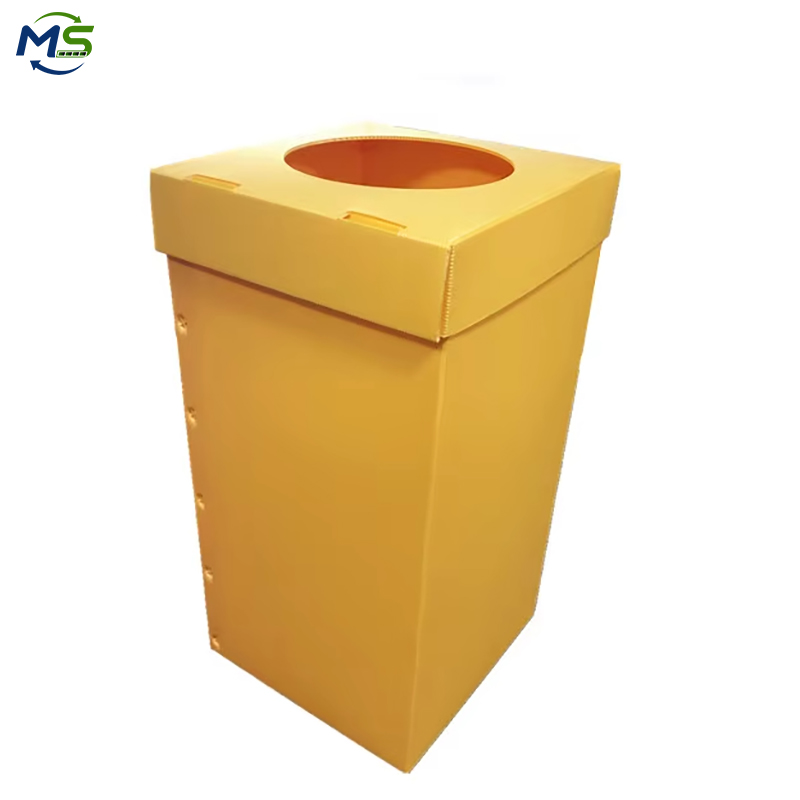
The first question in most box enquiries is what thickness, and it is usually answered with a GSM figure. GSM is grams per square metre of the sheet the box is made from, and it is a reasonable proxy for stiffness and puncture resistance. It is a poor proxy for how long the box survives, because boxes do not wear out – they get broken, and what breaks them is impact.
What GSM buys you
Higher GSM gives a stiffer wall, better puncture resistance against sharp corners, and a higher safe stack load. It also gives a heavier box, a higher unit price and – less obviously – a more brittle one at low temperatures, because a thicker PP section transmits impact rather than absorbing it. Doubling GSM roughly doubles the material cost and does not remotely double the service life.
What actually kills a box
In order: torn hand holes, split base corners, punched walls, and delamination at a fold. Only the third is a GSM problem. The first two are geometry problems – a slot cut in a single wall will tear eventually no matter how thick the wall is, and a square corner with no radius will split under set-down impact at any thickness. Specifying a heavier sheet to solve a torn handle is paying material cost for a design problem.
Specify the corners and the handle first
Get three things right and mid-range GSM will outlive heavy GSM: a doubled or reinforced hand hole, a radiused and double-folded base corner, and a rim that locates the box above rather than letting it walk. These are manufacturing details rather than material choices, and they are where experienced and inexperienced suppliers diverge most. A well-detailed 700 GSM box routinely outlives a poorly-detailed 1200 GSM one.
Then set GSM by puncture risk
Once geometry is fixed, set GSM by the sharpest thing that will ever be dropped into the box. Castings, machined blanks and cut metal edges need a heavier wall than mouldings or sub-assemblies in a bag. If the sharp item is only one of ten in the kit, put a divider or a base pad under it rather than thickening the whole box – a loose corrugated PP sheet in the base is cheaper than a fleet-wide thickness increase.
Ask for the two numbers that matter
Ask a supplier for safe stack load at a stated height and for drop test results from a stated height onto a corner. Both are measurable, both are cheap to run, and a supplier who cannot produce them is quoting a catalogue rather than an engineered container. Compare those two numbers, not GSM, and you will get a box that lasts. It is also the basis of the comparison in turnover boxes versus euro crates. It is also the basis of the comparison in turnover boxes versus euro crates.
What thickness does not buy
A thicker sheet buys stiffness and puncture resistance. It does not buy impact resistance at a corner, it does not buy handle life, and it does not buy resistance to creep under sustained load – a thicker PP section creeps at broadly the same rate as a thinner one under the same stress. Those three are the failure modes that actually retire boxes, and none of them are solved by adding material.
It is worth saying plainly because the specification conversation almost always drifts toward thickness, partly because it is the only number on the quote. When a fleet is failing early, the useful question is never “should we go up a thickness” – it is “where is it breaking”. If the answer is corners and handles, the geometry needs changing and going up a thickness will add cost and maybe a season of life. If the answer is punctured walls, thickness is genuinely the answer, and it should be applied to the base panel rather than across the whole box.
What we can do
We build PP corrugated turnover boxes across a range of GSM and we will specify geometry first and thickness second. Tell us the sharpest part, the drop height the box will actually see and the stack height, and we will quote the lightest box that survives it – not the heaviest one we sell.