
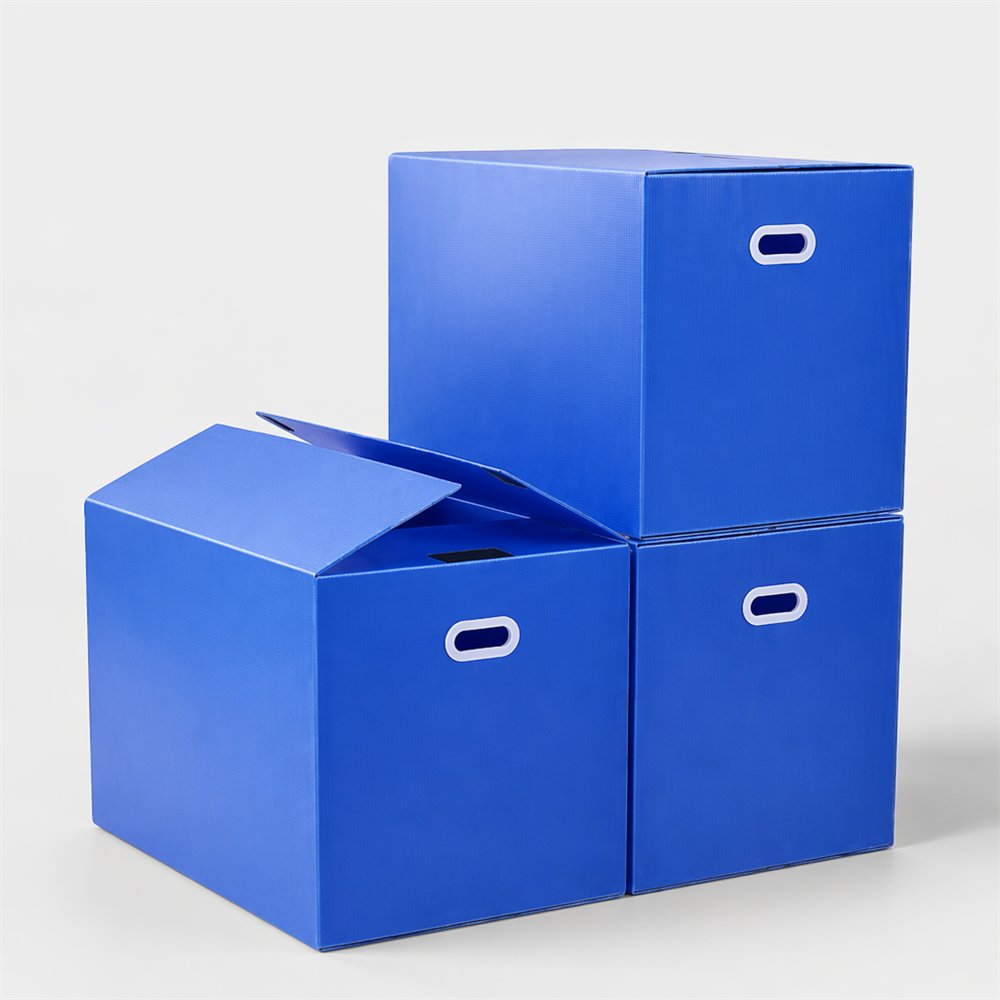
Two options dominate internal logistics: the moulded stack-and-nest crate in a standard footprint, and the fabricated turnover box. They are often bought for the same job, and the differences between them only show up once one of them is in service.
The moulded stack-and-nest crate
Injection moulded, usually in a standard footprint that matches pallets and shelving, and designed to stack when full and nest when empty. The material distribution is optimised, so it is light for its strength.
Strengths. Highly consistent dimensions, which matters for automation. Takes impact and rough handling without cracking. Long service life. Nests efficiently when empty, so return and storage are economical. Repair is usually not attempted, but the crate lasts long enough that it does not matter.
Weaknesses. Tooling cost, so only economic in standard sizes and reasonable volumes. Heavy for its volume compared with board. Damaged crates are scrap. And the nesting mechanism, which is the clever part, is also the part that jams when a crate is damaged.
The fabricated turnover box
Made from PP board – corrugated or solid – folded or welded into a box. Sizes are flexible and tooling is minimal.
Strengths. Low tooling, so custom sizes are economic. Light. Cheap per unit. Easy to modify or make in small quantities.
Weaknesses. Less dimensional consistency between units. Lower impact resistance, and it fails at edges and corners. Folded and bonded constructions age faster under aggressive washing. And it is easier to damage in a way that makes it unusable rather than merely scruffy.
How to choose
- Standard size, high volume, long life? Moulded crate. Tooling amortises and the service life is much longer.
- Custom size, low volume, or changing requirement? Fabricated box. Minimal tooling and flexible.
- Automated handling? Moulded crate, for the dimensional consistency.
- Very light contents and manual handling? Fabricated box – the weight saving is real for an operator lifting all shift.
- Aggressive washing? Moulded crate, unless the box is welded rather than bonded.
- Rough handling, dropped and dragged? Moulded crate.
- Short-term or one-off requirement? Fabricated box.
Where the two are often mixed
A lot of operations end up with both: moulded crates for the main internal loop and fabricated boxes for specific products, overflow, or new lines that are not yet proven. That is not indecision – it is using each for what it is good at.
The mistake is choosing on purchase price alone. A moulded crate can cost several times a fabricated box and be cheaper over its life, because it survives many more trips and needs no replacement in between.
The stacking-and-nesting question
If your crate has to nest when empty, the moulded design’s nesting mechanism is a genuine advantage – it saves return volume and storage space. If it only has to stack, a fabricated box with a simple rim does the job for much less.
Be honest about which you need. Buying nesting crates for an operation that never nests them means paying for a feature that also happens to be the thing that jams when damaged.
What we can do
We make corrugated PP turnover boxes with welded corners and reinforced bases, and we will tell you honestly when a moulded crate would serve you better – usually when the size is standard, the volume is real and the handling is rough. Tell us the contents, the volume and the handling, and we will say which side of the line you are on.