
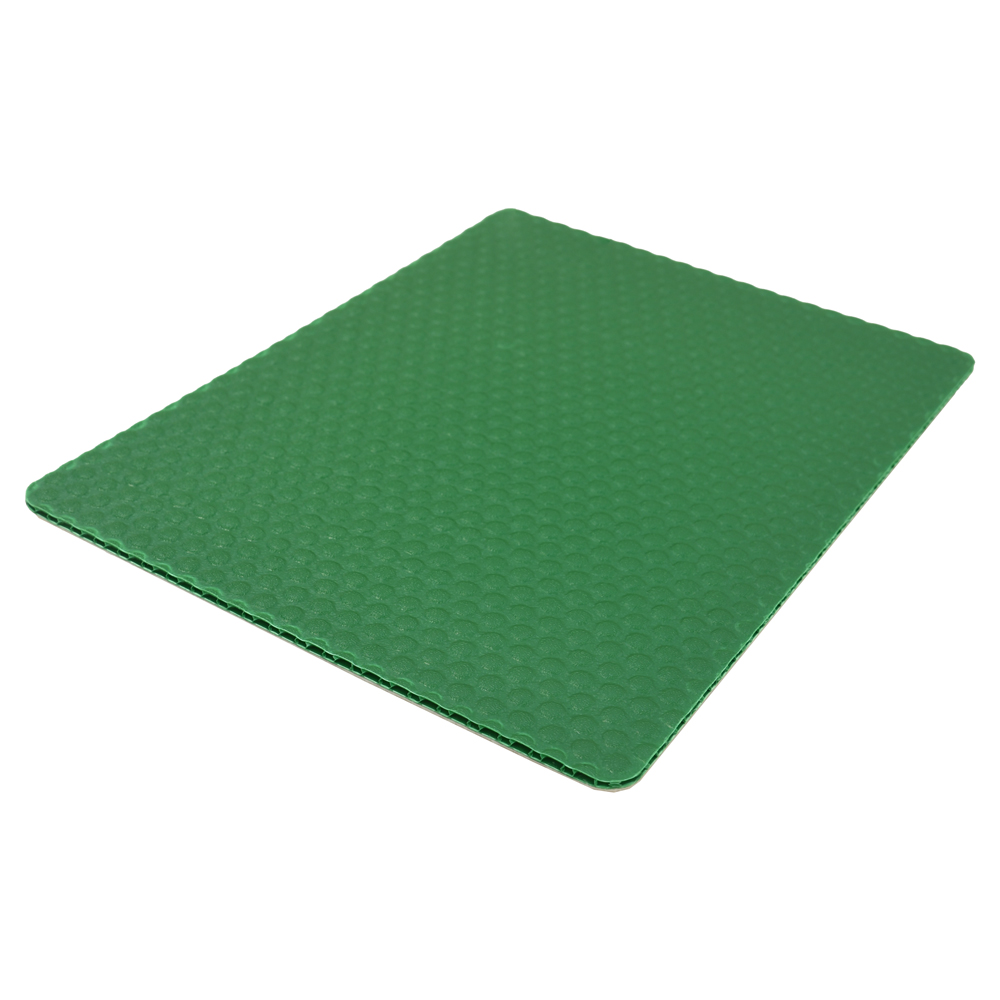
Wooden pallet lids get replaced with honeycomb panels for three reasons, and only one of them is cost. Before deciding, it is worth being clear which reason applies to you, because if none of them does, the answer is to keep buying wood.
Reason one: the lid has to span
If whatever is under the lid does not provide continuous support – gaps in the load, stringers rather than a flat top – the lid is working in bending. Honeycomb is very good at that and plywood of equivalent weight is not. This is the clearest technical case for switching.
The counter-case is a flat, fully supported load, where a thin panel and a sheet of ply do the same job and ply is cheaper. We set out where the line sits in honeycomb panel versus corrugated sheet for pallet liners.
Reason two: weight
A honeycomb lid is substantially lighter than a ply one. On an air-freight or long-haul lane that weight is money on every shipment, and it accrues for the life of the lid. On a domestic pallet moved by truck, it usually is not enough to matter.
Work it out against your freight rate before deciding. This is the reason most often assumed and least often calculated.
Reason three: the loop is closed
If lids come back, a polypropylene panel that survives many trips beats a ply lid that is damaged within a few. If they do not come back, you have replaced a cheap disposable with an expensive one.
Ask this first. It usually settles the question faster than anything else.
Where wood is clearly better
Anything that takes a fastener. Polypropylene holds a screw poorly and a honeycomb panel has very little material at the edge to hold one. If the lid is nailed or screwed down, stay with wood.
Anything that takes a sustained load for weeks. Polypropylene creeps – it deforms slowly under constant load, and faster when warm. A lid on a stack sitting in a container for a month is a creep problem, and wood does not have it.
And anything exposed to fire risk or high heat, where ply behaves better than a thermoplastic.
The middle option
Plenty of operations switch only the lids that span, or only the lids on export lanes, and keep ply for domestic. That is not indecision – it is usually the configuration that captures the weight and durability benefit where it pays and avoids paying for it where it does not.
If you want to size the panel properly rather than match the ply thickness, what thickness honeycomb panel you need sets out the inputs.
What to trial, and how to judge it
Put twenty panels into the loop alongside the plywood and mark them. Check them at three months and at six: whether any have crushed, whether the faces are lifting at the edges, and whether they still sit flat. Compare against the ply lids running next to them over the same period.
That gives you your own answer in half a year on a small outlay, and it is worth much more than a supplier’s estimate – including ours. If none of the panels have failed and none of the loads have suffered, switching the rest is a straightforward decision.
What we can do
We supply PP honeycomb panels and will size a lid from span, load and lane. Tell us what you use now and why, and we will tell you whether switching pays – including, quite often, that it does not.