
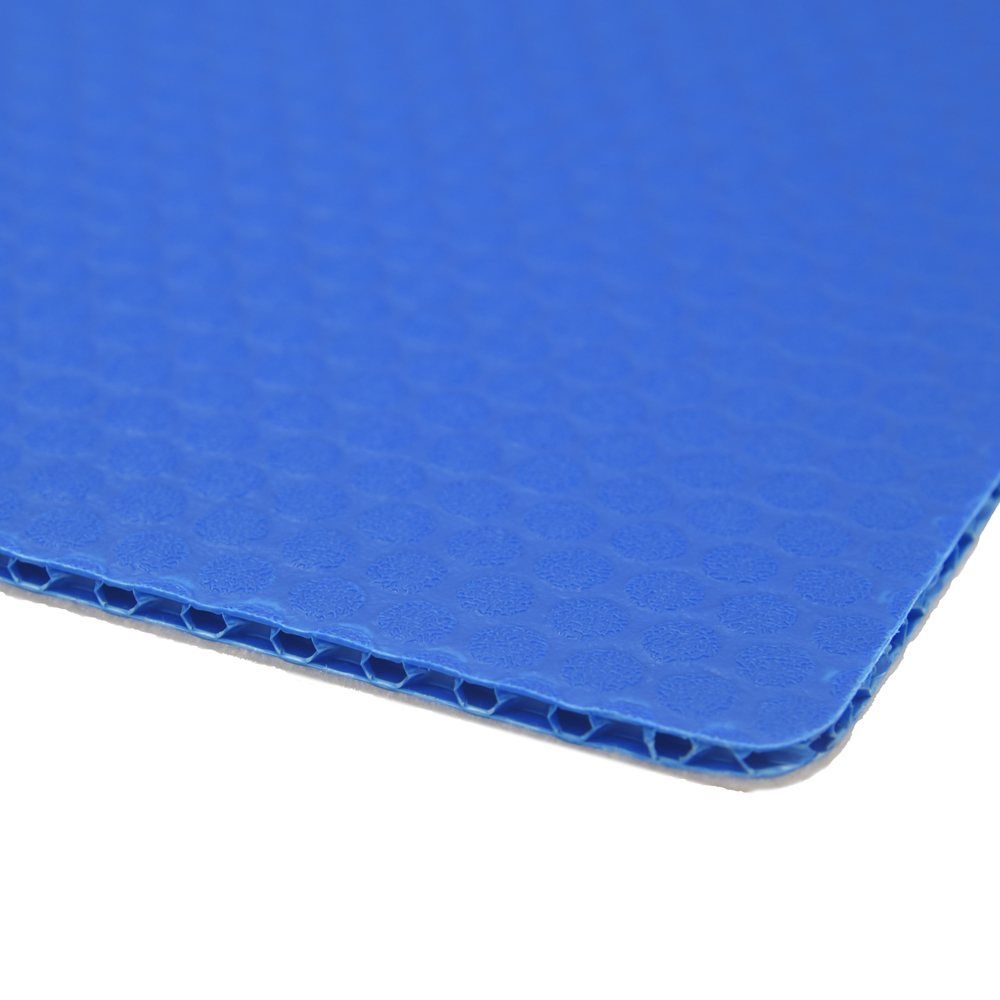
These two get compared constantly and usually by people who have been quoted both for the same job. They are not really alternatives – they fail differently, and knowing which failure you are trying to avoid settles it faster than any comparison table.
What each one is good at
Honeycomb is a sandwich: two faces with a cellular core between them. Its stiffness comes from its thickness, and it resists crushing through the thickness very well. That makes it the right answer for a pallet topper that has to bridge a gap between boards, or for a layer pad carrying point loads from castings or machined parts.
Corrugated sheet is a single sheet with channels running through it. It is stiff in one direction and much less stiff across the flutes, it bends to a radius, and it is cheap. For a flat layer pad on a continuous surface – the ordinary case – it does the job for a fraction of the cost.
Where honeycomb is genuinely better
Spanning. If there is a gap under the sheet, honeycomb handles it and corrugated does not, particularly across the flutes. Crush resistance under a concentrated load – a heavy part resting on a small footprint. And repeated reuse, because the faces take surface wear better than an exposed flute structure does.
Also: if the pad has to be washed. An open flute channel traps water and dries slowly; a honeycomb face wipes clean.
Where corrugated is genuinely better
Cost, first and always. Bending – corrugated makes a corner or a wrap; honeycomb does not, not without a machined fold. Weight, marginally. And thickness: where you need something thin, corrugated goes down to gauges honeycomb cannot usefully be made in.
And there is an honest point about where honeycomb is oversold. If your pallet deck is continuous and your load is distributed, honeycomb buys you very little. We have talked customers out of it more than once.
Cost per trip, which is the number that matters
Unit price is the wrong comparison. A honeycomb pad might cost several times a corrugated one and still be cheaper across a year if it survives a loop the corrugated pad does not. But that only holds if the pads actually come back. In a one-way export where nothing returns, corrugated wins on cost every time, and no amount of durability changes it.
Ask first whether the pad is coming back. That single question usually decides it.
If you want the arithmetic
We set out how to size a honeycomb panel from span and load in what thickness honeycomb panel you need. If the answer that gives you is “thinner than our thinnest”, you want corrugated.
Weight and handling, briefly
Corrugated sheet is lighter per sheet at the same thickness, which matters if the pads are being handled by hand a lot. Honeycomb is heavier but far stiffer, so where a pad can be thinner because it is honeycomb, the two come out closer on weight than the thickness suggests.
There is also a housekeeping point. Honeycomb panels stack neatly and slide less than corrugated sheet, which has a tendency to slip when stacked. In a busy packing area that small difference shows up as fewer dropped pads.
What we can do
We supply both, which makes us a poor advocate for either. Tell us the pallet, the load and whether the pad returns and we will quote both with trip-life estimates. We supply PP honeycomb panels and corrugated sheet, and we would rather sell you the one that works.