
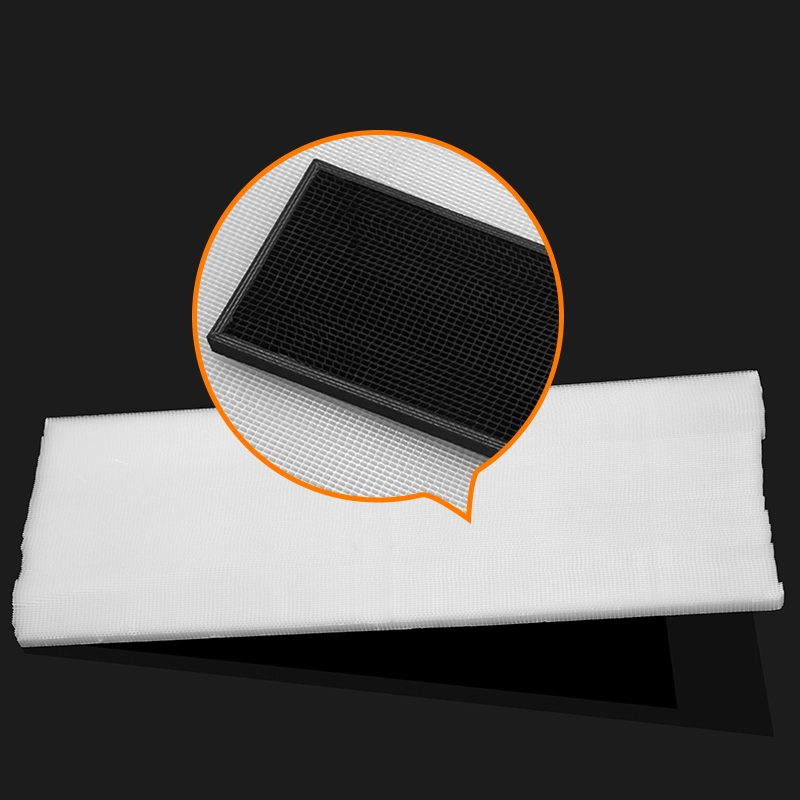
A workshop intake – the make-up air coming into a woodshop, a fabrication bay, a packaging area – carries a lot of coarse material at a fairly high loading rate. What you want in front of the fine stage is something that catches the bulk without adding much resistance, and that can be dealt with when it loads up.
Open area is the number
Open area is the fraction of the filter face that lets air through. A screen with high open area adds very little pressure drop, which means the fan is not fighting it, and it holds a surprising amount of material before it needs attention because the loading happens on the cell walls rather than across a blocked face.
A dense pad restricts more, loads faster at the face, and needs changing more often. In a dusty environment that difference is the whole game.
Washable, if the dust is dry
Wood dust, paper dust, textile lint, general workshop grit – all dry, all rinse out of an open polypropylene structure. A washable honeycomb screen suits these well and will run for years.
It is worth being clear about the maintenance though. Washable only works if somebody washes it. In sites where nobody owns filter maintenance, screens get fitted, forgotten and left loaded, at which point they are worse than a pad that somebody would have changed. If that describes your site, buy disposables and put them on a schedule.
When washable is wrong
Oily aerosol. Machining with oil mist, any process with a sticky or greasy airborne fraction – the oil wets into the structure, holds dust and does not rinse out. Once that has happened, the screen is finished. We would rather tell you before you buy than after.
Also anything hazardous, where washing means handling the captured material or putting it into a drain. That is a disposal question, not a filter question.
Sizing to the airflow
Match the screen’s face area to the fan. A screen that is too small for the airflow becomes the restriction – you have added a filter and reduced the air changes. If the intake face is small and the airflow high, increase the face area by using a pleated or angled arrangement rather than accepting the pressure drop.
The same trade is described for purifiers in matching a washable pre-filter to a purifier’s airflow, and the arithmetic transfers directly.
Where to put it, and why position matters
A pre-filter belongs on the intake side of whatever it is protecting, as far upstream as is practical – catching material before it reaches a fan blade, a coil or a fine filter. Putting it close to the protected component is common and is worse: the ducting upstream gets coated instead.
Also think about which side is accessible. A screen loaded with dust has to come out for washing, and if the only access is from the roof or from inside a plenum, it will not be washed. Fit it where somebody can reach it with a step, not with a permit.
What we can do
We supply reusable PP honeycomb filter media with high open area, cut to the intake dimensions. Tell us the face size, the airflow and what the dust is, and we will specify the open area – and tell you honestly if your contamination is the kind that does not wash out.