
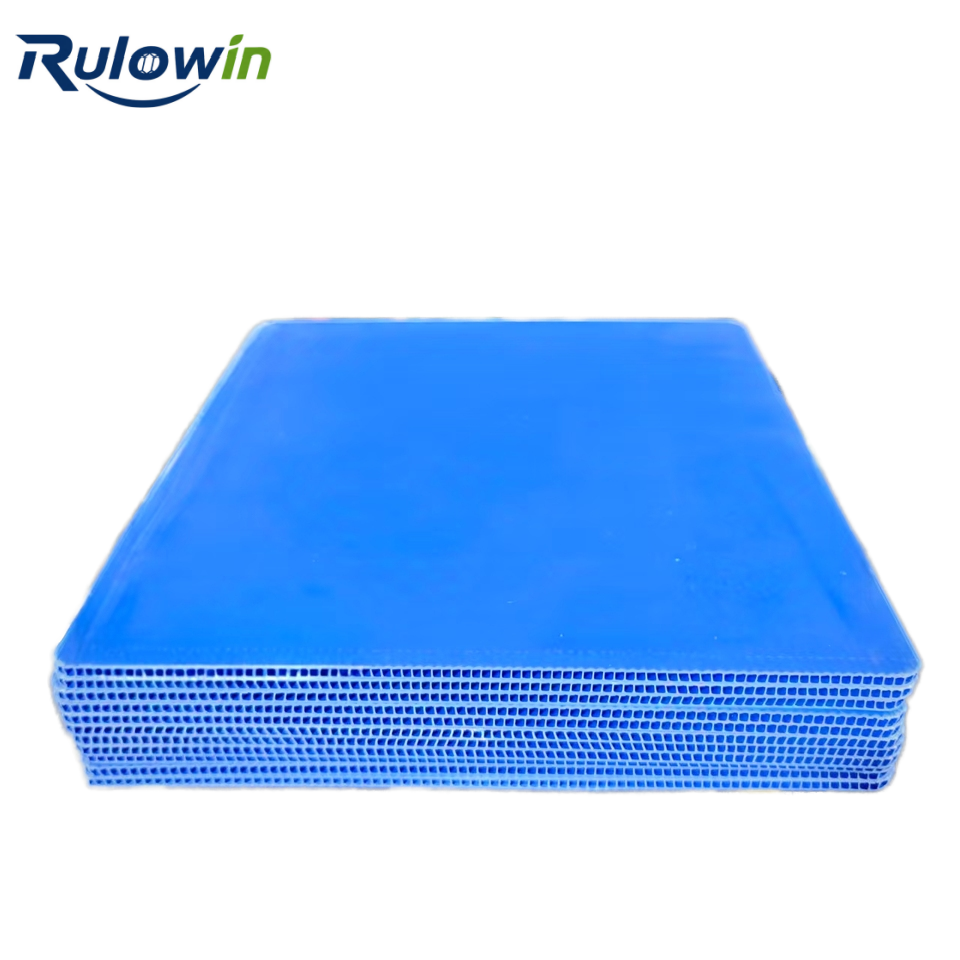
If your layer pads are failing because of humidity, the material answer is polypropylene – it does not absorb water and it does not lose stiffness when it is wet. That part is straightforward. The part that needs thought is which form of polypropylene, and whether replacing cardboard is worth it at all in your case.
Why cardboard fails in humidity
Corrugated board gets its stiffness from the geometry of its flutes and from the fibre itself, and the fibre softens as it takes up moisture. A humid warehouse – or a cold store with condensation, or a container crossing – takes that stiffness away gradually. The pad does not visibly fail; it just lets the course above settle a little further each time.
If your product arrives with the bottom course deformed and no obvious cause, this is usually it.
The two polypropylene options
Corrugated PP sheet is the direct substitute. Same form, same handling, cut to the same footprint, and it behaves the same in a stack while being completely indifferent to moisture. For a distributed load on a continuous surface this is the answer and it is not much more expensive per pad.
Honeycomb panel is the answer when the load is concentrated or the pad has to span. Thicker, more expensive, much better at resisting a point load. If the thing on top of the pad has feet, or the pallet deck has gaps, corrugated sheet will not do.
The decision between them is set out in honeycomb panel versus corrugated sheet.
Two adjustments that people forget
Friction. Polypropylene is slippery. A stack on smooth PP shifts more easily than one on cardboard. If pallets are not wrapped tightly, specify an embossed face. This is the single most common complaint after switching, and it is a specification fix rather than a reason to go back.
Edge exposure. Cut corrugated sheet has open channels at the edge. In a wet or dusty environment those channels collect things. Sealed-edge sheet is a small premium and removes the problem.
When to keep cardboard
Dry, short, one-way moves where the pad is discarded at the receiving end and baled with the rest of the paper. In that case polypropylene buys you nothing and creates a disposal problem. It is a perfectly reasonable answer and we say it often.
The test is simple: if the pads come back, or if the environment is humid, switch. If neither is true, do not.
What to do with the first trial
Run a trial on one lane rather than switching everything. Pick a lane where the cardboard is currently failing – the longest one, or the one with the most claims – and switch only that. Polypropylene pads cost more per unit and a single lane gives you a real number on claim rates without a large commitment.
Measure what happens. Count damage at the receiving end before and after. It is a simple before-and-after and it is the only evidence that will convince anyone holding a budget.
If the improvement is not clear within a few months, the pads were not the problem, and you have learned something useful for a modest outlay.
What we can do
We supply PP corrugated sheet cut to pallet footprint, plain or embossed, sealed or open edge. Tell us the pallet size, load per course and whether pads return, and we will quote it against what you pay for cardboard – including the honest version when cardboard still wins.